Italian Theatre in Félicien's story
L'Amour et les ForêtsThe Italian Theatre in Félicien's story is where the public splendor of opera gives way to a sudden, private recognition. On a night when Paris seems to shine around the theatre, Maria-Felicia Malibran appears in Norma for her farewell performance. Her singing gathers the audience into a collective ovation, but the decisive turn comes when a young spectator, absorbed in the music, sees a solitary woman in a box. The theatre becomes the setting not only for a farewell but for the beginning of an imagined bond that will direct his actions as soon as the curtain falls.
Performance and farewell
The evening is marked by Malibran's departure. The audience rises to the last notes of Bellini's Casta diva and calls the singer back amid a tumult of applause. Flowers, bracelets, and crowns are thrown toward her. The ovation makes the scene feel almost immortal, even as the singer is described as nearly dying and fleeing while she believes she is singing. The performance thus holds triumph and impending loss together: the crowd celebrates an artist whose leave-taking gives the spectacle its exceptional charge.
The young man in the orchestra seats is initially one spectator among many, applauding so passionately that he breaks his gloves. Yet the music has already displaced the visible theatre for him. Its first notes stir an inner world shaped by the silence of woods, the rough wind at rocky shores, water moving over stones in torrents, and the deep tones of dusk. The voice seems to carry the soul of those remembered natural sounds and a distant summons to return. The theatre's performance is therefore received not simply as entertainment but as an experience that joins the crowded auditorium to the solitude he associates with nature.
The spectator and the box
The young man is twenty, at the threshold of a new life in Paris and, as the narration presents it, entering a world of fire, forgetfulness, commonplace pleasures, and gold. No one in Parisian society knows him. His new-looking clothes, impeccable cut, and air of mysterious elegance distinguish him without making him socially familiar. That sense of separation matters to the scene: although he sits among the audience, he appears to belong to a different world, one of space, sky, and solitude.
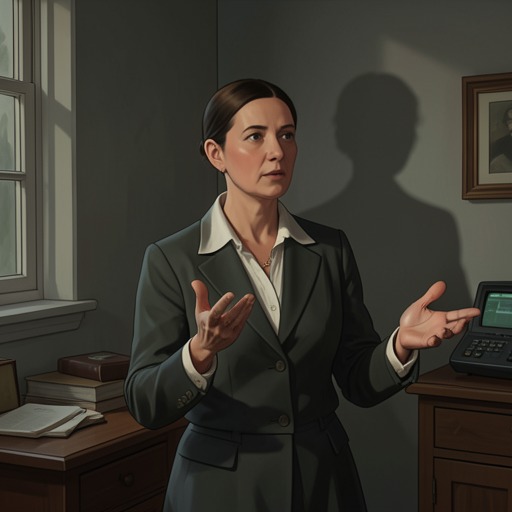
While he is applauding Malibran, his hands suddenly stop in midair. A beautiful young woman has appeared at the balcony of a box. Pale and alone, with a gardenia in her brown hair, she watches the stage, seemingly indifferent to the rest of the auditorium and absorbed in the music. Her black moiré dress is veiled with lace; an opal set in gold rests at the opening of the bodice. The description gives the woman the stillness of an image framed within the theatre, while the crowd below remains caught up in the singer's farewell. She, too, is attending to the performance, but her solitary absorption makes her seem apart from the public celebration.
A look that redirects the scene
By chance, the woman turns her eyes toward the crowd, and her gaze meets the young man's for a single second. The narration enlarges that instant into an apparent recognition beyond ordinary acquaintance: they have never known one another on earth, yet the look persuades him that their connection precedes their lives. Its effect is sudden rather than gradual. He closes his eyes as if to hold onto the two blue lights he has seen, then looks back toward the stranger. The theatre's visual arrangement—the audience below, the woman elevated in her box, the stage occupied by Malibran—briefly funnels the young man's attention away from the performance and toward a possible life with someone he does not know.
He considers raising his opera glass toward the box, then decides it would be improper. Instead, he concludes that he loves her and begins searching for a way to reach her. He has no acquaintances to introduce them and wonders whether he might find her name in the theatre's register the next day. The possibility that the box was purchased only for this particular evening makes that plan uncertain. His improvised alternative is to have his carriage follow hers after the performance, while he also believes, with trusting naivety, that if she loves him she will leave him some sign.
From auditorium to pursuit
When the curtain falls, the young man leaves the auditorium quickly and walks outside beneath the peristyle, simply pacing in front of the statues. He quietly gives instructions to his valet, who withdraws to a corner and watches attentively. The movement from orchestra seat to the space outside the theatre turns a moment of looking into an attempted course of action. The building's interior has brought the strangers within sight of one another; its threshold becomes the point from which the young man tries to follow the unknown woman's departure.
In Félicien's tale, the Italian Theatre concentrates several transitions into one evening: Malibran's farewell, the young man's entrance into adult life, and the beginning of his pursuit of the woman in the box. The opera supplies a shared focus for their first glance, while the auditorium's crowd, the elevated box, and the statues outside give that glance a sequence of distinct spaces. What begins as a public performance ends with a private resolve, leaving the woman's identity and response unknown as the young man prepares to follow her.