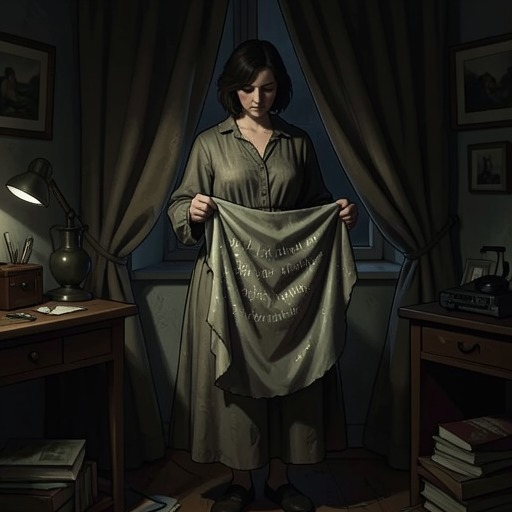
L’amour et le mensonge dans la vie conjugale
L'Amour et les ForêtsThe concept of love and deception in married life names the fiction through which Bénédicte Ombredanne makes her marriage to Jean-François Ombredanne bearable: a need for attachment becomes a belief in love, while the outward image of a successful family obscures a relationship marked by control and suffering. In her twin sister Marie-Claire’s retrospective account, the invented belief is neither a simple lie told to others nor a feeling that remains wholly unreal. It becomes the story on which Bénédicte organizes her life, even as the evidence of the marriage repeatedly contradicts it.
The need not to be alone
Marie-Claire connects Bénédicte’s choice of marriage to her difficulty imagining life without a partner. On their wedding day, Bénédicte spoke briefly about the decision: Jean-François had proposed something, and she had followed him. Marie-Claire understood that, in Bénédicte’s vulnerable state, the possibility of spending several years alone felt beyond her strength. The marriage therefore offered more than a formal partnership: it gave her the emotional dependence she needed in order to manage an everyday life that could otherwise be solitary.
Marie-Claire sets this need against her own understanding of being a twin. She describes a life organized around being either one half of a pair or on her own, and says Bénédicte likewise could not endure the idea of being alone in the world. That account gives the marriage’s origin a particular tension: Bénédicte may have accepted Jean-François not because a settled love had brought them together, but because the prospect of having someone to depend on was more bearable than uncertain solitude. Her choice established the conditions in which she would later need to make the marriage mean something more than it had initially meant to her.
Turning marriage into a love story
In Marie-Claire’s interpretation, Bénédicte did not love Jean-François when she married him. Once married, however, she imagined that she was in love, constructing after the fact a story in which authentic love had joined them or would gradually arise within their shared life. She hoped sincerity would help produce it. The fiction was thus not merely a public display: it allowed Bénédicte to understand her commitment as the beginning of a love that might yet become real.
The imagined love also helped absorb disappointment. As Marie-Claire sees it, Bénédicte came to suffer because Jean-François did not answer her desire for love as she wished. Yet she continued to believe in the bond, partly because she could not live without believing. The original fiction became so embedded in her life that she eventually forgot it had been invented. In Marie-Claire’s account, the distinction between the earlier falsehood and a genuine love made from it could lose its force: a belief created to sustain a marriage could become the reality Bénédicte chose to call love.
That private account supported a larger image of marital success. Bénédicte sought to represent a fulfilled family, to herself as well as to other people, and the satisfaction of that ambition could compensate for some of the pleasures she did not receive from love. The appearance of a lasting, accomplished family life was therefore not incidental to the fiction; it was one of the rewards that made the fiction endure. Marie-Claire says Bénédicte never let her see how much Jean-François hurt her, in part because she knew her sister had disapproved of the relationship from the beginning.
The fiction under pressure
The novel places this idealized account beside details that make the marriage’s imbalance difficult to dismiss. Bénédicte describes having no mobile phone because Jean-François feared she might use one to develop a social life or have lovers. He knew her schedule and could contact her at home; although she insisted she was not captive and could go out for errands, she also acknowledged that he kept track of where she was. Her description holds two realities together: a claim to ordinary freedom and an account of its close surveillance.
The pattern extended into relentless questioning. After Bénédicte’s afternoon with Christian, Jean-François repeatedly demanded explanations, including at night, and required her to recount what had happened. The affair became the focus of prolonged interrogation rather than a matter that could be addressed and left behind. At other moments, Bénédicte herself reduced his physical aggression to being jostled, falling, or receiving a sudden rough gesture, while denying that he hit her. Her hesitant qualifications show how narrow the available language for naming her experience had become; they also contrast with the harm that Marie-Claire and the narrative account recognize.
A radio program about harassment brought a brief rupture in that pattern of denial. Jean-François recognized his own conduct in the accounts of people who had called in and admitted that, for years, he had treated Bénédicte like a harasser. His admission gave her a new vantage point: her suffering was not, as he had led her to believe, merely the product of an irrational or defective perception. But his remorse came with promises she had heard before. Bénédicte refused to treat a promise of normal respect as a favor owed gratitude, and suggested that he seek professional help. Recognition exposed the harm without undoing it.
Dependence and the limits of the story
The fiction of loving marriage persists alongside practical dependence, especially during Bénédicte’s cancer treatment. Jean-François controlled her prescriptions and prepared her medicines, giving them to her before leaving for work. Marie-Claire objected that this arrangement made Bénédicte dependent and infantilized her; she urged her sister to take responsibility for her own medication and reclaim authority over her body and treatment. The episode shows how care could also function as control, making dependence appear necessary at the very moment Bénédicte needed to retain what autonomy she could.
That conflict became urgent when Bénédicte grew severely unwell during chemotherapy and asked to go to hospital. Jean-François insisted that she remain at home, presenting her condition as the effects of treatment rather than the disease. Marie-Claire found Bénédicte pale, weak, and unable to keep food down; Bénédicte said she feared she would die if left at home and needed medical staff around her. In this scene, the reassuring account of the marriage as care cannot conceal the consequences of whose judgment and wishes prevail.
The concept therefore does not reduce Bénédicte’s marriage to a single, conscious deception. It describes a more painful entanglement: the need for emotional attachment led her to imagine love, the imagined love sustained a picture of family accomplishment, and that picture helped hide the degree to which the relationship constrained and injured her. Marie-Claire’s account makes the fiction intelligible without making it harmless. Its durability explains how Bénédicte could continue to believe in a successful marriage even as her lived circumstances repeatedly disclosed its cost.