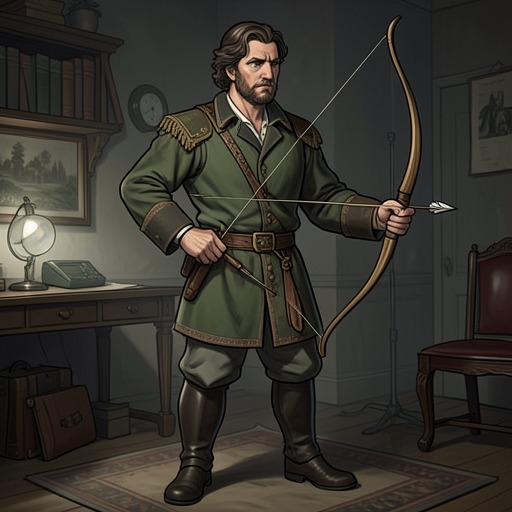
La flèche, c’est la continuité de votre bras, de votre mental
L'Amour et les ForêtsChristian’s phrase “La flèche, c’est la continuité de votre bras, de votre mental” turns an explanation of longbow technique into a claim about intention and presence. In the scene, the arrow is not merely equipment: it links an archer’s state of mind to a chosen target, while the novel’s later episodes of monitoring and dependency give that ideal of agency a sharper counterpoint.
The Archery Demonstration
Christian explains the longbow to Bénédicte Ombredanne while she holds it. Its draw pressure is thirty-three pounds, and he first corrects the romantic impression created by its slender form: it is a powerful hunting weapon. He distinguishes it from a compound bow, which allows the archer to hold the string and aim for longer. The longbow, by contrast, is used in one flowing movement: see the target, raise the bow, draw, and release.
As he demonstrates, Christian uses an imaginary bow and places his carefully trimmed fingernails at Bénédicte’s dimple to indicate where the string comes near the lips. He imitates the arrow’s passage through the air and recalls the sound Bénédicte had used in an earlier message to describe a good shot. The small gesture makes his account both practical and personal: his explanation of technique unfolds through an intimate exchange between them.
Intention and Instinct
For Christian, the longbow’s defining quality is not merely speed but unity of action. The archer releases without prolonged calculation and, he says, can sense whether the shot is true before the arrow reaches its target. His formulation that the arrow continues the arm and the mind extends this account into a general principle: the archer must become attuned to the weapon, the visible world, and the present instant.
He describes the shot as the realization of an intention, with the archer’s inner attitude and the target connected by the arrow. The comparison makes accuracy depend on inward “rightness” as well as physical action. This is set against the compound bow, which he associates with extended aiming, calculation, discipline, and effort. Bénédicte says she understands his distinction and admires the arrows in his quiver, handmade of wood with real goose feathers. Christian says he prefers such arrows to commercial ones and explains that hunting regulations require their points to be kept sharp. He also recalls occasionally practising in the forest at the end of his garden when he was younger, though he no longer has much time for it.
A Counterpoint to Surveillance
The phrase’s emphasis on a person’s intention and relation to the world stands in tension with Bénédicte’s account of her marriage. She tells Christian that she has no mobile phone because her husband fears she might use one to develop a social life or take lovers. With the fixed telephone, he has her timetable and can call when he expects her home; she says he knows where she is and follows her movements. Her decision to disappear from his view for several hours is therefore described as taking responsibility, but she also anticipates having to bear its consequences.
After her afternoon away, Jean-François’s questioning becomes a recurring feature of daily life. He calls repeatedly, wakes her at night, and confronts her during ordinary private moments; the narration likens his ceaseless accusations and investigations to a dark, inescapable forest. Later, after discovering a second phone concealed behind Mallarmé’s collected works and reading its tender messages, he turns his suspicion toward the person corresponding with Bénédicte. These episodes show how the practical freedom implied by Christian’s account of archery contrasts with the restrictions imposed on her movements and communications.
Agency and Dependence
The contrast continues when Bénédicte is ill. Her twin sister finds that Jean-François controls the prescriptions and prepares the many medicines Bénédicte must take, setting them out with water and remaining until she has taken them. The sister urges Bénédicte to reclaim responsibility for her medication and, more broadly, for her body, illness, and decisions. The scene does not repeat Christian’s archery image, but it brings its central idea—action as an expression of one’s own intention—into a different context.
Read alongside these episodes, the phrase marks a distinction between an ideal of self-directed action and the conditions under which Bénédicte is made dependent on another person. In Christian’s account, the arrow carries the archer’s thought toward a target; in Bénédicte’s marriage, access to communication, movement, and medical choices is constrained. The expression’s significance therefore lies both in its immediate description of instinctive shooting and in the autonomy it evokes by contrast with the control surrounding her.