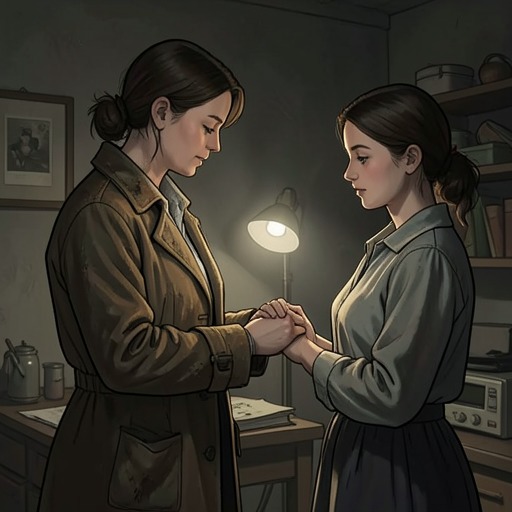
La gémellité comme identité et lien vital
L'Amour et les ForêtsLa gémellité comme identité et lien vital is the novel’s portrayal of twinhood as both a way of understanding the self and an enduring source of attachment. Through Marie-Claire Ombredanne’s account of her relationship with Bénédicte Ombredanne, the bond appears not as a sentimental accessory to family life but as a formative relationship: it shapes how each sister understands solitude, how Bénédicte enters marriage, and what she needs from her sister as her life draws to a close. Its persistence also exposes the difference between a sustaining intimacy and Jean-François Ombredanne’s attempt to make Bénédicte dependent on him alone.
Twinhood and the Formation of Identity
Marie-Claire first identifies the twin relationship as part of what mattered most to Bénédicte: when Éric Reinhardt asks about Bénédicte’s family, Marie-Claire stresses the importance of her parents, siblings, and twin sister. The disclosure surprises Éric, who had not known that the sisters were twins. For Marie-Claire, however, twinhood is no incidental biographical detail. It is a fundamental feature of her own identity and, she believes, a key to understanding her sister’s fear of being alone.
The sisters were understood as opposites, a contrast Marie-Claire relates to their different temperaments and physical presence. She describes herself as energetic, exuberant, and intensely active, while Bénédicte was more inward and anxious, and became less expansive over time. Marie-Claire speculates that a sense of deprivation had contributed to her own appetite for life and activity, whereas Bénédicte’s inwardness distinguished her from her twin. Their closeness therefore did not rest on being alike. The bond held across a marked difference in personality and in the ways they occupied the world.
Marie-Claire’s own life also shows how twinhood informs her understanding of partnership. She says that she has never experienced life without a close counterpart: first her twin, and then Damien, whom she loved from the age of four. She describes their relationship as encompassing friendship, marriage, intimacy, and companionship. They chose not to have children, in part because she experienced the couple’s two-person bond as sufficient to her sense of identity. She is comfortable alone so long as she is not alone in life; being without any sustaining attachment would be much harder. She regards this need for connection as especially acute for twins.
Marriage, Dependence, and Solitude
Marie-Claire interprets Bénédicte’s decision to marry Jean-François through that fear of solitude. When Bénédicte committed to the relationship, Marie-Claire sought advice from a psychiatrist, still trying to understand why her sister would choose him. On their wedding day, Bénédicte offered only a brief account of the decision: Jean-François had proposed something, and she had followed him. Marie-Claire understood her sister to have been too vulnerable to face the possibility of remaining alone for years.
In Marie-Claire’s reading, Bénédicte needed emotional dependence as a condition for managing daily solitude. Marriage supplied that dependence, but did not begin as a love match in the way Bénédicte later wished to believe. Marie-Claire argues that her sister invented, after the fact, a story in which genuine love had brought them together or would gradually grow between them. The imagined love helped sustain the appearance of a successful marriage and a complete family, even as Bénédicte suffered disappointment. In time, Marie-Claire suggests, the account Bénédicte had constructed became difficult to separate from the life she was living. Love and the fiction of love merged into a durable picture of marital and family fulfilment.
That picture also helps explain why Bénédicte concealed the harm in her marriage from her twin. Marie-Claire had disapproved of the relationship from the beginning, and Bénédicte knew it. Rather than confide in her, she protected the marriage’s appearance and gave excuses when Jean-François refused plans for the sisters to travel together. Their closeness persisted, but Bénédicte had to defend its place in her life without openly telling Marie-Claire how much her husband opposed it.
A Bond Under Pressure
Marie-Claire recalls that Jean-François treated her as an adversary and worked to reduce her access to Bénédicte. He did not want to visit the family farm, and resisted the sisters’ regular meetings and frequent phone calls. Although the sisters did not intrude into the couple’s life or criticize their marriage, Bénédicte repeatedly had to protect the relationship from being pushed out altogether. Marie-Claire believes Jean-François was jealous of the natural affection and happiness within her family, and particularly of the unconditional love between the twins. She insists that sisterly love and marital love need not compete; in her view, the threat arose from Jean-François’s fear of losing control over Bénédicte, not from any effort by Marie-Claire to displace him.
The novel places this effort at isolation within a broader pattern of control. Bénédicte explains to Christian that she has no mobile phone because Jean-François fears she might use one to form a social life, while the household landline and his knowledge of her timetable allow him to track her movements. After her afternoon away, his accusations and questioning become a repeated feature of daily life: he calls several times a day, sometimes wakes her during the night, and questions her when they are alone. Later, when he discovers a second phone hidden behind books in her office, the messages it contains lead to a violent confrontation and her first experience of his physical assault. These incidents show the shrinking space in which Bénédicte can maintain relationships beyond her marriage. The twin bond is not presented as a simple remedy for that coercion, but as one of the attachments Jean-François seeks to limit.
The Twin Bond at the End of Bénédicte’s Life
Marie-Claire says that she only understood the extent of the couple’s private life after she began visiting Bénédicte regularly at home during her illness. Bénédicte then disclosed how long Jean-François had opposed the sisters’ plans and tried to stop their contact. The revelation alters Marie-Claire’s understanding of the earlier excuses: what she had taken for delays or practical difficulties had often concealed Bénédicte’s effort to preserve access to her twin.
The sisters’ attachment becomes especially visible in the final period. Marie-Claire visited Bénédicte in Metz, often on Fridays, and describes Bénédicte as crying when each visit ended and Marie-Claire had to return to Reims. Bénédicte told her sister that Marie-Claire would suffer most after her death. Marie-Claire accepts the force of that prediction, explaining that she had no children and that Bénédicte was the person she had most in life. The bond thus remains reciprocal: Bénédicte depends on her twin for an irreplaceable closeness, while Marie-Claire anticipates bereavement as the loss of her central relationship.
At the hospital, Bénédicte’s wish for her twin’s company takes on the quality of a return to origins. Marie-Claire understands her sister’s desire to be with her, without anyone else, as a wish to die as she had been born: with her twin close beside her. This image brings the concept to its final point. Twinhood cannot undo the damage of Bénédicte’s marriage or prevent her death, but it remains a source of identity and intimacy that the marriage could not wholly erase. Bénédicte died on January 23, 2011; the account of her last months gives the twin bond both its practical form, in visits and protected contact, and its lasting emotional meaning.