Lola
L'Amour et les ForêtsLola, the daughter of Bénédicte Ombredanne and Jean-François and the older sister of Arthur, is both a witness to her family’s private distress and one of its most persistent sources of conflict. Her bluntness lets her name what the adults try to contain: her fear of her father, her mother’s unexplained absences, and the unhappiness permeating the household. As she grows older, her arguments with Bénédicte become a struggle over education, femininity, and whose experience should guide her future. The later account of Lola’s life makes that estrangement part of the family’s lasting grief, without resolving the anger between mother and daughter.
Identity and Family Background
Lola first appears in the family home during an evening when Bénédicte returns late from a meeting and finds the house dark and silent. After searching in panic, Bénédicte discovers Lola and Arthur together beneath a duvet, surrounded by stuffed toys. The children cling to their mother, and the three calm one another by settling into a shared rhythm of breathing. This moment of closeness contrasts with the fear that has driven them to hide and with the unusual quiet that greeted Bénédicte at the door.
When Bénédicte asks what happened, Lola takes the lead in explaining the evening. Their father had been listening to the radio while the children ate. After he demanded that they make less noise, Lola challenged his instruction; he shouted at them and ordered them out of the kitchen. She tells her mother that she later approached Jean-François’s closed bedroom door to ask what was wrong, but he told her to leave him alone and expressed a wish to be left to die. Lola then took Arthur upstairs, told him to keep out of trouble, and waited with him in his room because he was frightened. Her account shows her acting protectively toward her younger brother even while she herself is alarmed by their father’s behavior.
The children’s fear is not limited to that evening. When Bénédicte says she will go to see what Jean-François is doing, Lola asks whether he will hurt her as he had on another occasion. Bénédicte reacts with disbelief, but Lola insists that her mother knows what she means. The exchange establishes that Lola has noticed a prior threat to her mother’s safety, even though the passage does not spell out what happened. Her warning makes visible a family reality that Bénédicte initially resists discussing with her.
Reading the Family’s Distress
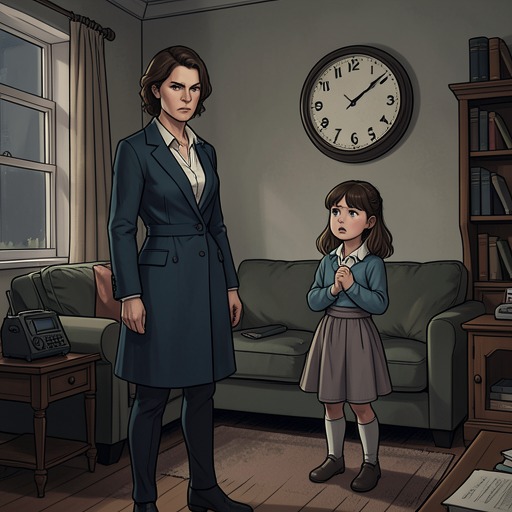
Lola is perceptive about changes in her mother’s appearance and behavior. When Bénédicte returns after spending a day away, Lola notices that she is wearing her eye ring, a dress she considers especially fine, and her favorite boots. She also asks why Bénédicte had not said she would be away for the day, and wonders about a Thursday trip to the Vosges with only the two of them. Lola says she is afraid of the state her father is in and asks whether her parents are going to separate. She wants them to stay together, but also wants Jean-François to stop shouting and the household to become happy again.
Bénédicte reassures her that the marriage is not ending and says that the day’s events concern her adult life, which Lola is too young to understand. Lola answers by stressing that her mother is also a parent, not only a woman entitled to make her own choices. The exchange does not simply show a child demanding an explanation: Lola is trying to reconcile her mother’s private autonomy with the practical fear and uncertainty that the adults’ actions have brought into the home. Her ability to identify the contradiction does not give her power to settle it.
That same insight appears in the earlier evening account. Lola reports her father’s outburst, notices that Arthur is frightened, and later asks Bénédicte whether she will be harmed. These observations make her more than a background presence in the marriage’s collapse. She registers its effects on the children and, at times, presses her mother to acknowledge them. Yet the burden of interpreting adult behavior falls on her without any corresponding ability to control it.
Conflict over Education and Self-Definition
As an adolescent, Lola resists Bénédicte’s attempts to shape her ambitions. In one extended argument, her mother warns that abandoning school to preserve an imagined, unformed self could leave Lola confined to a restrictive social role: a woman expected to be attractive, emotionally compliant, and obedient. Lola does not accept her mother’s interpretation of her position. She disputes the idea that she intends to give up school and objects to being reduced to a caricature of vanity or laziness.
The argument grows more personal as Bénédicte criticizes Lola’s attention to her hair and appearance, her interest in other things, and what she sees as declining schoolwork. Lola replies that her average is still fifteen and that she has merely organized herself differently. She experiences her mother’s criticism as humiliating and asks why Bénédicte is so relentlessly focused on her. When Bénédicte acknowledges that her own life is miserable and says this is why she cannot bear to see Lola waste hers, Lola turns the mother’s unhappiness into evidence against her advice: seeing the life Bénédicte has, she says, makes her prefer to make her own choices.
The quarrel ends with Lola leaving and slamming doors. Bénédicte is left distressed by the misunderstandings between them; the account describes the resulting coldness as lasting for days and Bénédicte as unable to find a way to make amends. The conflict has a wider significance than disagreement over school. Bénédicte wants her daughter to avoid forms of female dependence that she believes she has experienced, but her warnings come through as pressure and contempt. Lola, in turn, defends her independence by rejecting the person offering the warning.
Adolescence and the Growing Estrangement
In the family’s later history, Marie-Claire Ombredanne describes the first serious deterioration in the relationship as coinciding with Lola’s early adolescence. Around thirteen, Lola had her first boyfriend, wanted to go out, and wanted to take the pill; Bénédicte considered her too young. Bénédicte also believed Lola was neglecting school for the relationship, although Marie-Claire says her results did not in fact fall much, if at all. The distinction matters: the mother’s alarm was real, but her account of the scale of the school problem exceeded what her sister later understood to have happened.
The conflict also developed within a household whose divisions shaped the children’s loyalties. In Marie-Claire’s retrospective view, Bénédicte carried much of the work of enforcing rules, managing school expectations, and maintaining the home, while Jean-François retained the more appealing role with the children. Marie-Claire says Lola increasingly aligned herself with her father and with values Bénédicte opposed, including status, conspicuous consumption, popular entertainment, and social success. This is her aunt’s interpretation of a complicated family dynamic, not a complete account of Lola’s own motives. It nevertheless helps explain why arguments about clothes, school, and dating became entangled with the parents’ conflict.
During the week-long walk in the Cotentin, Bénédicte was in severe pain and exhausted, but Jean-François insisted that she continue and dismissed her complaints. Lola eventually took her father’s side, according to Marie-Claire’s account, and blamed her mother for spoiling the holiday. After the family returned, a medical examination led to an urgent hospital referral; tests showed that Bénédicte had widespread cancer. Lola’s alignment with her father in that episode became part of the painful record of how illness and family loyalties converged, rather than an isolated disagreement about a holiday.
Bénédicte’s Death and Lola’s Aftermath
During Bénédicte’s final hospitalization, Lola was among the family members unsettled by her mother’s apparent failure to retain that she was going to die. When Bénédicte spoke of returning home and having her bedroom painted blue, Lola reacted with disbelief and described the situation as incomprehensible. A doctor explained that patients may not retain the fact of their impending death and that this response should be respected. The episode sets Lola’s demand for recognition of the medical reality against Bénédicte’s expressed expectation of going home; it does not establish that Lola understood the emotional reasons for her mother’s refusal to make formal farewells.
The conflict continued after the funeral. Three days after the burial, Lola called Marie-Claire Ombredanne and blamed her for Bénédicte’s death, saying that the visits Marie-Claire had required at her home in Condé-sur-Marne had tired Bénédicte. She said she would resent her aunt for the rest of her life and then ended the call. Marie-Claire was hospitalized that same evening and died three weeks later. The sequence is presented as a final eruption of grief and accusation, not as evidence that Lola caused either death.
Marie-Claire also reports that, after her mother’s death, Lola intended to prepare for the HEC entrance track in Paris and hoped to work in the luxury industry. This ambition contrasts with Bénédicte’s wish that her daughter pursue advanced academic studies at the École normale supérieure, a future Lola had once invoked sarcastically during an argument. The contrast leaves Lola’s development unresolved: she neither simply fulfills nor simply rejects her mother’s hopes. Her portrait is formed instead by the friction between the future Bénédicte imagined for her, the life Lola chose to claim, and the family’s inability to separate those disagreements from its deeper injuries.