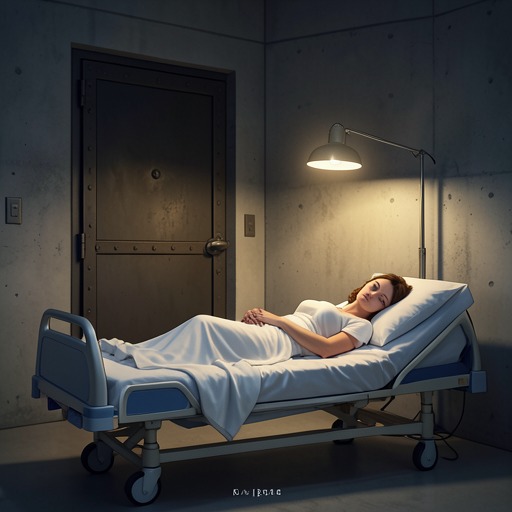
Marie-Claire helps get Bénédicte urgently admitted to hospital
L'Amour et les ForêtsMarie-Claire helps get Bénédicte urgently admitted to hospital when her sister becomes gravely unwell during cancer treatment and Jean-François insists she remain at home. The intervention is both practical and revealing: Bénédicte can identify what she needs, but has been left to plead for care that her husband refuses to provide. Marie-Claire’s presence turns that plea into action and briefly interrupts a pattern in which Jean-François controls decisions about Bénédicte’s body and treatment.
Illness and the denial of symptoms
Bénédicte’s urgent admission comes after a long period in which Jean-François has dismissed her reports of pain and fatigue. When she complains of pain, he treats it as psychological or exaggerated and urges her to exercise. In February, he insists that she join a week-long walk in the Cotentin, despite her severe back and leg pain and her concern that she cannot manage it. She continues walking in considerable distress; even Lola eventually sides with her father and blames her mother for spoiling the holiday.
The illness is discovered after an incident on the return journey, when Jean-François brakes to avoid a dog and Bénédicte believes the seat belt may have injured her ribs. At an appointment two days later, her phlebologist examines both the painful area and a lump on her abdomen. Concerned by the lump, the doctor directs her to seek urgent hospital assessment. A few days after the examinations, the family learns that she has widespread cancer, with metastases in her lung, liver, bones, and adrenal glands. The diagnosis recasts the earlier symptoms that Jean-François had minimized; the account also makes clear that, in Marie-Claire’s view, signs of the disease had been present earlier.
Dependence within the marriage
Bénédicte’s difficulty obtaining care belongs to a broader relationship of surveillance and dependence. Earlier, she explains that she has no mobile phone because Jean-François fears she might use one to create a social life beyond his reach. He has her timetable, expects her to return home after classes, and can call the landline to check where she is. She describes being tracked even while insisting that she is not literally captive. When she once disappears from his view for several hours, she anticipates shouting, demands for explanations, and several days of having to reassure him.
After learning of her affair with Christian, Jean-François subjects her to repeated questioning, including interruptions to her sleep, and turns her confession into a continuing demand for explanation. When she later maintains a tender correspondence with Éric, he discovers her concealed second phone and reacts violently, pushing her against a wall while taking the device. These episodes establish a pattern in which privacy and independent relationships provoke monitoring and punishment. By the time cancer makes her physically vulnerable, dependence is also embedded in her medical care: Jean-François holds the prescriptions, knows the doses, and prepares her many medications each morning, leaving only after she has taken them. Marie-Claire warns that this arrangement makes Bénédicte more dependent on him and urges her to reclaim responsibility for her own medication.
Marie-Claire intervenes
The immediate crisis unfolds during chemotherapy. Marie-Claire arrives at the house on a Friday and finds Jean-François at the door rather than Bénédicte. He says that his wife is in bed and dismisses her complaints as something that would otherwise lead to constant calls to doctors and hospitals. In the bedroom, Marie-Claire finds Bénédicte markedly weakened. Bénédicte explains that she has been vomiting repeatedly, cannot keep food down, and can barely stand. She wants to go to hospital and believes she needs an intravenous infusion, but Jean-François has refused.
Marie-Claire establishes that Bénédicte has already asked her husband for help and that he has said no. Bénédicte is frightened that staying at home will leave her in danger and says she needs the support of a medical team. The distinction between the sisters’ responses is central to the scene: Jean-François interprets the symptoms as chemotherapy side effects and expects her to recover at home, while Bénédicte trusts her own sense that something is seriously wrong and asks for hospital care. Marie-Claire listens, takes the request seriously, and ensures that her sister is admitted. The account presents her arrival as decisive: without it, Bénédicte might have been left to suffer in her room, and her condition could have become fatal.
Short stay and later hospitalization
Bénédicte remains in hospital for three days, long enough to regain some strength. That brief admission does not end the underlying crisis. Her family understands that she will soon be unable to remain at home and that she will need admission to the public hospital in Metz to spend her final days. The intervention therefore provides immediate relief without reversing the advanced course of the cancer or resolving the dependence that has shaped her care.
The episode gives Marie-Claire a role beyond that of a visiting relative: she becomes the person who recognizes Bénédicte’s request as urgent when her husband has dismissed it. Its significance lies in the contrast between Bénédicte’s need to be heard and the authority Jean-François has accumulated over her everyday movements, medication, and access to help. During the three-day stay, that authority is interrupted long enough for Bénédicte to receive the care she has explicitly asked for.