César
La uruguayaCésar is Magalí Guerra Zabala’s boyfriend and the concealed partner in an affair with Rocío, Guerra’s friend and housemate. The reader encounters him through Guerra’s retrospective account to Lucas Pereyra rather than through an independent account of his own. First introduced as a man who dislikes Rocío, he becomes the center of a domestic betrayal when Guerra discovers his gray hair on Rocío’s pillow. The revelation leads to a public confrontation, but the story of César does not end with exposure: later glimpses show him in a triple wedding with both women and feeding the children they each have with him.
Identity and Introduction
César enters Guerra’s story as her boyfriend, a relationship Guerra had not previously described to Lucas. The revelation comes during an afternoon conversation, when Guerra explains that a steep rent increase led her to invite Rocío, a friend from her publishing circle, to share the house. Guerra and Rocío divided the rent, cooked together, and took turns cleaning. Rocío sometimes went to her mother’s, leaving Guerra and César time alone in the home, but otherwise kept to herself: she brought home pastries, took a few, and withdrew to her room to read.
César’s attitude toward the arrangement was less comfortable than its practical routine suggested. He said he could not stand Rocío. At first, that dislike appears to Guerra as a complaint about a difficult housemate; after the affair is uncovered, she reinterprets it as evidence of the strain between the two people concealing their relationship. César is thus established less through a detailed portrait than through the mismatch between his stated hostility and the intimacy Guerra discovers.
The Affair and Its Discovery
Guerra’s account turns on an ordinary domestic task. While airing Rocío’s room and sweeping it, she goes to straighten the sheets and sees a short gray hair on the pillow. Rocío has no gray hair; César does. The smallness of the clue is central to the discovery: Guerra describes the hair as the piece that sets a larger puzzle in motion, making earlier occasions when César and Rocío were alone newly legible.
She recalls that César would sometimes delay leaving until Guerra had gone first. She also revisits the bad feeling between César and Rocío, which had seemed to confirm that they disliked each other. Once she suspects the affair, that same hostility takes on another meaning: what she had read as dislike now seems to her like the discomfort of people forced to conceal their closeness. The account presents the affair as something assembled from repeated circumstances, not confessed voluntarily. César’s role becomes visible through Guerra’s changed interpretation of the home’s routines.
Exposure and Immediate Aftermath
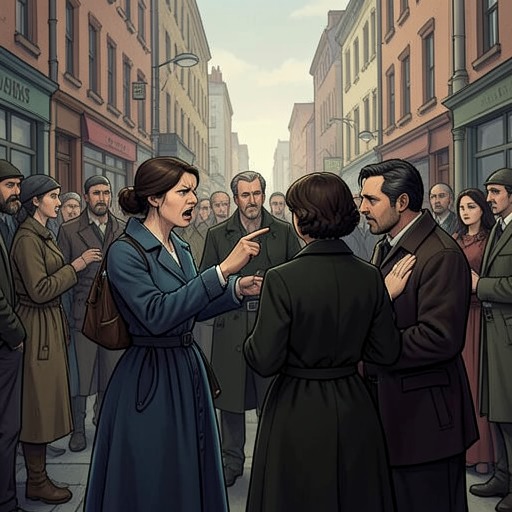
Guerra describes confronting the pair in front of friends. The scene is noisy and public: people laugh, others do not understand what is happening, and the slaps she delivers are audible. César goes to the speakers, disconnects Guerra’s mobile phone, and smashes it against the wall. He does not look at her before heading for the door. Guerra calls him a coward as he leaves, then tells Rocío that she can leave too.
Rocío begins to cry, but the confrontation is overtaken by a second revelation. She tells Guerra that she and César had meant to disclose the news the next day: Rocío is pregnant. The pregnancy makes the concealed relationship consequential beyond the breach of trust between housemates. It also complicates the scene’s apparent ending. César has fled the confrontation, while the women remain with the discovery and its implications; the account does not supply his response to the pregnancy or explain what he intended to do.
Later Family and Narrative Significance
César’s later appearances come in compressed images rather than a new conversation. Watching a later episode of Tiranos temblad, Lucas sees a five-second report that presents Guerra, César, and Rocío’s ceremony as the first triple marriage in Montevideo. Both women are pregnant in the image, standing in white beside César in a patio ceremony that appears alternative and almost parodic. Lucas has to pause the brief footage to recognize Guerra. The public picture gives the trio a shared form that the earlier household revelation had exposed as secret and painful.
A further glimpse comes through photographs on Rocío’s Facebook page. Each woman is holding her child; in one photograph, César feeds the two children simultaneously, with a spoon in each hand. Lucas wonders whether all five might live together, but explicitly does not know. He and Guerra no longer exchange emails, and their connection has cooled into silence, so the family’s day-to-day life remains beyond his knowledge. The photographs nonetheless change the meaning of César’s place in the story: the man first disclosed as one half of a hidden affair appears later as a father caring for two children whose mothers are both part of the same family arrangement.
César’s arc is therefore conveyed through a sharp contrast between secrecy and an unconventional public union, not through a narrated reconciliation or a direct explanation of his motives. The betrayal is concrete—the shared house, the hair on a pillow, the smashed phone, the pregnancy—but the later images resist a simple conclusion about what followed. Lucas’s account leaves uncertainty about the household’s practical shape while showing that the women and César fashioned a family form that did not match the conventional arrangement Guerra initially believed she inhabited.