Gualdar Tattoo
La uruguayaGualdar Tattoo is the trisquel that Lucas Pereyra has tattooed on his left shoulder during his day with Magalí Guerra Zabala in Montevideo. Chosen in a small tattoo shop after he asks to see symbols of war, the image of three connected spirals gives material form to the day's loose chain of associations. Lucas presents the tattoo not as a declaration of lasting devotion but as its opposite: an anti-tattoo intended to help him forget Magalí, even as the design seems to gather his desire and thoughts about family into a single mark.
Setting and First Associations
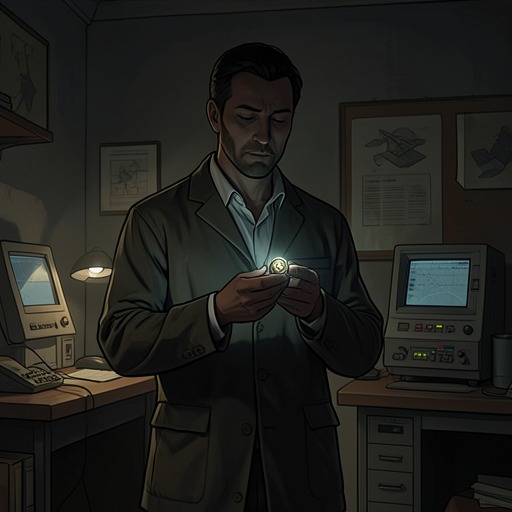
The tattoo enters the narrative before Lucas reaches the shop. Walking along Avenida 18 de Julio, he is already reading the city through his longing for Magalí: songs, videos she has sent, and street details make Montevideo feel partly imagined, a place assembled from memory and desire. A leaflet handed to him outside a gallery advertises tattoo designs and piercings. He keeps it in his jacket, partly arrested by the leaflet's shifts between forms of address. In his heightened state, the paper becomes one more thing that seems to speak directly to him. It also turns his thoughts toward Magalí and an aspect of her life that their email exchanges had not addressed.
Later, after dancing with Magalí, Lucas goes down a spiral staircase to the gallery's basement bathroom. There, while intoxicated and high, he recalls the turn he made while dancing and the pleasure he believes it gave her. He remembers a study he had read claiming that women preferred men who turned more to the left when dancing. The staircase's leftward spiral joins the dance in his mind; the bodily motion becomes a pattern he can carry from the evening into the tattoo shop. This sequence matters to the object's meaning: the trisquel does not arrive as a settled emblem with a single explanation but as the visible point where a succession of movements and thoughts converge.
Choosing the Trisquel
When Lucas returns upstairs, he enters the tattoo shop and asks to see symbols that signify war. The tattoo artist first shows him Chinese ideograms, which do not appeal to him; he prefers the Celtic designs. Some are intricate and intertwined, while others are simpler. On seeing the trisquel, he immediately feels that it is the image he was looking for. Its three connected spirals seem to fit the intuitions he has been following through the night, as if he had somehow known the design was there before he saw it.
The image gives the tattoo an explicit relation to war while also extending the spiral pattern that has already shaped Lucas's thoughts. In the bathroom, he had linked the turn in his dance to the staircase and then to questions about ancestry, reproduction, and the future. For what he describes as the first time, he imagines having a daughter. The trisquel's joined spirals can therefore be read alongside this movement from a present encounter toward successive generations and a possible child. That association belongs to Lucas's unfolding interpretation, not to a meaning the tattoo artist supplies: the design takes on force because Lucas recognizes it within the pattern his own mind has made.
The Tattooing and Magalí's Response
The tattoo costs 1,200 Uruguayan pesos, which Lucas estimates at about forty dollars. The artist asks which shoulder he wants; Lucas chooses the left. Before beginning, the artist prints the design and applies it with washable ink so Lucas can see how it looks in the mirror. He approves the placement, takes off his shirt, and is preparing to proceed when Magalí appears looking for him. She laughs at finding him there and tells the artist not to let him go through with it because he is very drunk. Her intervention registers both the impulsiveness of the decision and her recognition of his condition, but the tattoo is not stopped.
Lucas jokes about getting a heart bearing Magalí's name, then suggests a phrase associated with distant tenderness. The joking turns into a direct explanation of the design he has chosen: because of Magalí, he says, he needs a tattoo that will help him forget her, not remember her. He asks the artist what a tattoo for forgetting a woman would be. The contrast is the object's central irony. Lucas is having an image permanently placed on his body in the company of the woman he says he wants to forget; the attempt to make forgetting concrete is itself bound to an encounter that gives the mark its emotional charge.
Magalí looks at the stencil and admires the trisquel. Lucas's teasing gives way to the tattooing itself. He describes the sensation as a succession of small, quick injections, and Magalí briefly tugs the waistband where the money protrudes from his trousers. The artist works on while the mood around them shifts. When he finishes, he cleans the area and covers the tattoo with a square of plastic and adhesive tape, offering aftercare advice that Lucas does not listen to. Lucas puts his shirt back on, pays, and leaves with the new image covered.
Meaning and Narrative Role
The trisquel's significance rests on the gap between the explanation Lucas gives aloud and the associations that have led him to choose it. He calls it an aid to forgetting, but its connected spirals recall the dance, the left-turning staircase, and his sudden speculation about having another child. The tattoo thus holds incompatible impulses together: attachment and attempted release, a desire organized around Magalí and a gesture ostensibly directed away from her. The design is not evidence that Lucas has resolved those tensions. Rather, the act records how intensely he is trying to turn an unstable chain of thoughts into something definite.
The scene also links the tattoo to the larger shape of Lucas's remembered day. Elsewhere in Montevideo, landmarks and images trigger associations that make ordinary movement feel charged with private meaning. In the shop, that associative movement reaches the body: the symbol he finds on a page is transferred to his shoulder, while Magalí watches and responds. The covered mark is therefore both a literal object and a compact record of the day's emotional contradictions. Its declared purpose is to help Lucas forget; its origin, image, and setting keep it inseparable from the woman and the encounter it is meant to put at a distance.