La crisis cambiaria argentina
La uruguayaLa crisis cambiaria argentina appears not as an abstract financial upheaval but as a system of exchange controls that redirects Lucas Pereyra’s work, travel, and family obligations. In September, he crosses from Buenos Aires to Montevideo to withdraw $15,000 in book advances, planning to bring back more dollars than Argentina permits. The discrepancy between official and parallel rates makes the journey seem financially rational; the border, the bank, and the possibility of inspection make it perilous. Money is at once payment for completed literary labor, relief for a strained household, and the imagined means to recover time for writing.
Exchange Controls and the Cross-Border Route
Lucas had opened a bank account in Montevideo in April, but the advances from contracts in Spain and Colombia did not arrive until September. If the dollars were transferred to Argentina, his bank would convert them into pesos at the official rate and deduct income tax. By collecting the money in Uruguay and carrying it back as cash, he expected to exchange it in Buenos Aires at the unofficial rate and retain more than twice as much. That calculation turned a ferry trip into a deliberate attempt to get around the financial consequences of the controls, not simply a convenient way to access his earnings.
The money was explicitly connected to two books he had agreed to deliver: a volume of chronicles for Milenio and a novel for Astillero. He planned to withdraw the fifteen thousand dollars in cash, divided into eight thousand from the Spanish contract and seven thousand from the Colombian one. The sum, converted at the parallel rate of the time, came to about 240,000 pesos; through a domestic bank, he believed he would receive less than half that value. He knew he would return with more dollars than the permitted limit and accepted the risk of their being discovered at customs.
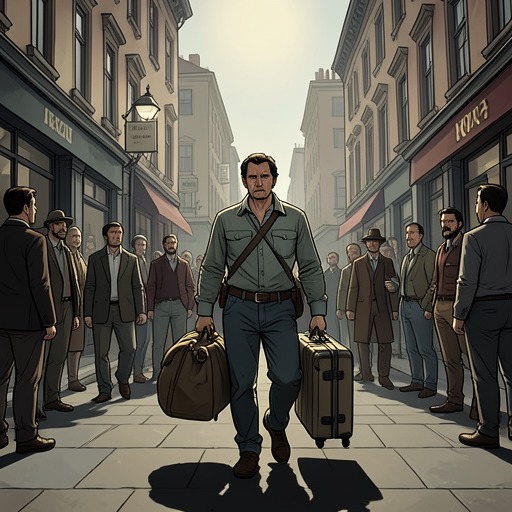
The crossing makes the state’s rules tangible as a series of procedures and uncertain encounters. Before boarding, Lucas passes through immigration and wonders whether the official’s unusually prolonged look means that people making a same-day trip are being marked or listed. The narrative presents this as his anxious suspicion, not as confirmed surveillance. On the return, employees stop and search passengers: Lucas is patted down, asked to remove his jacket and lift his shirt, and watched as an employee looks inside his ukulele. The customs search is physical and intimate, directed toward finding cash concealed on the body or among belongings. By then, however, he has no money to find, and he is allowed through.
A Fragmented Value of Money
At the bank, the withdrawal is both an ordinary transaction and an act he would rather keep private. When his turn comes, Lucas leans toward the opening in the teller’s window and quietly asks to withdraw fifteen thousand dollars, then repeats the request after the teller points him toward a speaker. The small exchange captures the practical awkwardness surrounding a sum he has traveled across a national border to collect. The money is legally held in an account abroad, but moving its value into his household depends on navigating different rates and the rules governing cash at the border.
The narrator evokes the currency system through the proliferation of dollar labels: official, parallel, blue, soybean, tourist, brick, and futures. Their coexistence makes it difficult to know what things are worth. The peso is losing value, inflation is present, and controls have split the market between official and parallel exchange. Informal exchange houses, intermediaries, and personal contacts occupy the space between those rates. This is not presented as a tidy alternative market: Lucas recalls that, on an earlier trip to change money in the city, he was followed and someone broke his car window in an attempted robbery. A contact at an exchange house defended the people involved as friends, while Lucas doubted the reassurance and suspected that people in the parking area had identified customers. Seeking a better rate could expose a customer to danger as well as offer a financial advantage.
The irony is that this improvised route exists in a period of electronic transfers and virtual money. Lucas describes himself as traveling to smuggle his own earnings: printed proceeds from book contracts that could not be brought into Argentina on the same terms through an ordinary bank transfer. His image of searching for a narrow opening in the rules links the financial controls to the border itself. The controls are not merely a change in how money is priced; they shape where he must go, what he carries, and what risks he must take to turn a literary payment into usable funds.
Household Need and the Value of Writing Time
The hoped-for dollars answer a chain of problems that had made ordinary life feel stalled. Lucas thinks of money as the reason he cannot go out, send a letter, print a form, visit an agency, resolve his anger, paint chairs, repair dampness, or send a résumé. Earlier financial strain had accumulated in domestic details: the kitchen sink basin came loose and was propped up with cans; an appliance in the living room burned out, leaving the room dim; the washing machine broke, and the old oven began to smell strange. A dental crown was postponed because it was expensive, as was an IUD; the family fell behind on Maiko’s kindergarten fees, building expenses, and health coverage. At a supermarket, both cards were declined, and the family had to return their groceries while Maiko protested on the floor. The exchange crisis enters a household already living through the consequences of limited cash and deferred decisions.
Lucas has only a vague plan for the money at first, but its intended uses are concrete: repay Catalina for the months when they had lived on her salary, clear overdue bills, repair the home, repay his brother, and hire an afternoon babysitter. He hopes that these expenditures will secure nine or ten months in which he can work with the door closed and without interruptions. The chronicles are nearly complete but need structure; the novel remains to be written. The withdrawal is therefore not simply a windfall. Its value lies in the stretch of work time it might buy, and in the possibility of fulfilling contracts already signed while restoring some financial balance to the family.
That promised future also carries an imaginative excess. Lucas pictures the novel as the story of a man who leaves his wife and children, disappears into Brazil, and becomes someone else; it will range across beaches, Brasília, and the Amazon, with contraband, drugs, shamans, gunfire, and stories within stories. He imagines it as his total novel, a work expansive enough to transform the money into literary possibility. The contrast is sharp: the actual funds come from two specific contracts, and the book for which he most needs time remains unfinished. The controls make the first step toward that imagined freedom a trip devoted to collecting cash and evading a limit.
Escape, Risk, and the Limits of the Windfall
The crossing briefly feels like escape before it feels like a financial operation. Once the ferry leaves the dock, Lucas feels enormous relief at getting away from the country, even temporarily. The onboard announcement of the duty-free shop prompts him to associate the appeal of freedom with a word shaped by commercial restrictions. On the road from the port, the palms, the moving landscape, and the sensation of travel bring a sudden happiness and the feeling of passage into another place. Those moments do not remove the conditions that sent him across the river, but they reveal how strongly the journey is invested with the hope of leaving his stalled life behind.
The crisis ultimately gives money a double meaning: it is a practical means of meeting obligations and a provisional promise that life can start moving again. Lucas’s belief that the dollars will clear the fog rests on specific anticipated payments, repairs, debts, childcare, and writing deadlines; it is not simply faith in wealth. Yet the return journey ends without the cash he had set out to collect. At the port in Buenos Aires, customs searches him and his ukulele and finds nothing. He leaves on foot, without pesos for a taxi, walking more than thirty blocks toward the family apartment. The inspection cannot recover money he no longer has, and the episode closes not with the secure working months he imagined but with his sense of being exhausted and, paradoxically, invincible. The exchange controls remain the framework of his journey, while the hoped-for conversion of earnings into financial security and writing time remains unresolved.