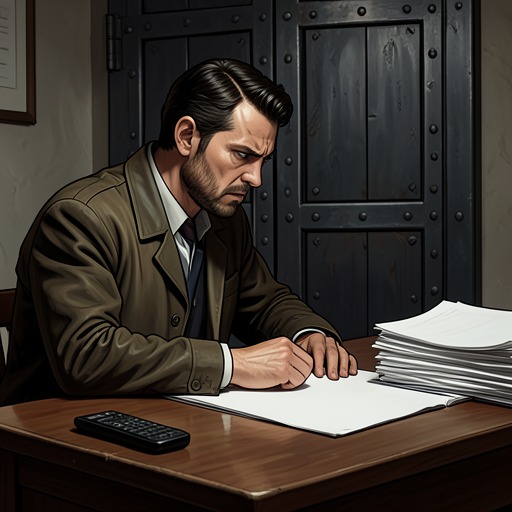
Lucas's Creative Block
La uruguayaLucas Pereyra’s creative block is not simply a shortage of ideas: it is the knot joining unfinished work, financial insecurity, and a collapsing domestic life. When two book contracts finally bring money, he imagines that the advance will buy the quiet needed to write. Instead, the obligation sharpens the question at the center of his paralysis: how can he repay money with a book that does not yet exist?
Work Under Financial Pressure
The block takes shape against a household’s accumulating failures. Lucas has not brought projects to completion, has not finalized agreements, and has declined opportunities to teach. Meanwhile, the kitchen sink comes loose and has to be propped up with cans; cookware, lights, the washing machine, and the oven deteriorate; the car’s steering shakes. Unpaid bills spread from Maiko’s kindergarten to health coverage and building expenses. When both cards are rejected at Walmart, Maiko has a tantrum among the checkout lines and the family must return the groceries. The episode makes the abstract difficulty of earning a living brutally concrete: there is no income to cover the ordinary costs of a household.
The financial strain also feeds a crisis in Lucas’s marriage to Catalina. He describes months of sexual frustration and arguments in which he cannot clearly say what he wants beyond expressing his own discontent. At night, he lies awake listening to an irregular drip whose source remains unknown. He imagines moisture gathering unseen, damaging plaster and weakening the structure. The sound gives domestic unease a physical form, while insomnia and his own inward monologue leave him less able to work. His sense of defeat is thus both material and mental: unpaid obligations press from outside, and doubts multiply within.
The Promise and Burden of the Advance
The payments from publishers in Spain and Colombia arrive months after the contracts were signed. Transferring the dollars to Argentina would mean conversion at the official rate and a tax deduction; collecting the money in Uruguay and bringing back cash could yield more than twice as much at the unofficial rate, despite the risk of exceeding the amount legally permitted across the border. Lucas eventually looks forward to fifteen thousand dollars in cash: eight thousand from Spain and seven thousand from Colombia. The exchange-rate disorder makes that sum feel at once substantial and unstable, a possible escape from the household’s arrears rather than a simple measure of earnings.
He has practical uses for the money in mind. He wants to repay Catalina and his brother, catch up on bills, repair the house, and hire a babysitter so that he can work behind a closed door. He estimates that careful spending might secure nine or ten months of relative calm. The advance therefore seems to offer a direct solution to his block: time, space, and fewer interruptions. Yet the hoped-for freedom comes already encumbered by commissions. He owes a novel to a Spanish publisher and chronicles to Colombia; the chronicles are nearly finished but still need structure, while the novel remains the more daunting task.
An Unwritten Total Novel
In the bank, Lucas asks himself what his actual skill is. Writing phrases has not made him much money, whereas teaching has paid better. He recalls his workshops as a practice of restraint: encouraging enthusiasm, letting participants make mistakes and recognize them, and helping each person find what they are seeking. Now the arrangement is different. He is being paid to sit and write, and he feels indebted to the publishers for work whose substance has not yet been made.
That debt seems almost unreal because its repayment cannot be found anywhere in advance. The payment must be matched by something invented: a sequence of connections in the brain that will produce what he thinks of as a verbal daydream. He wonders whether the narrative machine will work at all. The image makes the block more than a missed deadline. He has to create the very thing that could prove he deserved the time and money, while lacking assurance that creation can be summoned to order.
His imagined answer is expansive. He sees a man leaving his wife and children, disappearing into Brazil, and becoming someone else. The book would move through beaches, Brasília, and the Amazon, with shifting language, wordplay, sex, river journeys, smuggling, drugs, shamans, gunfire, dance halls, and stories nested within stories. Lucas imagines it as his total novel, a work able to contain everything. The scale is exhilarating, but it also exposes the distance between conception and execution: the more the imagined book promises, the more impossible it may become to begin.
Fatherhood, Advice, and a Change of Scale
The pressure of paid writing is sharpened by the actual conditions of Lucas’s life. He complains that he cannot write with Maiko constantly demanding his attention while he also reads for thousands of students and teaches. The response he receives is to write about precisely that situation. Later, an interlocutor tells him that he is still too angry to understand where his writing should go, and predicts a return to poetry once the anger has passed. Lucas resists the prospect: he has only five hundred dollars left after exchanging money into Uruguayan pesos and spending some on whisky, while debts and family expenses remain. The advice does not immediately solve the practical problem, but it challenges the assumption that writing must escape his circumstances in order to become literature.
The eventual outcome is mixed rather than triumphant. A year later, Lucas says that his book of chronicles has appeared in Bogotá. The Brazilian adventure novel, however, has dissolved into a neural fog. He is working on a book of poems and, slowly, another novel stripped of the Amazonian scale: no traffickers, gunfire, or knives, only smaller episodes across the river. This change of scale marks a meaningful alteration in his relation to the work. The grand project remains unrealized, but writing itself has resumed in forms that do not depend on the fantasy of one total book.
Significance of the Block
Lucas’s creative paralysis is bound to the contrast between money as time and writing as an uncertain form of repayment. The advance can settle bills and purchase hours, but it cannot guarantee the imagined work those hours are meant to produce. His difficulty also emerges from the same ordinary life he first treats as an obstacle: caring for Maiko, teaching, debt, marital conflict, and the damaged household. The suggestion to write about what obstructs him makes that conflict newly available as subject matter, even though the evidence does not show the advice instantly curing the block.
The ending preserves both failure and movement. The novel he envisioned with Brazilian landscapes and a cascade of adventures never takes shape; the chronicles do, poetry returns as a possibility, and another novel proceeds slowly on a smaller scale. Lucas’s block therefore ends not with a sudden breakthrough but with a change in what he can undertake. The work becomes less total, more closely proportioned to his circumstances, and no longer dependent on the promise that one immense book will redeem the time, money, and expectations invested in it.