Lucas's Post-Separation Co-Parenting and Blended Family
La uruguayaLucas Pereyra’s post-separation family life takes shape through shared care of Maiko and a deliberate effort to loosen the boundaries of the former marital household. Rather than treating separation as the end of family, Lucas proposes a more flexible arrangement: Maiko can live with Catalina and her partner during her days, the adults can meet without secrecy or strain, and they may even share meals, outings, or holidays. The new family is not presented as settled or effortless; it is something they must learn to make through ordinary arrangements and mutual recognition.
From marital strain to separation
Before the new arrangement, the family had been under pressure from money problems, stalled work, and the strain of caring for a young child. Lucas’s household fell behind on bills and expenses; appliances broke, the car needed repairs, and two bank cards were declined during a grocery trip, forcing them to return everything in the cart. The financial strain accompanied deeper conflict between Lucas and Catalina, including arguments over their sex life and Lucas’s frustration with his stalled career.
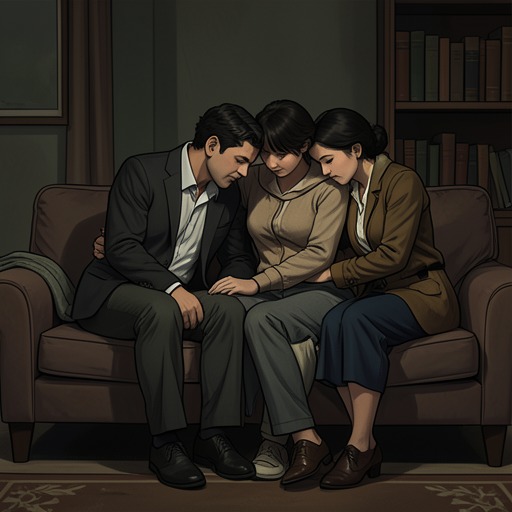
Their separation follows a disclosure that reorders Lucas’s understanding of the marriage. After a night at the hospital, Catalina tells him that Maiko will sleep at her mother’s and asks what they should do about their relationship. She asks who Magalí Guerra is, and Lucas tells her about his distant attachment. Catalina then reveals that she is in love with a woman, a doctor she met at a foundation event, and that their relationship has lasted nearly a year. She says she will no longer hide it. Lucas had assumed she was seeing a man; the revelation leaves him shocked and hurt, even as it makes clear that their separation involves more than his own infidelities.
Parenting as care and vulnerability
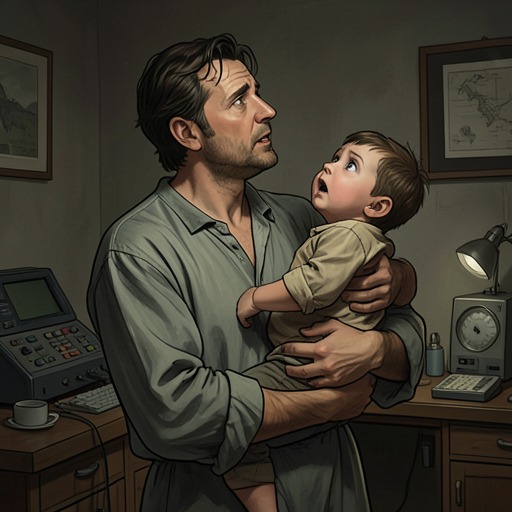
Lucas’s account of fatherhood includes devotion alongside exhaustion and fear. He loves Maiko intensely, but describes the constant worry of raising him as a new vulnerability: he fears that something might happen to his son, to Catalina, or to himself, leaving Maiko exposed. The practical demands of parenthood sharpen that anxiety. Sleep is interrupted, leisure and sex require planning around childcare, and familiar routines are shaped by children’s songs and repeated readings of a picture book about a rhinoceros. Lucas even admits to hiding that book because he could no longer bear reading it.
The family’s physical closeness is also described as a kind of fusion. Maiko brings infections home from kindergarten, and Lucas says the illnesses lay him low; he imagines the child’s germs moving through their shared household body. This image makes care feel both intimate and costly: the child is not merely someone Lucas protects, but part of a family organism whose members affect one another. That vulnerability persists after the adults separate, even as the household arrangement changes.
Shared custody and everyday belonging
In the later arrangement, Maiko spends half the week with Lucas and half with Catalina. Lucas notes that Maiko adapted quickly, though he wonders whether the boy adapts too readily. One small exchange clarifies what the schedule means to Maiko: when a neighbor assumes he is visiting his father, Maiko corrects her, explaining that he lives with Lucas too. The distinction is important. Lucas’s home is not a place Maiko visits outside his real family life; it is one of the homes in which he belongs.
Other practical changes accompany this shared parenting. Maiko attends public school and appears to have settled in. Lucas has given up the car, which had consumed money and time through fuel, repairs, parking, and traffic, and he describes its absence as a relief. These adjustments do not erase the distance between the former spouses, but they make the reorganized family workable in daily life. Lucas misses Maiko on the days they are apart, and says that he writes more then, making the custody rhythm part of the conditions of his creative life as well as his parenting.
Imagining a wider family
Lucas’s proposal to Catalina is unusually open-ended. He says he has no objection to Maiko living with Catalina and her partner on her days, wants to meet the partner, and would welcome them all at his home for a meal. He hopes Maiko might see the three adults together without nervousness or silence. He also imagines shared outings and perhaps a holiday at the same seaside resort, while acknowledging that some forms of closeness may be too much. The proposal is not a claim that these plans have already happened; it records a willingness to negotiate a family that no longer fits the old household structure.
A brief segment from Tiranos temblad gives Lucas another image for that possibility: the triple wedding of Magalí Guerra, César, and Rocío, shown in a fleeting report as an alternative, almost parodic ceremony. Lucas pauses the video to recognize Magalí Guerra, who is visibly pregnant. Later, he sees photographs of each woman with a baby and César feeding both children at once. He does not know whether the five of them live together, and he no longer exchanges emails with Magalí Guerra. What matters to him is the glimpse of a family assembled in an unconventional form, not certainty about its private arrangements.
Lucas turns that image into a broader understanding of family as something made from combinable parts, with each person assembling it as best they can. He connects that idea to Catalina’s decision to live openly with her partner and to his own willingness to meet her and include her in Maiko’s life. His position is not presented as uncomplicated transcendence: he remains wounded by the marriage’s end and still wonders about the people and relationships that altered it. Yet the ending of the account places the emphasis on simplification, shared parenting, and an emerging capacity to imagine family beyond the couple that first formed it.