Pit bull
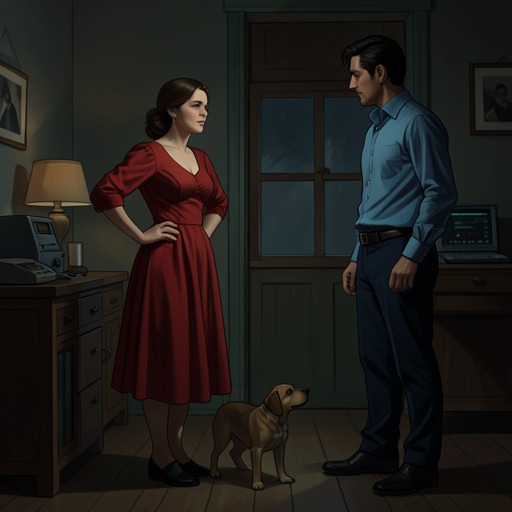
La uruguayaThe Pit bull is Magalí Guerra Zabala’s boyfriend’s dog, introduced at a bar in Montevideo when Guerra unexpectedly arrives and hands Lucas Pereyra its leash before going to the bathroom. Muzzled and black with a white patch on its chest, it is at once an actual animal Lucas must care for and a focus for the fears and associations he brings to the reunion. Its timid conduct unsettles his first, violent image of it.
Identity and Introduction
Lucas first notices the dog at the edge of his vision, wearing a muzzle. Guerra has come from the rambla and, after embracing him, asks him to hold the dog while she goes inside. In the brief interval before she returns, Lucas is left standing with the leash, struck by the suddenness of Guerra’s appearance and by the force of his reaction to her.
The dog is a black Pit bull with a white mark on its chest. Lucas describes it as shy; the two of them seem equally uncomfortable in the forced encounter. The dog looks at him, lowers its eyes, and sits, and Lucas sits too. This quiet exchange supplies the scene’s clearest evidence of the animal’s behavior, in contrast with Lucas’s frightening account of what its breed might mean.
Lucas’s Projection and the Dog’s Conduct
Left alone with the Pit bull, Lucas imagines that years of genetic manipulation have made it a creature of pure aggression: a heavy, compact mass of lethal bites, its muzzle suppressing what he regards as its essence. He compares it to Tyson in handcuffs. These are Lucas’s charged interpretations, not actions by the dog; the animal’s visible behavior is reserved and self-effacing.
His thoughts turn the dog into a possible sign of something hidden in Guerra’s domestic life. He wonders what emotional vacancy such a creature might fill and speculates that it could be an animal double or a version of her boyfriend. The questions reveal how readily Lucas reads the reunion through jealousy and metaphor: rather than knowing what the dog signifies to Guerra, he makes it carry meanings produced by his own unease.
Public Rules and the Reunion
Lucas initially thinks that the dog cannot be brought into the hotel, especially because it is a Pit bull. Later, when he asks whether it bites and whether it belongs to Guerra’s boyfriend, she says it is very good-natured and explains that fighting-breed dogs have had to wear muzzles in public places in Uruguay for several years. The muzzle therefore has a practical explanation in the scene, even as Lucas reads it as an image of restraint and menace.
The small business of handling the leash continues after Guerra returns: Lucas gets up and slips the chair leg through its loop. The gesture keeps the dog physically present between the two people as they begin to talk, but the animal does not attack or threaten him. Its role in the encounter rests on this tension between the regulations and stereotypes Lucas associates with the breed and the shy, manageable dog sitting beside him.