Rocío
La uruguayaRocío is a friend of Magalí Guerra Zabala and a colleague at a publishing house, whose affair with César is exposed after she shares a home with the couple. In the account, she moves from the apparently unobtrusive housemate Magalí remembers to one of the two pregnant women in an unconventional three-person marriage. Her story also marks the limits of what the narrator can know: much of it reaches him through Magalí’s recollection and, later, fleeting online images.
Identity and Arrival
Rocío enters the story through Magalí’s explanation of how their household formed. When the rent on Magalí and César’s home rose substantially, Magalí suggested that Rocío move in because she was looking for a place. Rocío was already known to Magalí as a friend from the publishing house, and Magalí recalls that they had encountered her in Valizas. The arrangement begins as a practical response to higher rent and a friend’s housing search, before the shared home becomes the setting for a concealed relationship.
The Housemate and the Clue
Magalí remembers Rocío as withdrawn from the household’s ordinary sociability. Rather than sit with the others to drink mate or watch television, she would bring home bizcochos, take two or three, and retreat to her room with her mate to read. That conduct made her seem, in Magalí’s initial, bitter assessment, like an ideal tenant: self-contained and unobtrusive. The contrast between this routine and what Magalí later suspects gives the domestic details a new charge. Rocío’s privacy had looked like a harmless preference; after the discovery, Magalí rereads it as part of a pattern she had failed to see.
The turning point is a short gray hair on Rocío’s pillow. While airing the room and sweeping, Magalí notices it as she goes to straighten the sheets. She knows Rocío has no gray hair, but César does. The clue prompts her to assemble earlier moments into a different account: César and Rocío had been alone together when Magalí was out, and César sometimes delayed leaving until Magalí had gone first. Even the tension Magalí had sensed between them changes meaning; she now interprets it as discomfort caused by their secret. The affair is disclosed to the narrator through Magalí’s retrospective reconstruction, not through a direct account from Rocío or César.
Exposure and Pregnancy
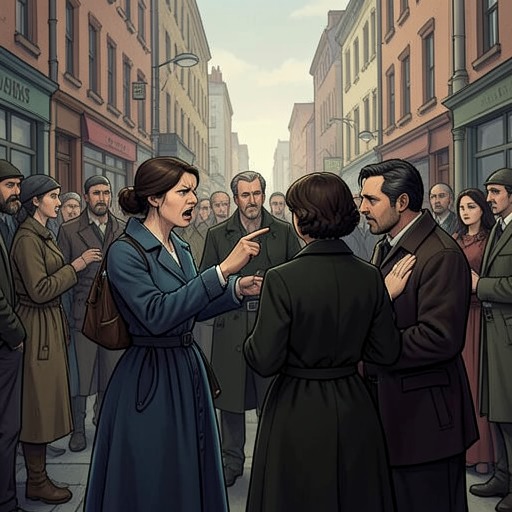
Magalí describes confronting the pair in front of friends. The scene becomes public and physically disruptive: César goes to the speakers, disconnects Magalí’s phone, and smashes it against a wall. He leaves without looking at her. Magalí calls him a coward as he reaches the door, then tells Rocío that she can leave too. Rocío begins to cry. The friends understand what has happened, but are left unsure whom to comfort; Magalí is standing and waiting for Rocío to go when Rocío announces that she is pregnant.
The announcement changes the immediate stakes without resolving the confrontation. Rocío is pregnant, and Magalí reports this as the revelation that follows her exposure of the affair. The scene supplies no account of what Rocío had intended to tell Magalí, beyond the statement that she and César were going to tell her the next day. It also does not establish how the pregnancy will affect their relationships at that moment. Instead, it leaves the household’s rupture suspended beside the new fact of an impending child.
Marriage, Children, and the Limits of the Record
Later, the narrator sees a brief segment of Tiranos temblad describing the first triple marriage in Montevideo. The image lasts only seconds: two pregnant brides in white stand with the groom between them, all laughing in a patio during an alternative ceremony that the narrator reads as almost a parody of a wedding. He has to pause the image to recognize Magalí. The glimpse places Rocío within a strikingly different arrangement from the secretive affair Magalí once uncovered: the three are now presented publicly together, rather than as a couple and a concealed third party.
The narrator then looks at a friend’s Facebook page, since Magalí has closed her own. Photographs show each woman holding a child. In one, César feeds two children at once, with a spoon in each hand. The image suggests an ongoing shared family connection among the adults and children, but it does not establish their living arrangements. The narrator explicitly does not know whether all five live together. Nor does the account supply Rocío’s own explanation of the marriage, the earlier affair, or the later household. After the photographs, the narrator notes that correspondence with Magalí faded into silence; Rocío’s life remains visible only in these small, mediated traces. Her role therefore carries both a plot consequence—the exposure of the affair—and a larger contrast between the household’s hidden tensions and the unconventional family form that later appears in public.