The “monster” and the fused family body
La uruguayaThe fused family body is Lucas Pereyra’s name for an intimacy that can erase the people within it. First imagined as a suffocating symmetry between spouses, the monster expands to include Maiko: a family whose members feel joined by shared routines, vulnerability, and care, but whose closeness threatens the private boundaries each person needs.
The Couple as a Shared Organism
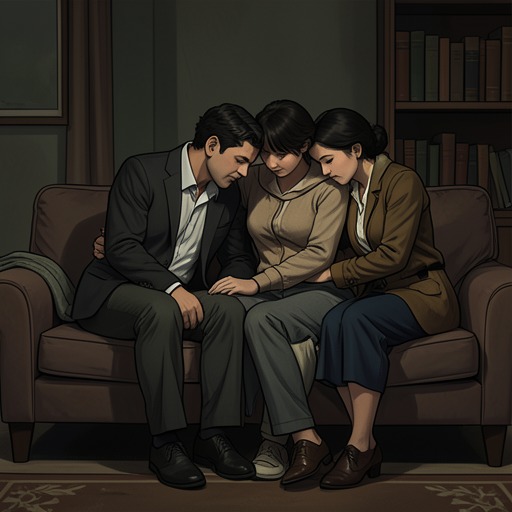
Lucas fears the kind of partnership in which two people come to want and do everything alike. He pictures sameness accumulating through shared routines, meals, habits, fears, plans, and even bodily rhythms until the couple seems to operate as one being. His monster is therefore not a literal creature but an image of intimacy carried to the point of self-erasure: two people become a single, two-headed body with one desire.
The image also has a family origin. Lucas imagines a child arriving to wrap the couple’s embrace and seal it permanently. He plays with blended names to make the metaphor concrete: a hypothetical daughter might be called Lucalina, while Maiko might instead be called Catalucas. The names collapse Lucas and Catalina into each other, just as the monster represents their lost distinction. In his account, this fusion is frightening not because the family lacks love, but because love appears to leave no room apart from the shared body.
Privacy and the Marriage’s Decline
Lucas says that both spouses resisted this fusion even as habit drew them into it. He describes a former sense of separateness giving way to breaches of privacy: he talked in his sleep, and Catalina read his emails. Lucas had deliberately kept his email account closed, valuing the mental space and quiet it preserved. Catalina, by contrast, left her own account open, but he says he did not take that as permission to read it. The asymmetry becomes part of his complaint: he experiences her reading as a crossing of a boundary he had carefully maintained.
The same tension appears in the couple’s changing physical relationship. Lucas remembers an earlier intimacy as energetic and varied, then contrasts it with a later pattern that had become predictable and increasingly detached. The change is not simply a matter of frequency: he describes the former mutual pursuit as giving way to exhaustion and distance. At night, Catalina might fall asleep without getting fully into bed; a taut sheet could leave them beside each other but unable to touch. The image makes separation palpable within the place ordinarily associated with closeness, turning the shared bed into evidence that proximity does not guarantee connection.
Their conflict gives the decline a history. During an argument, Catalina said she was tired of Lucas and his defeated outlook. He felt cornered and responded by raising his frustration with their diminished sex life, while she challenged the idea that his restraint deserved praise. Lucas recalls this exchange alongside the lost vitality of their earlier relationship. His account does not present the monster as a stable condition: it is a form of togetherness that has changed, becoming at once too fused in its routines and too distant in its affection.
Maiko and the Three-Person Body
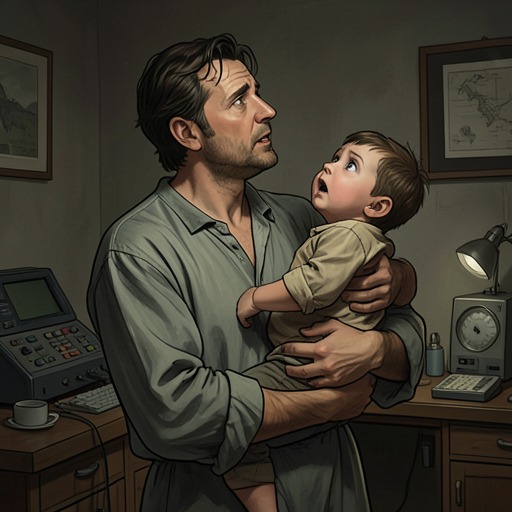
When Lucas turns from the couple to parenthood, the monster becomes a family body of three. He describes Maiko’s childhood illnesses as a source of fear because they spread to him and left him feeling unwell and incapacitated. In the image he uses, the child is not merely another person in the household: he is bound to Lucas through bodily vulnerability, so that caring for Maiko also means confronting the possibility that his condition will affect the parent.
Lucas extends the metaphor from shared exposure to shared existence. The family, he says, has one circulation; harm to any one of its three members would feel like an amputation from the others. The comparison explains the intensity of his fear without turning it into proof that the family is literally one organism. The bond is emotional and imagined, but its consequences are real to him: Maiko’s dependence makes Lucas newly conscious of how much he could lose, and how exposed attachment leaves him.
The Metaphor’s Double Meaning
The monster holds together two judgments that Lucas cannot resolve into one. As a couple, fusion seems to threaten privacy and individual identity; as a family, bodily connectedness expresses the force of attachment. The same image can therefore describe an engulfing marriage and the vulnerability that comes with loving a child. Its meaning changes with the relationship it is asked to contain.
That doubleness gives the metaphor its weight. Lucas does not portray separation as simple freedom from intimacy, nor does he treat family unity as uncomplicated comfort. His imagined blended names make the loss of individual identities comic and unsettling, while his account of shared vulnerability makes separation from the family seem almost unthinkable. The monster is the shape he gives to that contradiction: a shared body can feel like a trap, yet the bonds that create it are also what make every member’s pain matter to the others.