The Breakdown of Lucas and Catalina's Marriage
La uruguayaThe Breakdown of Lucas and Catalina's Marriage is a gradual unmaking rather than a single decisive quarrel: money worries, Lucas's stalled writing, diminished intimacy, and resentment in the daily care of Maiko accumulate until both partners must speak openly about lives they have kept from one another. Its decisive turn is a mutual disclosure that overturns Lucas's assumptions about Catalina and leaves the marriage unable to continue in its old form. The aftermath, however, is not simply separation. The two begin to shape a cooperative family life around Maiko.
Strain in the Household
The marriage is already under pressure before its final conversation. Lucas has been out of work, and the household has depended on Catalina's salary. He has not completed projects or committed to other work, while his intention to write has not yet become a reliable livelihood. Their financial difficulty is visible in ordinary objects and deferred needs: the kitchen sink needs support from cans, the washing machine breaks, and repairs and expenses go unpaid. At one point both payment cards are rejected during a shopping trip, forcing the family to return what they had put in the cart. The incident brings anger and embarrassment into a life already narrowed by money.
That pressure also shapes how Lucas experiences Catalina's exhaustion. He sees her as too tired for the sexual relationship he wants and tells her that he cannot live with their limited intimacy. She challenges the implication that his not pursuing other women deserves gratitude, and asks him to say what he actually wants. Her response does not resolve the conflict: Lucas says no more, and the exchange ends without a shared account of what either partner needs. The argument exposes a basic impasse. He presents frustration as his grievance, while Catalina is already weary of his defeatism and the burden she feels it places on the household.
Intimacy and Accumulated Resentment
Lucas remembers the marriage through a stark contrast between its earlier vitality and its later routine. He recalls a relationship once marked by mutual desire and spontaneity, then describes a gradual narrowing into predictable encounters and physical distance. In the present, even sharing a bed does not guarantee closeness: on some nights Catalina is so tired that a sheet separates them, and Lucas lies awake beside her without finding a way to bridge the distance. The memory of what they once shared makes the change feel like a loss rather than a simple decline in frequency.
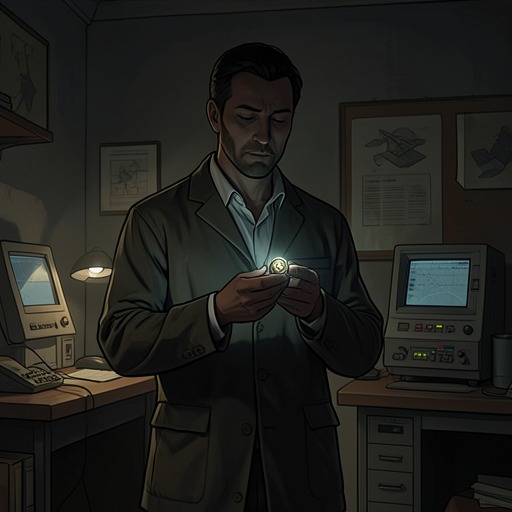
The domestic atmosphere gives that separation a repeated, almost material form. At night Lucas hears an irregular drip whose source neither of them identifies; he imagines the unseen water accumulating and damaging the building. The sound accompanies his insomnia and his sense that something is worsening out of sight. When he cannot sleep, he retreats to the living-room sofa and returns to bed feeling defeated. His account links the marriage's unspoken damage to his own inability to work: when he is not writing or working, the internal noise grows louder, and suspicion takes its place. This is Lucas's perception of the breakdown, not proof that he understands Catalina's private life.
Conflict in Everyday Family Life
The strain surfaces not only in arguments about intimacy but in the ordinary work of caring for Maiko. On weekend mornings, the child wakes early and asks for a drink; Lucas and Catalina silently compete to remain in bed. One of them eventually gets up to care for him and make coffee for the other, who stays under the covers. The person already awake sometimes washes the previous night's dishes with exaggerated noise, turning a household task into a message of resentment. In Lucas's recollection, the scene is both comic and hostile: the family continues its morning routine, but each small act carries the accusation that the other is avoiding responsibility.
The repetition matters. Their anger has become part of a pattern of caregiving rather than an interruption to it, and neither partner says plainly what the other should do. Lucas describes wanting a fight but keeping that desire to himself. The gap between what he thinks and what he says helps explain why their conflicts can remain unresolved: frustration accumulates in gestures, imagined confrontations, and silence instead of becoming a negotiated change in their shared life.
Disclosure and the End of the Marriage
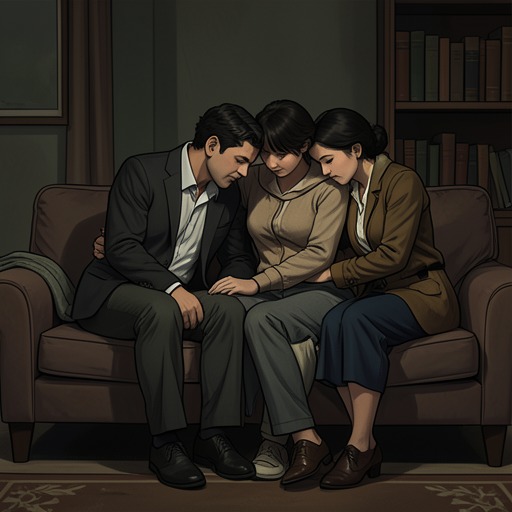
A later conversation brings those concealed lives into the open. Lucas has assumed that Catalina's late returns and changes in appearance mean she is seeing a man connected to her work. When they talk about whether they can continue as they are, she asks who Magalí Guerra Zabala is. Lucas tells her about his attachment to Magalí, which he understands as a somewhat childish, long-distance love. Catalina then discloses that she is in love with a woman and has been for nearly a year. She explains that they met at a Fundación Cardio Life event, exchanged messages, and had begun seeing one another; she does not want to hide the relationship any longer.
The disclosure overturns the story Lucas had privately constructed. He had suspected a man and treated that possibility as the likely explanation for Catalina's changed habits. He had not imagined that her partner would be a woman, or that she would describe her feelings as love. His shock and hurt are real, but the scene also shows the limits of his guesses: he had been reading signs without knowing the life they pointed toward. Catalina's statement gives her own desire a direct place in the account. Their separation follows not from one partner's discovery alone but from a relationship in which both have held back consequential truths and no longer share a workable understanding of marriage.
Co-Parenting and a Reconfigured Family
After the separation, Lucas's account shifts from the marriage's collapse to the practical question of what family can mean. He says that Maiko can live with Catalina and her partner on the days he is not with Lucas, and that he wants to meet her partner. He can imagine the three adults sharing a meal with Maiko, meeting future partners without strained silences, and perhaps arranging outings or even vacations. He admits that some possibilities, such as staying at the same seaside resort, may be too much, but insists that Maiko's family has become something different. His image of family is no longer a single fixed arrangement; it is something its members can put together in blocks.
The shared schedule gives that idea a daily form. Maiko spends half the week with each parent and adapts quickly. When a neighbor describes him as visiting his father, Maiko corrects her: he lives with him too. Lucas finds the correction telling, while also acknowledging that Maiko may be adapting exceptionally well. He misses his son on the days they are apart, but the arrangement is presented as a working life rather than a temporary visit.
Lucas also locates his own recovery in this changed routine. He is working at a radio station, though he does not enjoy the job, and says he writes more when Maiko is away. A book of chronicles has appeared in Bogotá, and he is working on poems and another novel. He is still repaying money Catalina lent him, so the economic history of the marriage has not vanished; it has become an obligation he is gradually settling. The ending therefore does not restore the couple or erase the hurt. It marks a different outcome: Lucas and Catalina remain connected through Maiko, while the family form they once treated as settled gives way to one they must continue to negotiate.