The reconfiguration of family
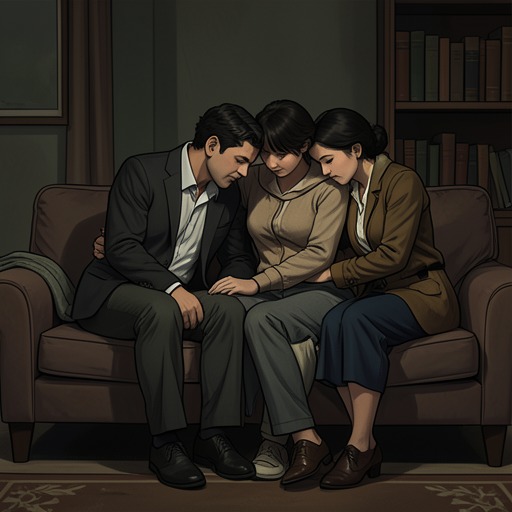
La uruguayaThe reconfiguration of family is the novel’s movement away from the ideal of one settled household toward a family made and remade through care, shared time, and negotiated relationships. Lucas and Catalina’s marriage breaks down, but their bond as Maiko’s parents continues; Lucas comes to imagine a family that can include former partners, new partners, and different households without requiring everyone to pretend that nothing has changed. The idea remains practical as well as emotional: who cares for Maiko, where he lives, and whether the adults around him can meet without tension become the measures of family after marriage ceases to organize their lives.
Marriage Under Pressure
Before separation, family life is shaped by strain that is both material and intimate. Lucas’s stalled work and the household’s debts accumulate alongside the ordinary failures of domestic life: a damaged sink propped up with cans, broken appliances, delayed medical and childcare expenses, and two bank cards declined during a grocery trip. With Maiko crying on the floor between the checkout lanes, Lucas and Catalina have to return the groceries. The scene makes financial hardship part of family experience, not just background: scarcity affects the home, their sense of dignity, and the labor of caring for their child.
The pressure also enters the marriage through exhaustion and frustrated intimacy. Lucas recalls Catalina crying after arguments, while he describes feeling defeated and resentful when her fatigue left little room for sex. His account includes his own clandestine encounters and careful concealment, followed by his belief that Catalina’s late returns and secretive schedule were a conscious or partly conscious retaliation. These recollections do not offer a single, neutral explanation of the marriage’s collapse; they show a household in which grievance and secrecy accumulate alongside parenting and financial worry.
Parenthood as Shared Vulnerability
Lucas’s account of fatherhood complicates any simple division between the burdens of family and its affection. He says he adores Maiko, yet admits that constant concern for the child has made him newly vulnerable: he fears that something might happen to Maiko, to Catalina, or to himself while Maiko is still dependent on them. The fear is attached to the routines of care, from trying to stop Maiko running toward a street to the exhaustion of interrupted sleep, postponed intimacy, children’s songs, and repeated readings of a picture book. Lucas even hides the book about a rhinoceros because he can no longer bear reading it, a small act of frustration within a life organized around the child’s needs.
That closeness becomes bodily in Lucas’s image of the three of them as one fused family organism, sharing a circulation. Maiko brings infections home from kindergarten, and Lucas describes being laid low by the illnesses that barely trouble the child. The image is comic in its details but serious in implication: parenthood makes separation difficult to imagine because the child’s body, the parents’ care, and their fear are experienced as entangled. Later, the question is not whether that bond ends when the marriage ends, but how it can be lived across two homes.
Separation and the Work of Co-Parenting
After a night at the hospital, with Lucas holding the radiographs of a cracked rib, Catalina tells him that Maiko will sleep at her mother’s home and says they must discuss what they want. She asks who Magalí Guerra Zabala is, and Lucas tells her. Catalina then reveals that she is in love with a woman, a doctor she met at a foundation event, and that the relationship has lasted nearly a year. Lucas had assumed the person she was seeing was a man; the disclosure overturns that assumption and leaves him shocked and hurt. The separation therefore changes more than the children’s schedule: it exposes how little either spouse fully knew about the other’s private life.
Over time, Lucas describes a practical arrangement in which Maiko spends half the week with him and half with Catalina. Maiko adapts to the public school and to moving between his parents’ homes. When a neighbor treats his stay with Lucas as a visit, Maiko corrects her: he lives with his father too. The exchange gives the new arrangement its clearest everyday definition. Lucas does not present himself as a temporary destination in Maiko’s life; the child belongs in both homes, and his own understanding of the arrangement matters.
Lucas also makes room in his thinking for Catalina’s partner. He says he would like to meet her and imagines the three adults sharing a meal so Maiko can see them together. He extends that possibility to outings and perhaps even holidays in the same resort town, while recognizing that some versions of closeness may be asking too much. The proposal is not evidence that the adults have already achieved an effortless blended family. It is Lucas’s expressed willingness to negotiate boundaries and make future contact less tense, rather than forcing Maiko to experience the adults’ relationships only through silence or separation.
New Models and the Image of the Fallen Frames
Lucas’s thinking about family also takes shape through an image from his relationship with a yoga instructor. In her home, photographs of children, relatives, and ancestors cover a piece of furniture; during sex, their movement knocks the frames down onto the carpet. Lucas returns to the scene while considering marriage and family, seeing the toppled photographs as an image of the old family ideal losing its authority. The comparison does not mean that the people in the photographs cease to matter. Instead, it makes room for the possibility that family can persist in a changed arrangement, rather than remaining intact only as a fixed picture.
A televised item about an unconventional marriage offers another, more public image. In an episode of Tiranos temblad, Lucas sees Magalí Guerra Zabala, César, and Rocío in what the program presents as Montevideo’s first triple marriage: two pregnant brides in white, with the groom between them, at an alternative ceremony in a patio. Lucas pauses the brief segment to recognize Magalí Guerra Zabala. Later, photographs show each woman holding a child and César feeding the two children at once, one spoon in each hand. Lucas wonders whether all five might live together, but explicitly does not know; the image supports his reflection, not a confirmed account of their household. He is glad that Magalí Guerra Zabala became a mother and reads her visible happiness in the video alongside the tiredness apparent in the more domestic photographs.
An Open-Ended Family
The contrast between these examples and Lucas’s own situation is important. The triple marriage does not supply a model he simply adopts, and his invitation to Catalina’s partner does not erase the pain of the separation. Rather, these different arrangements help him question the assumption that family must take one conventional form. He proposes that family can be assembled from blocks, with each person making an arrangement as circumstances allow. In his case, that begins with Maiko’s regular life in two homes and with a willingness to recognize the other adults who may become part of it.
The reconfiguration remains unfinished. Lucas and Magalí Guerra Zabala no longer exchange emails, and he retains uncertainty about her possible connection to the robbery that marked his experience of the day; he says he is almost certain she was not responsible, while acknowledging a small remainder of doubt. That unresolved feeling sits beside his effort to imagine family more generously. The novel’s change is not a clean reconciliation or a claim that unconventional arrangements solve conflict. It is a shift in what Lucas can count as family: not only a married couple under one roof, but an ongoing practice of care, shared parenthood, and possible coexistence among people whose relationships have changed.