
Mellors Against Industrial Modernity
Lady Chatterley's LoverThis flow traces Mellors’s opposition to industrial modernity as a response to dehumanized labor, social isolation, and the fragility of intimate life.
increasing Bearing strength in each event
 decreasing
Bearing strength in each eventdecreasingThe Lights Beyond the Wood
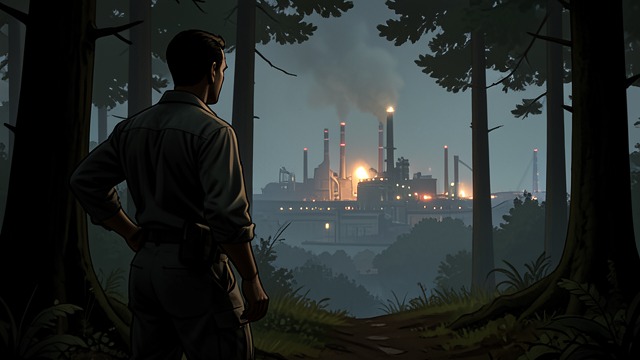
The Lights Beyond the Wood
A fragile privacy
After Connie leaves the hut, Mellors sees the industrial lights and hears the machinery surrounding the wood. His private encounter has revived desire, but it has also made him aware of what renewed attachment may cost.
He understands that the forest is not an isolated refuge. Industry reaches into its darkness through noise, roads, and the steady movement of labor.
Vulnerability becomes political
Mellors interprets the mechanical landscape as a threat to tenderness and natural life. His fear is not only for himself and Connie, but for the trees and other vulnerable forms of living presence.
The conflict moves from private caution toward a broader rejection of a social order that treats efficiency and money as more real than human contact.
Workers Without Fellowship
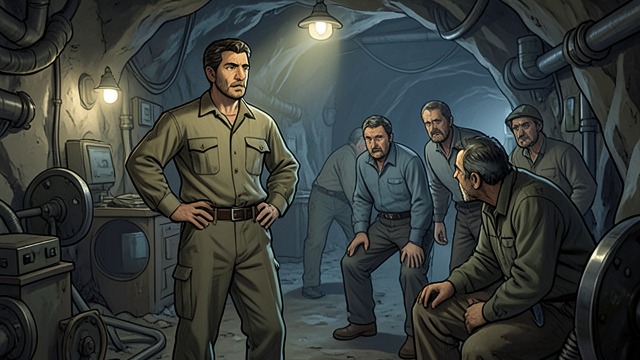
Workers Without Fellowship
Labor reshapes people
Mellors describes miners whose bodies have been altered by hard work and whose social prospects are narrowed by the industrial economy. He sees them as men damaged by the work that sustains the region.
His account is not a simple celebration of the working class. He recognizes that money, machinery, and exhaustion have also changed workers’ desires and habits.
An inadequate remedy
Mellors imagines a different life in which people could work less and find pleasure in movement, craft, and physical presence. His proposal is deliberately concrete, but it is not a practical political program.
The conflict lies between human flourishing and a system that makes earning and spending seem unavoidable. He cannot show how to remake society, but he refuses to accept industrial survival as the same thing as life.
A Future Under Threat
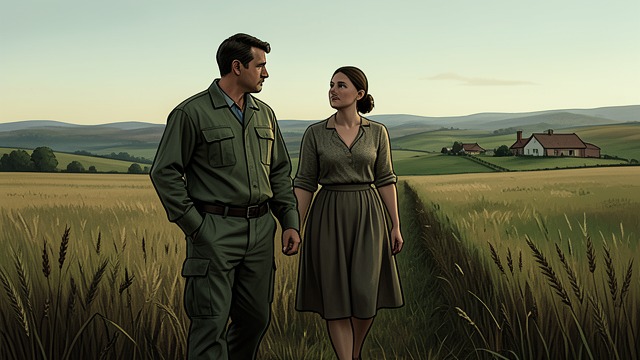
A Future Under Threat
Work and uncertainty
At Grange Farm, Mellors earns wages and learns agricultural tasks while waiting for legal freedom from Bertha. The work gives him a means of supporting himself, but it does not reassure him about the future.
His letter describes the mining population’s economic insecurity and the dependence on spending that industrial culture has encouraged. He sees no easy political solution in nationalization or technical innovation alone.
A small counterforce
Mellors places his hope in the bond with Connie and in the tenderness they have experienced. He calls their connection a small flame that must be protected through patience and separation.
The letter does not claim that love will remake society by itself. It offers intimate commitment as a fragile refusal of a world that threatens to extinguish whatever cannot be converted into money.
After Mellors’s first encounter with Connie
During Mellors’s conversations about the mining population
In Mellors’s final letter to Connie
