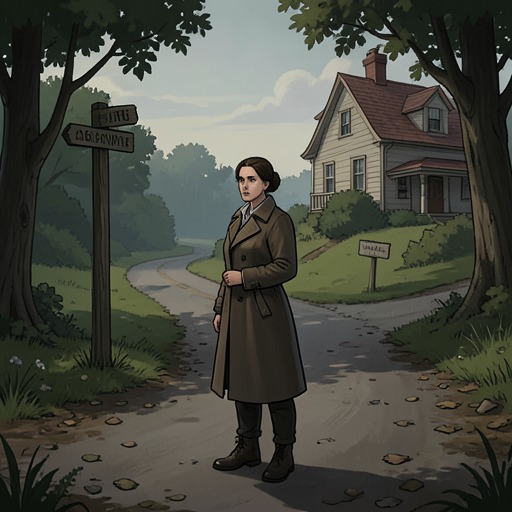
Connie Leaves Wragby for Venice
Lady Chatterley's LoverConnie Leaves Wragby for Venice begins as a carefully arranged journey and turns into a last-night negotiation. As Connie sets out from Wragby with her sister Hilda, she insists on seeing Oliver Mellors before leaving for Venice. Hilda reluctantly alters the plan to make their meeting possible, while Connie’s farewell to Clifford carries an intimacy that complicates the apparent finality of her departure. The scene makes separation a divided act: Connie leaves her husband’s home, but refuses to leave her lover without one more meeting.
Departure and the altered itinerary
Connie is permitted only a suitcase, although she has sent a trunk ahead to her father, who is traveling by train. A car would be useless for the journey to Venice, and Italy in July is too hot for motoring. Hilda takes charge of the practical arrangements, presenting the departure as a matter of luggage, transport, and timing. That orderly framework gives Connie’s request its force: she asks to remain near Wragby for the night, not to cancel the journey, but because she has promised to see someone who lives nearby.
Hilda first asks where Connie means to go. Connie says that Hilda knows she loves somebody; Hilda replies that she had gathered there was something. Connie then makes the urgency explicit: she must spend the final night with him or she cannot go to Venice at all. She is frightened at first, then insistent. The pressure is not a general reluctance to travel. It is attached to a specific promise and a specific person, and it forces Hilda to choose between the itinerary she has arranged and her sister’s demand.
Hilda gives way after recalling their father and judging concession the more diplomatic course. She proposes a tightly managed compromise: they will drive to Mansfield for dinner, take Connie back to the lane-end after dark, and return for her the next morning. Hilda will sleep in Mansfield, which is only half an hour away by a good route. Agreement does not mean approval. She is furious and stores the obstruction against Connie, so the practical help remains shadowed by resentment. Connie’s emerald-green shawl, flung over the windowsill, marks the interruption in the arrangements with a small, conspicuous gesture.
Farewells at Wragby
The altered plan affects how the people at Wragby regard one another. Hilda’s anger makes her warm to Clifford: she thinks that he has a mind and regards his functional sexual incapacity as one less source of quarrels. Her judgment is pointedly shaped by her dislike of what she considers the selfishness and unpleasantness of men in sexual relationships. Clifford, in turn, decides that Hilda is intelligent and could make an excellent political helpmeet. By comparison, he regards Connie as childish and unreliable. Their mutual approval is not a reconciliation between the sisters; it grows out of their shared, if differently motivated, frustration with Connie.
The next morning, doors stand open in the hall to admit the sun, and everyone seems to be panting a little. The brief goodbyes expose the unevenness of the parting. Clifford asks Connie to return safely; she answers that she will not be long and is almost tender. He asks Hilda to keep an eye on her, and Hilda promises to keep two. Her assurance sounds protective, but the previous night has shown how much anger lies beneath her supervision.
When the car leaves, everyone waves. Connie looks back and sees Clifford seated at the top of the steps in his house-chair. The sight does not erase their marriage: she recognizes that he is her husband and Wragby her home, while also measuring those facts against the circumstances that have shaped her life there. Her departure is therefore neither a simple rejection of the household nor a return to settled loyalty. The farewell holds attachment and constraint together, even as the car carries her away.
The road, Mansfield, and the disclosed name
Mrs. Chambers holds the gate and wishes Connie a happy holiday. The car passes out of the dark spinney that screens the park and reaches the high road, where colliers are walking home. Hilda turns onto Crosshill Road, a route running toward Mansfield rather than a main road. They travel beside a railway cutting, cross it by a bridge, and pass the lane leading to the cottage. Connie recognizes the turn; Hilda, impatient with the detour, remarks that they might otherwise have reached Pall Mall by nine. Connie apologizes for spoiling her sister’s plans, but does not withdraw her request.
In Mansfield, a town the narration contrasts with its once-romantic past by describing it as utterly disheartening, Hilda stops at the hotel listed in the motor-car book and takes a room. She remains too angry to talk much, but Connie has to tell her something about the man’s history. Hilda presses the question of his name because Connie has referred to him only as he. Connie explains that neither of them has ever used a name for the other. They have, instead, the playful names Lady Jane and John Thomas; his actual name is Oliver Mellors. The disclosure gives Hilda the identity that Connie’s insistence had so far withheld and makes the promised meeting concrete.
Significance of the parting
The journey’s central turn is the collision between a public itinerary and a private obligation. Venice remains the destination, and the preparations continue, but Connie makes her ability to leave depend on seeing Mellors first. Hilda’s compromise enables the meeting while preserving her own anger; Clifford’s farewell recognizes the marriage and home Connie is leaving without resolving the conditions that have made departure necessary. The scene thus makes the road away from Wragby run, briefly, back toward the cottage. Its final emphasis is not on travel as escape alone, but on the relationship Connie cannot yet leave unnamed or unattended.