Connie’s first encounter with Oliver Mellors
Lady Chatterley's LoverConnie Chatterley’s first encounter with Oliver Mellors is a brief park-side meeting that turns an ordinary walk into an encounter with an unsettlingly independent presence. First seen with a gun and a spaniel, the new gamekeeper startles Connie; then, as he helps Clifford Chatterley with the chair, his reserved manner and soldierly bearing complicate the role of servant. The scene leaves Connie noticing both his detachment and a warmth she cannot readily explain.
An Unexpected Appearance
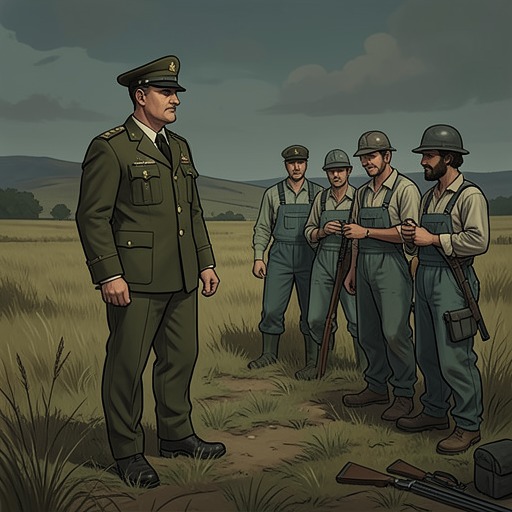
Connie is watching a brown spaniel that has run out of a side-path, its nose lifted toward her and Clifford as it gives a soft, fluffy bark. A man carrying a gun strides swiftly and softly after it, facing them in a way that makes Connie feel he might attack. He stops instead, salutes, and turns downhill. The reversal is immediate: he has seemed to emerge as a threat, but proves to be the new gamekeeper.
His clothes and appearance make him conspicuous. He wears dark green velveteens and gaiters, an old-fashioned style, and has a red face, a red moustache, and distant eyes. He is already moving quickly downhill when Clifford calls him by name. Mellors turns lightly and salutes with a quick gesture that marks him, in Connie’s perception, as a soldier. The scene thus gives him two distinct first appearances: the alarming, armed figure coming out of the path, and the disciplined man who responds to Clifford’s call.
Introduction and First Impressions
Clifford asks Mellors to turn the chair around and get it started. Mellors slings his gun over his shoulder and comes forward with the same swift yet soft movements Connie has noticed before. Moderately tall and lean, he is silent, and at first he looks not at her but at the chair. Clifford formally introduces him as the new gamekeeper and asks whether he has spoken to Connie. Mellors replies with ready neutrality that he has not.
When Mellors lifts his hat, Connie sees his thick, almost fair hair. He looks straight into her eyes with a fearless, impersonal gaze, as if he wants to see what she is like. That direct attention makes her shy; she bends her head, and he transfers his hat to his left hand and gives her a slight bow like a gentleman. He still says nothing. The encounter balances distance with courtesy: his gaze is searching, but his manners are controlled, and Connie’s response is a shy acknowledgment rather than conversation.
Connie asks how long he has been there. Mellors answers that it has been eight months, then calmly corrects his form of address from “Madam” to “your Ladyship.” The correction makes the social difference audible within the meeting itself. He recognizes the title and adjusts his words, yet the scene has already presented him as more than a deferential employee: his soldierly salute, self-contained manner, and gentlemanly bow sit alongside his service to the household.
The Chair and the Walk
Clifford starts the chair’s small engine, and Mellors carefully turns it so that it faces the incline curving toward the dark hazel thicket. When Clifford asks whether that is all, Mellors explains that the chair should be accompanied in case it sticks because the engine is not strong enough for the uphill work. He glances around for his dog; the spaniel looks back and faintly moves its tail. For a moment, a small smile, teasing or mocking yet gentle, enters Mellors’s eyes, then disappears, leaving his face expressionless.
As the chair moves down the slope, Mellors keeps one hand on its rail to steady it. Connie reads his bearing as that of a free soldier rather than a servant, and something about him reminds her of Tommy Dukes. That comparison belongs to her first impression, not to any explanation Mellors offers: the narrative makes his composed, independent appearance the point of contrast with the practical assistance he is giving Clifford. He is physically beside the chair, performing a task, but his manner does not seem wholly absorbed into that role.
The Gate and the Unanswered Question
At the hazel grove, Connie suddenly runs ahead and opens the gate into the park. As the chair passes, Clifford looks at her critically; Mellors regards her with cool wonder, impersonal but intent on seeing what she looks like. In his blue eyes she detects suffering and detachment, together with a certain warmth. Her perception does not resolve into a confident judgment: she is left wondering why he seems aloof and apart.
Once they are through the gate, Clifford stops the chair and Mellors comes quickly and courteously to close it. Clifford then asks Connie why she ran to open the gate, noting in a quiet, calm voice that Mellors would have done it. His displeasure gives the small action a social edge: Connie has taken up a task available to the gamekeeper, while Clifford treats that choice as something to question. The meeting ends with Mellors performing the service expected of him and Connie’s attention fixed on the difference between that position and the more elusive person she has just encountered.
Significance of the Encounter
The scene introduces Mellors through movement, manners, and Connie’s uncertain reading of his face rather than through an account of his past. The gun and sudden approach make him momentarily seem threatening; the salute, bow, steadying hand, and careful closing of the gate show discipline and courtesy. Yet neither obedience nor politeness fully defines him. Connie sees detachment without coldness, and a warmth that appears only briefly. That unresolved contrast is the encounter’s decisive effect: the new gamekeeper becomes, in her first impression, a man who serves the household while seeming inwardly separate from it.