Hilda’s Intervention in Connie’s Decline
Lady Chatterley's LoverHilda’s intervention begins when Connie Chatterley can no longer dismiss her decline as ordinary boredom or fatigue. She has grown thinner, feels trapped in the repetitive talk and days at Wragby Hall, and is haunted by the white tombstones on the hillside beneath Tevershall Church. Her appeal to her sister turns private distress into action: Hilda comes from Scotland, takes Connie to London for an examination, and helps secure a nurse for Clifford Chatterley. The arrangement addresses Connie’s immediate need for relief, but it also alters the intimate and social boundaries inside the household.
Connie’s decline and appeal for help
Connie’s distress has accumulated gradually. After the visitors leave, the days seem to grind by without anything happening; irritation has taken hold of her body, and she continues to lose weight. The housekeeper notices, as does Tommy Dukes, although Connie insists that she is all right. Her fear of the marble tombstones above Tevershall gives that exhaustion a stark image: from the park she sees them as a false-toothed, ghastly host, and imagines her own burial among them in the polluted Midlands. The vision makes her anxiety about her surroundings feel inseparable from anxiety about her own future.
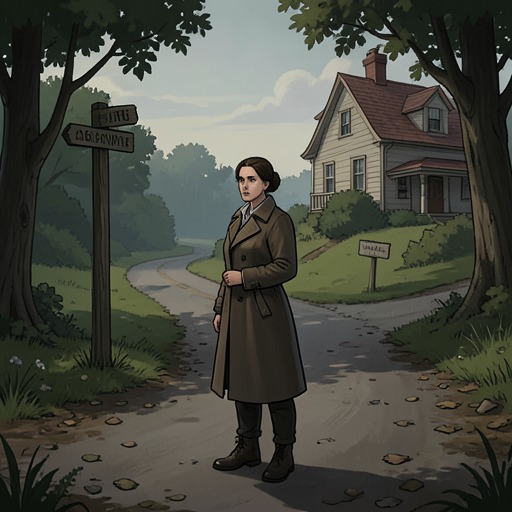
Connie recognizes that she needs help but does not know how to explain what is wrong. She writes to Hilda that she has not been well lately and cannot identify the cause. Hilda responds by coming alone from Scotland in March, driving a small two-seater up the Wragby Hall drive and around the grass in front of the house. Connie runs out to meet her, and Hilda’s immediate question about what is the matter gives the unspoken decline a witness. The episode begins not with a diagnosis but with Connie’s admission that she cannot manage the condition by herself.
Examination and the return to Wragby
The sisters travel to London together, with Hilda driving. At the Kensington house, where Sir Malcolm is away, a doctor examines Connie carefully and asks about her life. He finds nothing organically wrong, but judges her vitality to be dangerously low: he describes her as having no reserves, warns that her heart’s nerves are already unsettled, and insists that she needs to be properly amused and taken away from the life she is leading. In his assessment, the problem is not a disease he can locate in an organ, but a depletion that cannot safely continue without change.
For Connie, however, leaving Clifford at once feels impossible. At the thought of abandoning him, her heart seems to stop; she cannot bring herself to do it and returns to Wragby. Hilda takes the doctor’s warning more decisively. Back in the Midlands, she speaks to Clifford, who is still overwrought and has yellow eyes. He must listen to the doctor’s advice as relayed by Hilda, though not to Michaelis’s. Hilda makes clear that Connie must go, invoking their mother’s death from cancer brought on by fretting and saying that they will take no risks. Her firmness converts medical concern into a practical demand on the household.
Finding care for Clifford
Clifford has spent long enough with nurses to resent their presence and their intrusion on his privacy. He cannot bear the prospect of a man-servant hovering around him, yet he also resists being treated as an invalid. When Hilda proposes a suitable male attendant, Clifford refuses the idea and asks whether Connie will go instead. The exchange exposes the bind at the center of the arrangement: Connie’s health requires distance from constant care, while Clifford is reluctant to accept that care from someone else.
The solution is Mrs Bolton, the Tevershall parish nurse, who is preparing to leave parish work for private nursing. Clifford fears surrendering himself to a stranger, but Mrs Bolton has nursed him through scarlet fever, so he knows her. Hilda and Connie visit her in her neat, crowded sitting-room in a relatively select row of Tevershall houses. Mrs Bolton is attentive and confident, a former nurse accustomed to directing the care of sick miners; she agrees to come as soon as Dr Shardlow can release her. Hilda then contacts the doctor, and the following Sunday Mrs Bolton arrives at Wragby in Leiver’s cab with two trunks. She is forty-seven, though her flushed animation makes her seem younger.
Her history gives the appointment a significance beyond the transfer of domestic tasks. Her husband, Ted Bolton, was killed in a pit explosion twenty-two years earlier, when he was twenty-eight. At the inquiry, the employers’ side attributed his death to his supposed failure to obey orders, and the family received only three hundred pounds, treated as though it were a gift rather than compensation. Mrs Bolton had wanted the money paid at once so she could open a shop, but was required to draw it in weekly installments of thirty shillings, waiting at the offices every Monday for almost four years. She enters Wragby not simply as a trained professional but as a working-class widow whose life has been shaped by the same mining world on which the household’s status rests.
Care, distance, and a changed household
Mrs Bolton soon takes over Clifford’s physical care. She helps him to bed and sleeps across the passage, coming when he rings during the night; in the morning she assists him again and gradually takes over his grooming, even shaving him. Her manner is soft and tentative, but she is competent, and she learns how to manage him. Handling his chin and bristles makes him seem less different from the miners she has nursed, even as the distance between his rank and hers remains part of her new experience. Clifford dislikes the loss of Connie’s personal care and privately regards it as the destruction of the intimate bond between them. Connie, by contrast, sees that bond as an attachment parasitic on her own life, not as a precious intimacy she wants restored.
With Mrs Bolton responsible for Clifford, Connie can play the piano and sing alone in her room. She arranges for Mrs Bolton to interrupt the old evenings of conversation and reading aloud at ten, so she can go upstairs. Clifford’s ceaseless talk, once something Connie had loved, has become an exhausting demand from which she is grateful to be released. The practical change in care thus becomes a change in the couple’s daily relationship: Clifford continues to want their former closeness, while Connie uses the new arrangement to recover solitude.
Mrs Bolton’s presence also shifts the social geography of Wragby. She eats with the housekeeper, and the servants’ rooms seem to draw nearer to Clifford’s study; Connie hears the women speaking together and feels the working people’s presence pressing into the previously secluded rooms. The nurse’s arrival does not merely replace Connie at Clifford’s bedside. It brings a voice and experience from Tevershall into the household and changes the atmosphere of the rooms where the couple had been alone.
Consequence for Connie
The immediate result is not that Connie’s difficulties vanish, but that she feels released. She describes herself as breathing differently, while still fearing that some of her roots, perhaps mortal ones, remain entangled with Clifford. The qualification matters: Hilda’s intervention has not settled every attachment or solved the larger conflict, but it has made room for Connie to feel that another phase of life can begin.
The event’s decisive shift is from unrecognized, privately endured depletion to acknowledged need and delegated care. Hilda listens, seeks medical advice, challenges Clifford’s reluctance, and helps make an alternative arrangement possible. Mrs Bolton’s nursing gives Clifford practical support while allowing Connie time alone; its consequences reach beyond medical management to the marriage’s intimacy and Wragby’s class boundaries. Connie’s first relief is modest and embodied—the sense that she can breathe more freely—but it marks a real change in the conditions under which she must live.