Industrial decline in the Midlands
Lady Chatterley's LoverIndustrial decline in the Midlands is both an economic crisis and an encroaching presence in the novel: it blackens the country around Wragby Hall, unsettles the authority of its landowning class, and narrows the prospects of the mining population. Tevershall’s failing collieries stand at the center of this decline, while mechanization and new attempts to convert coal into more valuable products promise adaptation without resolving the human costs of industrial dependence.
Landscape and Industrial Encroachment
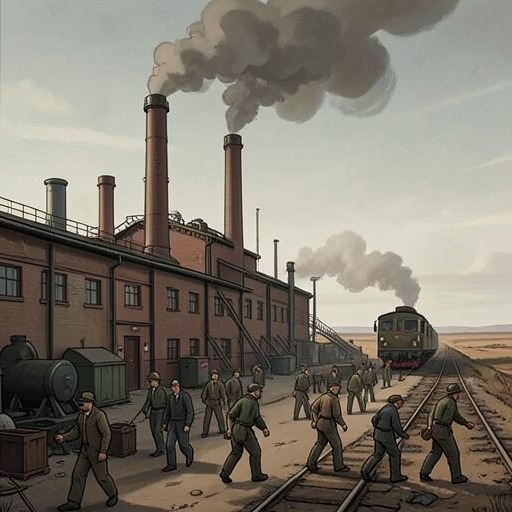
When Connie Chatterley and Clifford Chatterley return to Wragby in the autumn of 1920, the estate occupies an old park above Tevershall, but its apparent separation from the village is compromised by the nearby mine and its smoke. Tevershall stretches close to the park gates in rows of small, grimy brick houses. From Wragby’s rooms, the sounds of the colliery—screens rattling, the winding engine puffing, trucks clinking, and locomotives whistling—make industrial activity a constant presence in domestic life.
The damage is not confined to the view or the noise. The Tevershall pit-bank has been burning for years, and extinguishing it would cost thousands. Its sulphurous smell enters the house when the wind blows in the wrong direction; even when it does not, the air carries traces of what lies underground. Smuts settle on the Christmas roses. At night, the furnaces stain the low clouds with red, quivering patches. Connie first experiences the scene with horrified fascination, then becomes accustomed to it: the gradual pollution is absorbed into the ordinary conditions of living rather than resolved.
The wood offers a contrasting landscape, but not an untouched one. Its riding is a private route through a remnant of the great forest, and the path has been gravelled with sifted material from the pit-bank. The refuse of coal production becomes a bright pink surface beneath the walkers’ feet. Nature and industry therefore meet within the estate itself: the park and wood preserve older forms of landscape, while mine waste, ownership, and industrial pollution shape how those places are seen and used.
The Collieries in Decline
The mining district’s downturn is described as an uneven but accelerating loss of economic strength. Tevershall and New London are the two collieries in the area. Tevershall was once famous and highly profitable, but its best years are over; New London was never particularly rich and is especially vulnerable in bad times. The account of the pits makes clear that decline is not an abstract forecast: miners have already left for work at Stacks Gate and Whiteover, where newer industrial works offer better prospects.
Stacks Gate represents a changed model of production. Its large chemical works at the pit-head do not resemble a conventional colliery, and the chemical by-products are said to earn more than the coal itself. Tevershall, by contrast, is said to be nearing closure, with New London expected to go first. The local fear is that the disappearance of the pit would feel like the end of a world built around its daily activity. Other closures intensify that expectation: New England and Colwick Wood have shut, leaving deserted pit-heads, overgrown ground, and rusting lines as visible evidence of what may happen next.
The decline also exposes the limits of confidence in the industry’s permanence. Older residents remember when a job at Tevershall was considered fortunate and the mine seemed certain to continue indefinitely. Now miners describe it as a sinking enterprise and consider leaving, even as some resist the deep workings and machinery of newer mines. The contrast between remembered prosperity and present uncertainty gives industrial change a generational scale: what once seemed the stable basis of community life has become an uncertain employer that may disappear within a few years.
Mechanization and Clifford’s Industrial Ambition
Mrs Bolton’s account of the mines helps redirect Clifford’s attention toward industrial management. Under her influence he begins to feel that he belongs to the mining world and has authority in Tevershall. The novel distinguishes this renewed outward effectiveness from his earlier pursuit of literary fame: success in writing had served a public seeking entertainment, while the industrial economy depended on the harsher business of supplying work and making money. Clifford becomes interested in entering that second struggle, though his sense of power is also a sense of control over the managers, engineers, and hundreds of colliers beneath him.
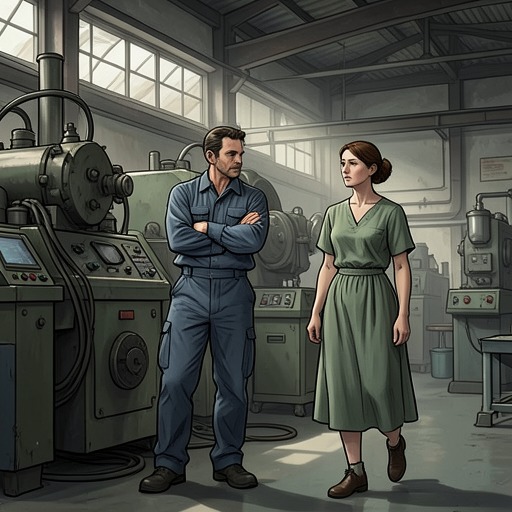
He returns to the mine and is carried down in a tub into the workings, where the underground manager shows him a coal seam by torchlight. He resumes technical reading, studies government reports, and follows research on mining and the chemistry of coal and shale. His attention shifts from literature to the technical possibilities of production. He first considers converting coal into electricity, then turns toward a concentrated fuel that burns slowly at intense heat and might supply a new kind of locomotive. He begins experimenting and recruits a gifted young chemist to assist him.
The industrial project gives Clifford a renewed sense of purpose, but the evidence establishes an ambition and a program of study, not a successful outcome. His practical attention focuses on extracting more use from coal and pulling Tevershall out of difficulty. That effort reflects the district’s predicament: survival appears to depend on adapting production, yet the adaptation itself means more machinery and a reorganization of work. The proposed solution can promise continuity for the industry without answering what place its workers will have in the new system.
Workers, Wages, and Industrial Dependence
Mechanization is described in terms of both efficiency and displacement. The newer machines that hew coal are called iron men, and some miners fear them because machinery is taking over work that men once performed. The change is also defended as economically efficient: what is lost as waste may be saved in wages. That calculation makes the conflict concrete. Industrial modernization is not simply a change of equipment; it alters the value assigned to labor and makes workers’ livelihoods vulnerable to decisions about cost and production.
Mellors’s later account of the district describes an industry operating far below full capacity. The pits work only two or two and a half days a week, and there is no sign of improvement for the winter. A man may have to support a family on twenty-five or thirty shillings. The miners he speaks with discuss nationalization and new uses for coal, but these proposals do not dispel their apathy or their sense that the whole system is failing. He doubts that changing ownership of coal alone could solve the problem while the wider industries and the need to sell what is produced remain unchanged.
The workers’ insecurity extends beyond the mine gate. Young people become angry because they lack money to spend, while household life is organized around earning and spending. Mellors sees this dependence as a weakness of the wider civilization: when money runs out, the habits built around consumption leave people with few alternatives. His observations do not offer a practical industrial policy; they register how deeply economic decline reaches into everyday expectations and the ability to imagine a life beyond wages and purchases.
Class, Power, and the Meaning of Decline
The novel places industrial decline inside an unequal structure of responsibility and control. Clifford argues that strikes can be made nearly impossible if the industry is properly managed. When Connie points out that people work in his coal mine, he answers that no man is forced to work for him. Their exchange sets an assertion of individual choice against the material dependence described elsewhere: workers face short weeks, low pay, departing colleagues, and the possible closure of the pits. The claim that employment is voluntary does not remove the economic constraints shaping the choices available to the mining community.
Clifford’s growing authority also reveals the distinction between managing an industry and sharing the conditions of those who depend on it. His descent into the mine and his questioning of its managers give him new command over production, while the miners’ future remains insecure. His experiments seek to preserve or expand the industrial enterprise, but the narrative’s accounts of mechanization and underemployment keep the workers’ costs in view. The drive to make the collieries more productive is not identical to making their communities secure.
Industrial decline thus works through both sudden signs of closure and slow, persistent pressures: smoke and sulphur in the air, burning waste, machines replacing labor, fewer working days, and the loss of confidence in a once dependable occupation. Around Wragby, the mining economy is at once the source of the estate’s environmental contamination and the basis of livelihoods beyond its gates. Its crisis unsettles the boundary between the landowning household and the industrial population, exposing how closely both are tied to a system whose survival is pursued through further extraction, technical change, and control over work.