Industrialism and the dehumanization of labor
Lady Chatterley's LoverIndustrialism and the dehumanization of labor is presented not as an abstract creed but as a force that reshapes the ground people live on, the work they must do, and the ways they understand one another. Around Wragby Hall, coal production brings smoke, noise, and persistent pollution into both the estate and the neighboring village. In the mines, mechanization and commercial pressure threaten employment while strengthening managerial control. Against this material order, Connie Chatterley and Oliver Mellors question whether a society organized around production and money can preserve human feeling, bodily vitality, or fellowship.
Landscape and Industrial Intrusion
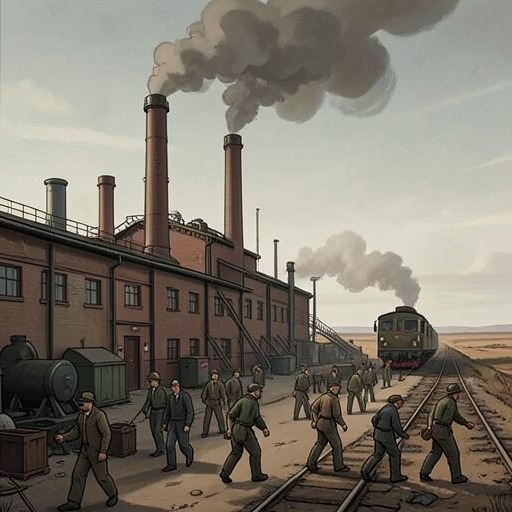
Wragby Hall stands in an old park, but its elevated position cannot shield it from the nearby Tevershall pit and village. The mining landscape is visible and audible from the estate: steam and smoke rise from the pit, machinery rattles, and colliery engines whistle. The Tevershall pit-bank has burned for years, and putting out the fire would cost thousands. When the wind carries its fumes toward the house, the air smells of sulfur and other substances associated with what lies underground. Even the Christmas roses gather smuts. The pollution is therefore not a single dramatic disaster but a continuing condition woven into ordinary days and seasons.
The village makes that environmental burden inseparable from class. Tevershall stretches close to the park gates in long rows of small, grimy brick houses. Connie first registers the coal-and-iron landscape as almost impossible to accept, then finds herself becoming accustomed to it. That adjustment does not make the damage disappear: it marks how an ongoing injury can become part of the expected surroundings. The estate and village occupy neighboring ground, but their proximity does not mean they share the costs or benefits of industrial wealth equally.
The wood offers no complete refuge. It is a remnant of an older forest, and its riding once crossed the country; now it passes through private woodland. During the war, Sir Geoffrey Chatterley had trees cut there for trench timber. The resulting bare knoll opens a view toward the colliery railway and the new works at Stacks Gate, making industrial expansion visible through a breach in the trees. Clifford Chatterley resents the cleared hill and has it replanted, yet the wood’s seclusion is also broken by the sounds and lights of nearby industry. Nature has narrative weight in its own right, but it remains exposed to property decisions, extraction, and the infrastructure that connects the mine to production.
Colliery Decline and Mechanized Work
The local mining economy is not depicted as uniformly prosperous. Tevershall was once a celebrated and profitable pit, but its best years have passed. The other local colliery is also vulnerable as trade worsens. Meanwhile, workers leave Tevershall for Stacks Gate and Whiteover, where new facilities and better prospects attract them. Stacks Gate’s chemical works represent a changed industrial model: chemical by-products are said to yield more than coal, and the works do not even resemble a conventional colliery. The uneven fortunes of nearby pits show that industrial change does not simply replace old work with secure new employment; it redistributes opportunity and threatens places that cannot compete.
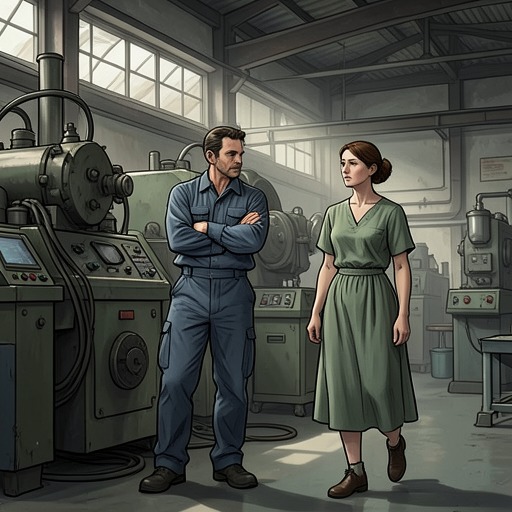
Mechanization sharpens that insecurity. Workers fear the deep mines and the machines that cut coal where men once did the work themselves. The machinery is described as wasteful in one sense, but the money saved on wages can outweigh what is lost in material. This calculation makes labor’s expendability explicit: efficiency is measured not only by what a machine produces but by how much human work it can remove. The story compares this transition with the earlier displacement of workers who used stocking frames, while Mrs Bolton’s account of abandoned collieries gives the change a visible aftermath. At New England and Colwick Wood, disused pitheads, encroaching bushes, and rusting lines make industrial closure resemble a death in the landscape.
Clifford Chatterley and Industrial Power
Under Mrs Bolton’s influence, Clifford Chatterley turns back toward the mines and discovers a new sense of belonging and authority. He visits the workings in a tub, where the underground manager shows him a seam by torchlight. Knowledge he had seemed to lose returns, and he resumes studying technical works, government reports, and research on coal and shale. He becomes absorbed by the ingenuity of industrial science, even as he recognizes a sharp disparity between technical sophistication and emotional or human understanding.
Clifford’s return to the pit changes his relation to power. He visits repeatedly, questions senior managers and engineers, and takes hold of decisions affecting hundreds of colliers. His renewed energy comes from the feeling that he can direct the enterprise and pull Tevershall out of decline. The narrative sets this revival against his earlier isolated life as an artist and a self-conscious observer: industrial work makes him outwardly effective, but the power he experiences is managerial power over other people and their labor. His plans include preventing strikes through proper management, which presents industrial conflict as something authority can eliminate through control rather than as a dispute rooted in workers’ conditions or interests.
Connie’s Challenge to Ownership and Responsibility
Connie challenges the assumption that an owner’s responsibility is fulfilled by the existence of employment or services. When Clifford presents the contributions of estates such as Wragby Hall and Shipley Hall as benefits given to colliers, she objects that these benefits are now sold for profit. Her criticism joins social dependence to the industrial damage imposed on workers: the owners profit from the mine, while the people who work within its system live lives shaped by it. Clifford answers that no one is forced to work for him, but Connie insists that the life of the coal mine has become the workers’ life. The exchange exposes the limits of treating formal choice as proof that working people are free of economic constraint.
Her view of industrialization also extends beyond employment. During a journey through Tevershall, she sees blackened housing, smoke in the rain, and settlements spreading through the country. She understands the industrial population as deprived of spontaneous, intuitive life and fears that no fellowship can survive such a transformation. At the same time, the old landed order is not offered as an uncomplicated alternative. The novel describes Georgian halls being abandoned or demolished as their upkeep becomes too expensive and the surrounding country less congenial to their owners. Fritchley is pulled down despite being in good repair; the mines that once enriched the halls now belong to a system that displaces both old houses and older forms of settlement. The transition is figured as one England blotting out another, with historical continuity becoming mechanical rather than organic.
Mellors’s Alternative and the Concept’s Significance
Oliver Mellors’s critique gives the social diagnosis a tentative practical counterpart. He imagines persuading miners not to organize their lives around accumulating money and proposes reducing industrial life gradually rather than relying on denunciation alone. In his account, work has damaged people physically and spiritually; he imagines a different form of public life in which human movement, appearance, and vitality matter. His proposals include rebuilding Tevershall with beautiful buildings, cleaning the countryside, and limiting the number of children. These remain proposals voiced in conversation, not reforms carried out in the story. Their importance lies in making a different measure of value imaginable: not output or wages alone, but the possibility of living well.
Mellors’s hopes are shadowed by his conviction that the industrial system is deeply difficult to escape. He sees money and mechanization as forces that make people less responsive to human feeling, and his account of machines and industrial work culminates in a wish to end the industrial epoch altogether. Yet he also doubts that anyone can accomplish such a wholesale reversal and retreats toward the possibility of living his own life. This tension prevents his critique from becoming a simple program for change. It links the system’s scale to the vulnerability of individual attempts at resistance.
Across these strands, industrialism dehumanizes labor by treating workers as replaceable inputs, while also deforming the places and relationships organized around production. Its environmental costs accumulate in smoke, burning waste, damaged woodland, and settlements built under industrial pressure; its economic costs appear in insecure employment and declining pits; its social costs emerge in the conflict between ownership and dependence. The novel’s recurring contrast between machinery’s technical power and human beings’ diminished lives makes the central problem one of value: an industrial order can become more efficient and more powerful while leaving less room for bodily vitality, mutual responsibility, and fellowship.