Industrialization of the English Midlands
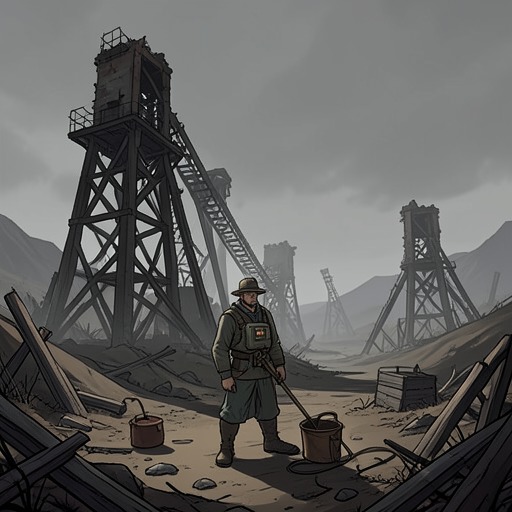
Lady Chatterley's LoverIndustrialization of the English Midlands reshapes the world around Wragby through smoke, machinery, changing mines, and settlements built for industrial work. It is not merely a backdrop: it alters the air Connie Chatterley breathes, the future of the local workforce, the fortunes of landed families, and Clifford Chatterley’s sense of power. The countryside’s older forms persist, but increasingly as fragments surrounded or overtaken by industrial production.
Setting and Material Conditions
When Connie Chatterley and Clifford Chatterley return to Wragby Hall in autumn 1920, the old brown-stone house stands in an oak park, yet the Tevershall pit and village are close by. The village stretches from the park gates in rows of small, grimy brick houses, while the colliery’s steam and smoke rise into the view. The contrast between the estate and the settlement is immediate: the house occupies an eminence, but it cannot place itself beyond the industrial landscape.
Mining enters the household through sound and smell as much as through sight. From Wragby, Connie hears screening machinery, the winding engine, shunting trucks, and colliery locomotives. The Tevershall pit-bank has burned for years, and extinguishing it would cost thousands, so it is left to burn. When the wind carries its fumes toward the house, the air reeks of sulphurous combustion; even when it does not, the air bears the smell of sulphur, iron, coal, or acid. Smuts settle on the Christmas roses. At night, furnaces redden the low clouds. Connie initially experiences this industrial presence with horror, then becomes accustomed to it—a change that registers not the removal of the damage but its normalization.
The wood offers a different kind of landscape, but not an untouched one. Its riding passes through a remnant of the forest associated with Robin Hood and is now a private way through Clifford’s property. A knoll cut for trench timber during the war has been left bare, with sawn stumps and burned brushwood; from its crown, the colliery railway and the new works at Stacks Gate are visible. Connie recognizes this opening in the trees as a breach in the wood’s seclusion. Clifford is having the hill replanted and resents the damage, but the industrial view beyond it remains. Later, at night, the lights and engines at Stacks Gate reach even the wood. The apparent refuge is acoustically and visually joined to the working industrial world.
A New Industrial Landscape
Connie’s journey through the district makes industrial change legible as a succession of landscapes. At Stacks Gate, a conspicuous new hotel stands apart from rows of modern dwellings laid out with spaces and gardens. Beyond them rise the immense overhead structures of a mine and chemical works, including long galleries and installations whose forms seem unprecedented. The mine’s own head-stock and pit-bank appear small beside the larger industrial complex. The new settlement seems organized around the works: production dominates, while the hotel and model dwellings complete its visible surroundings.
This new industrial center has displaced an older Stacks Gate nearby. The older colliery and its blackened brick homes, chapel, shops, and pubs remain, but no longer define the place in the same way. The modern works, with their smoke and vapor, have become the district’s dominant image. New housing has filled with people arriving from elsewhere; Connie’s account also associates some newcomers with poaching Clifford’s rabbits. Industrial expansion thus brings new settlement as well as new production, without erasing older local forms so much as subordinating them.
Further on, the industrial town of Uthwaite gathers railway lines, coal mines, steelworks, foundries, and heavy road traffic in its valley. Lorries loaded with iron shake the old church, while whistles and clanking machinery overwhelm the soundscape. Yet older streets survive behind the church, and the town’s market-town history remains visible beside the works. Across the wider country, old halls stand above industrial settlements, while mining cottages and newer workers’ houses spread along roads and slopes. Connie sees not a clean replacement of one landscape by another but layers of old and new, with the older countryside increasingly reduced to remnants.
Mines, Work, and Economic Insecurity
The economic transformation is uneven. Tevershall was once a famous and profitable mine, but its best days are over; New London is described as less prosperous and vulnerable in a period of bad times. Workers leave for the newer works at Stacks Gate and Whiteover, where employment is said to be better. Mrs Bolton reports that the chemical by-products at Stacks Gate may bring in more money than coal, and that Tevershall may close within a few years. Her account is local testimony rather than a settled forecast, but it conveys the uncertainty surrounding the old colliery and the prospect of a community losing its principal source of work.
Mechanization sharpens that uncertainty. Mrs Bolton says that some miners dread the machines used to hew coal, calling them iron men, and object that the process is wasteful. The counterargument is that what is lost in material is saved in wages. Her recollection of older stocking frames places this fear within a longer history of machines replacing familiar forms of labor, even as she notes the apparent paradox that more machines may mean more people. The pressure is not confined to miners: she also describes girls leaving the district for work elsewhere and voices the hope that a renewed lease of life for Tevershall’s collieries might employ them. The industrial economy promises new methods and possible growth, but offers no assurance that work or prosperity will remain where they were.
The older landed order is also exposed to this change. Connie’s view of the region links the wealth of stately houses to the mines that once sustained them, even as mining now contributes to their decline. Some houses are abandoned or demolished because they are too large and expensive to maintain; the gentry move away from places where the means of their wealth are visible. In Connie’s formulation, industrial England blots out agricultural England, and one historical meaning displaces another without an organic continuity between them. The countryside is not simply modernized: its structures of wealth, habitation, and work are being rearranged.
Clifford Chatterley and Industrial Power
The declining mines draw Clifford Chatterley into a new sphere of activity. Under Mrs Bolton’s influence, he begins to feel that he belongs to the industrial world and that he is the real authority in Tevershall. He goes down into the mine in a tub, is carried into the workings, and studies the coal seam by powerful torchlight with the underground manager. Former knowledge returns; he then reads technical works, government reports, and German writing on mining and the chemistry of coal and shale. He questions managers and engineers and experiences the investigation as a new command over the operation and its many workers.
Clifford’s ambitions concern not only extracting coal but finding uses for it. He first considers converting it into electric power, then becomes interested in a concentrated fuel that burns slowly at intense heat under particular conditions. A new locomotive engine with a self-feeder, reported as a German invention, suggests a possible application. Clifford begins experimenting and recruits a gifted young chemist to help him. These efforts remain a developing project, not a completed solution to the mines’ difficulties. They nevertheless show how industrial survival is imagined through further industrial processes: coal must be converted, used, or sold in new ways if production is to continue.
For Clifford, this work brings a renewed sense of effectiveness and power; for the narrative, it ties personal recovery to industrial command. His attention turns toward production and technical ingenuity even as the surrounding evidence points to polluted air, threatened employment, and landscapes reorganized around machinery. The new industry can revive his sense of purpose, but that private gain does not resolve the costs borne by workers, older communities, or the natural spaces it penetrates. Industrialization of the English Midlands is therefore presented as both a source of material and managerial power and a destructive force that makes the old countryside, and any hoped-for seclusion within it, increasingly difficult to sustain.