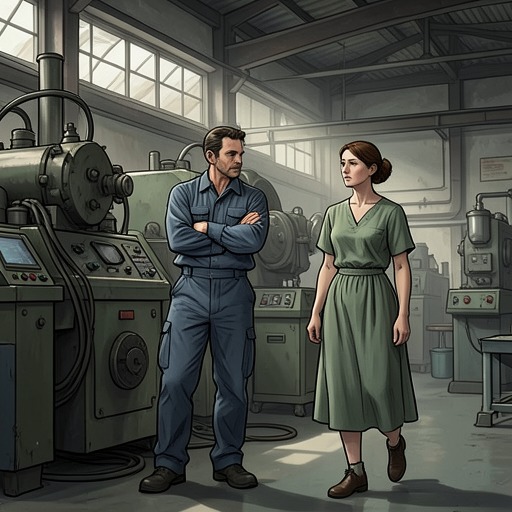
Mechanized greed
Lady Chatterley's LoverMechanized greed names a system in which industrial production pursues power and wealth while treating workers, communities, and the natural world as subordinate to its operations. The idea takes shape through the troubled mines around Tevershall and Clifford Chatterley’s effort to revive them: the same industrial activity that promises him command and renewal also makes labor precarious, blurs class distinctions into competition for money, and threatens the fragile refuge of the wood.
Economic Appetite and the Mines
The concept first becomes concrete in the fortunes of Tevershall and New London. Tevershall, once a celebrated and profitable mine, is running thin; New London, never especially rich, is more vulnerable still in hard times. Workers have left for Stacks Gate and Whiteover, where new chemical works and better houses offer prospects unavailable at home. The possibility that Tevershall will close is therefore not merely a change in ownership or output: it threatens the livelihood and continuity of a whole mining community.
The mine’s decline is bound up with changes in how coal is extracted and valued. Deeper workings and machinery displace older forms of labor, while the machines known locally as iron men provoke fear and criticism. The calculations favoring mechanization make waste acceptable when it reduces wage costs. At the same time, differences in coal mean Tevershall cannot simply imitate Stacks Gate’s more lucrative chemical production, though the works stand less than three miles apart. Industrial competition thus appears neither as a level field nor as straightforward progress: geological distinctions, investment, machinery, and employment determine which places prosper and which are left behind.
Two Economies of Success
Clifford’s developing interest in the mines reveals two connected arenas of success. His stories have brought him recognition among readers seeking entertainment, but the working population depends on a different kind of provision, tied to industrial production and material wealth. While Clifford has pursued literary attention, Tevershall has been deteriorating. The contrast makes cultural achievement and industrial power distinct forms of competition, but not separate worlds: each is drawn into an economy organized around winning favor and securing resources.
The novel figures this shared appetite through The bitch-goddess of Success, whose demands include both adulation and the material substance produced by industry. Writers and artists compete through amusement and acclaim; industrial operators compete through money-making production. The latter contest is less visible but more directly bound to the means of life. The image of rival groups of dogs distinguishes the showy struggle for recognition from the harsher struggle among those who supply wealth. Mechanized greed is therefore not simply personal avarice: it is a structure that rewards people for competing to feed different demands of success.
Clifford’s Turn to Industrial Power
Mrs Bolton’s account of the mines helps kindle Clifford’s renewed involvement. He begins to feel that he belongs to Tevershall and that he is its real authority. His attention turns away from the literary world and toward industrial production, even as he understands that his income is protected by his father’s trust and the pits do not determine his financial security. The mines become an arena in which he can pursue a more forceful kind of achievement.
Clifford returns underground in a tub, where the underground manager shows him a coal seam by powerful torchlight. He then studies technical works, government reports, and recent German writing on mining and the chemistry of coal and shale. The technical ingenuity impresses him; he is willing to set aside questions about the weakness of industrial leaders’ emotional and human understanding in order to concentrate on the machinery and methods themselves. Day after day he visits the pit, interrogates the managers and engineers, and experiences authority over them and the hundreds of colliers as a new form of power.
His proposed fuel project gives that ambition a specific direction. Clifford first considers converting coal into electricity, then becomes interested in a German locomotive with a self-feeder and a fuel that burns in small quantities at high heat. He begins experimenting with a concentrated fuel and recruits a gifted young chemist to assist him. The project lets him imagine that he has escaped the inward isolation associated with his earlier artistic life. Yet this personal sense of renewal is tied to intensified control over industrial processes and workers; the narrative presents technical accomplishment and human cost as sharply unequal measures of progress.
Labor, Management, and Social Division
The mines expose how industrial authority shapes the terms on which people live and work. Clifford claims that no man is forced to work for him, but Connie points out that the workers’ lives are organized around his coal mine and calls those lives industrialized and hopeless. Their disagreement sets formal choice against material dependence: the claim that employment is voluntary does not resolve the conditions created by a mining economy with limited alternatives and threatened closures.
Clifford’s return to the pit also makes management more immediate and personal. He puts the general, overhead, and underground managers, as well as the engineers, through demanding scrutiny, and feels himself gaining a grip on the operation. That command is part of the attraction of industrial work for him. For the colliers, however, machinery means uncertain employment and the possibility that their skills and labor will be made redundant. The novel places the manager’s exhilaration in power beside the workers’ vulnerability to the decisions and technologies governing production.
The Industrial Landscape and the Wood
Mechanized greed has a physical presence around Wragby and Tevershall. The pit-bank has burned for years, the air carries the smell of underground combustion, and smuts settle even on the Christmas roses. From the wood, the lights and engines of Stacks Gate, Tevershall, and the surrounding industrial country make solitude seem increasingly untenable; the mines work three shifts. The machinery is not confined to the workplace. Its noise and illumination reach into spaces that might otherwise offer privacy and retreat.
For Oliver Mellors, the wood’s seclusion is therefore fragile. He sees the industrial world as a force that threatens vulnerable life, imagining the wood’s destruction and the disappearance of its bluebells beneath the movement of iron. His apprehension connects environmental damage to the fate of tenderness: the system does not merely extract coal but presses against forms of life that do not conform to its demands. The image of mechanized greed culminates in this collision between the industrial landscape and the living wood. Clifford can experience the mine as a source of power and rebirth, while Mellors sees its lights, traffic, and engines as a menace to human intimacy and the natural world. The concept holds both perspectives in view without making their consequences equivalent: industrial achievement may promise command, but its costs fall across workers, communities, and environments that do not control its course.