Mellors's cottage
Lady Chatterley's LoverMellors's cottage is a small home at the edge of Wragby Wood whose ordinary domestic details make it a refuge for Connie Chatterley and Oliver Mellors. It is neither an idealized estate nor a world wholly apart: its clean rooms and warm fire offer shelter and intimacy, but Connie's longing to remain there is shadowed by the industrial world beyond it. The cottage's significance lies in that tension between a lived-in, private space and the larger world from which it cannot entirely be separated.
Setting and Approach
The cottage stands in sunlight just off the edge of Wragby Wood, with a small garden beside it. Double daffodils grow near the wide-open door, and red double daisies border the path. When Connie comes looking for Mellors, the keeper is not at the hut; she continues to the cottage, where the garden, the dog's bark, and Flossie's run toward her mark the transition from woodland to home.
The open door tells Connie that Mellors is there. Through the window she sees him at the table in his shirtsleeves, eating, before he rises and comes to meet her. The arrival is not staged as a formal visit: she asks to come in, he welcomes her, and she tells him to go on eating. The cottage is presented through this small sequence of seeing, entering, and sharing ordinary time. Its privacy is real, but it is not ceremonial or grand.
A Working Domestic Interior
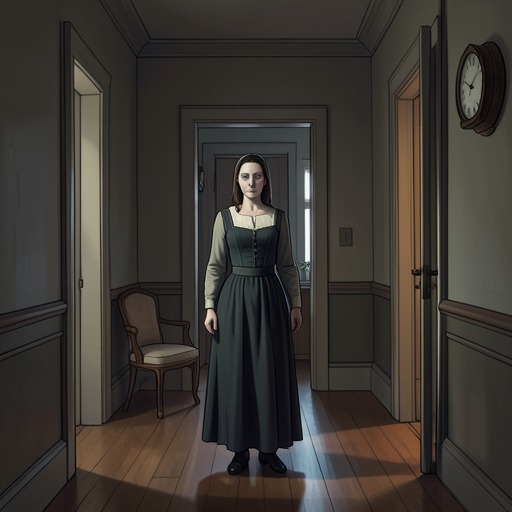
Inside, the room bears the evidence of a meal and a working household. The mutton chop has been cooked in a Dutch oven before the fire; the oven remains on the fender, beside a black potato saucepan on the white hearth. The fire is low and red, the bar is dropped, and the kettle sings. On the white oilcloth table are Mellors's plate, potatoes, the remains of the chop, bread in a basket, salt, and a blue mug of beer. These are not decorative tokens of country life but the immediate objects of a meal just eaten.
The cottage's furnishings are spare, and its comfort depends on use rather than display. The singing kettle and burning fire recur when Connie later enters with Mellors, after he has unlocked the door and bolted it behind them. She sits in a wooden armchair beside the fire, glad of its warmth after the chill outside. The same room can therefore be both an everyday home and a sheltered place apart: its warmth comes from the fire and the closed door, not from any suggestion that the outside world has disappeared.
Privacy, Intimacy, and the Night
The act of bolting the door sharpens the cottage's double meaning. Connie thinks of the closed house as if it were a prison, even as the fire, kettle, and cups on the table make it feel welcoming. That comparison keeps enclosure from becoming simple security. The cottage offers privacy for the pair, but its separation from ordinary life can also feel confining; the threshold protects their intimacy while reminding Connie that she has entered a space with limits.
The cottage also contains the couple's overnight closeness. After they have been together, they go to bed because the room is growing cold, and sleep enfolds them until sunrise. At about half-past five, Mellors wakes to the light and to blackbirds and thrushes calling in the wood. Connie remains curled asleep beside him before opening her eyes and smiling. The morning scene joins the small interior to the living woodland outside: the bedroom is private, but the birds and daylight make the new day present within it.
The Morning Room and Its Limits
The house's plainness becomes especially visible when Connie prepares to leave. The little bedroom contains only a small chest of drawers and a smallish bed, but the board floor is scrubbed clean. In a corner by the window gable, a shelf holds books, including works on Bolshevist Russia, travel, the atom and electron, the earth's core and earthquakes, novels, and India. The selection complicates the impression of a bare cottage: Mellors's home is modest, yet its few books reveal a range of reading rather than an absence of intellectual life.
From the gable window, sunlight falls on Connie, while she sees Flossie roaming outside and the hazel-brake misted with green. The scene places bodily warmth, a clean room, and the wood's renewed growth beside her thought of the other world of smoke and iron. She would be content with this little house, she imagines, if only it were in a world of its own; coming downstairs, she recognizes that she would accept its smallness if it could be set apart. The wish identifies the cottage as a refuge, but also defines what it cannot provide: a permanent escape from the wider world.
Narrative Significance
Mellors's cottage matters because its limited scale makes a different kind of life imaginable through concrete domestic acts. Connie finds him eating, enters a warm room, sits by the fire, notices the clean floor and books, and wakes beside him to the sounds of birds. The sequence makes intimacy continuous with meals, shelter, sleep, and morning rather than with display or grand surroundings. Yet the bolted door and Connie's wish for a world of their own prevent the cottage from becoming a complete solution. It is a real home in the wood and, for Connie, an image of the life she wants; the smoke and iron remain beyond its threshold.