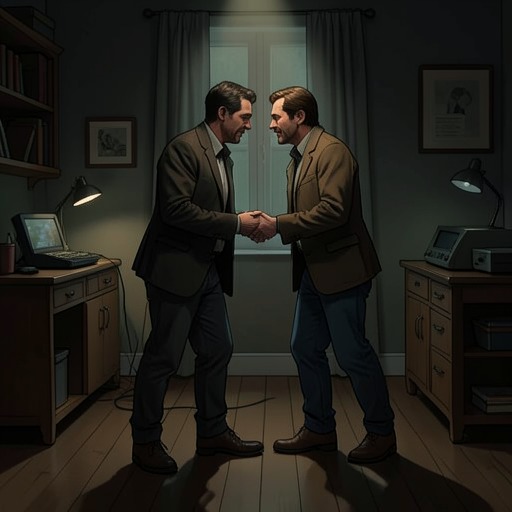
Mellors’s pheasant-rearing hut
Lady Chatterley's LoverMellors’s pheasant-rearing hut begins as a hidden work shelter in Wragby Wood and becomes a meeting place where Connie Chatterley can step away from the strain of Wragby and encounter Oliver Mellors on more intimate terms. Its modest construction, tools, fire, and bird coops keep it rooted in the keeper’s daily work, while its apparent seclusion is never complete: the wood belongs to the estate, its keeper serves its owners, and industrial sounds and lights press upon the landscape beyond it.
Discovery and Setting
Connie finds the hut by following a narrow track between young fir trees after hearing hammering in the wood. The track leads into an old-oak clearing where pheasants are being reared. Mellors is at work there, kneeling and hammering, while his brown dog comes forward with a short bark. His startled response and guarded silence make clear that Connie has arrived not at a public shelter but at a place he regards as private. The hut lies within Wragby Wood, a remnant of a much larger forest and now part of Clifford Chatterley’s private estate. That setting carries a tension the shelter cannot escape. The surrounding wood may seem remote, yet nearby clearings bear the effects of human intervention: trees were cut during the war, and from a denuded knoll Connie can see the colliery railway and new works at Stacks Gate. The hut offers withdrawal within a landscape already marked by ownership, work, and industrial change.
A Working Shelter
The hut is made of rustic poles and lined with unvarnished deal. There is no window; daylight enters through the open door. Its few furnishings include a table, a stool, and a chair, alongside a carpenter’s bench, a large box, tools, new boards, and nails. An axe, hatchet, traps, sacks, and Mellors’s coat hang from pegs. This practical jumble shows the hut as a place of labor rather than a furnished retreat, even as its small scale and separation from the house give it the character of a sanctuary. Its immediate purpose is the raising of pheasants. Outside, Mellors builds a low shelter from boughs and straw, beneath which five coops hold hens sitting on pheasants’ eggs. Connie later finds the birds settled over their nests, watchful and protective. Their presence keeps the hut connected to the routines of care and breeding; it also gives Connie a vivid counterpoint to her own sense of being forlorn and unused. The coops are not decoration: they establish the keeper’s work and shape what Connie sees and feels during her visits.
Access and Privacy
The hut’s meaning changes when Connie asks whether she can have a key and sit there sometimes. Mellors initially answers that he knows of only one key, and his use of the vernacular marks his resistance. Connie recognizes the question beneath the practical request: whether the hut is, in any meaningful sense, his. He is employed by the estate owners and cannot simply secure his privacy against them, yet the place is his last refuge from a world and a relationship he fears re-entering. Mellors eventually has a key made for Connie and offers it to her. He has also cleared and arranged the interior, moving the table and chair near the fireplace, leaving kindling and small logs, and putting away tools and traps as far as possible. The preparations make her access tangible, but they do not mean he has surrendered his wish for solitude. He stays away when she comes, apparently on purpose, and remains distant from her. The key therefore opens the hut without resolving the tension between her desire to be there and his effort to preserve a private life.
Refuge and Meeting Place
Connie uses the hut when she wants to escape the tension of her life with Clifford. On a rainy visit, she finds it locked and sits on the log doorstep beneath the rustic porch, watching the rain among the old oaks. The pause takes place outside the shelter as much as within it: the locked door preserves Mellors’s absence, while the clearing gives Connie a temporary distance from Wragby. Her return with the key later finds the room orderly, with blankets folded, straw neatly gathered, corn stored in a bin, and a hurricane lamp hanging from a nail. The hut eventually becomes the setting for a private encounter between Connie and Mellors. When he asks her to come there, he leads her inside, moves the furniture aside, and spreads a brown soldier’s blanket from the tool chest. He closes the door and later lights the small hurricane lamp. On another occasion, he lays the blankets carefully, folding one for her head, and draws her close. These details keep the intimacy tied to the hut’s actual, spare contents: a work shelter is temporarily rearranged to make room for the two of them.
Seclusion Under Pressure
The hut offers neither a permanent escape nor a world untouched by the forces around it. After Connie leaves, Mellors walks through the dark wood and climbs the denuded knoll. From there he sees the lights of Stacks Gate, Tevershall pit, and Tevershall, and hears the machinery working through the miners’ shifts. The industrial night makes the wood’s seclusion feel precarious; the hut may be hidden among trees, but it stands within a landscape whose noise, illumination, and demands reach into the apparent refuge. That pressure gives the hut its particular significance. It is at once a workplace, a shelter for birds, a contested private space, and a meeting place shaped by the unequal conditions of employment and estate ownership. Connie’s key grants her access, but Mellors’s repeated absences show that access is not the same as possession. The refuge enables contact while retaining the vulnerability of a place embedded in a managed wood, close to a world that does not leave its inhabitants entirely alone.