Nothingness
Lady Chatterley's LoverNothingness is the novel’s name for a life that continues in outward forms while feeling empty of reality, contact, and sustaining purpose. It first frames the story’s response to a civilization in crisis, then becomes Connie Chatterley’s private experience at Wragby: her marriage, conversation, and daily routine go on, but seem unable to make life substantial. Its recurring contrast is between impressive activity and an inward sense that nothing has truly happened.
A crisis larger than one life
The novel opens by announcing a cataclysm in civilization and the necessity of living through it. The abstract declaration establishes Nothingness not simply as an individual mood but as a condition connected to modern life and its social and economic upheavals. The story then brings that crisis into the household of Constance Chatterley and Clifford Chatterley, a wealthy landowner and industrialist. The movement from broad diagnosis to domestic history makes their private emptiness part of a wider question: what can make life meaningful when the prevailing forms of work, thought, and social order seem damaged?
The narration’s cool observations reinforce that question. Clifford’s look is described as vacant, the home as forlorn, and the characters’ relations as lacking warmth. This distance does not present Nothingness as an abstract idea alone; it lets the reader see how it appears in people and their surroundings. The language of diagnosis and the details of domestic life sit together, so that an era-wide crisis is registered through a marriage and a household.
Wragby: activity without contact
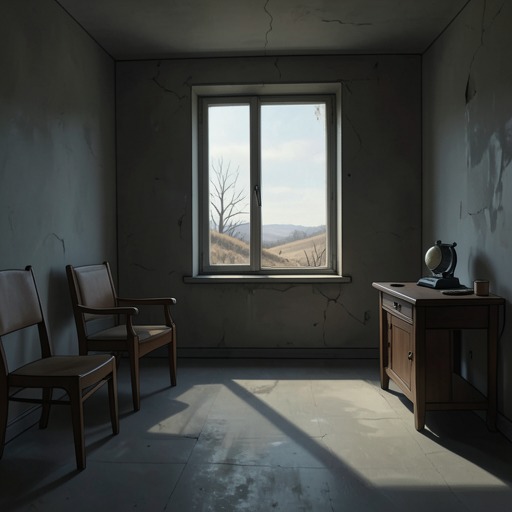
After nearly two years at Wragby, Connie and Clifford have built a life organized around Clifford and his work. Their interests converge in his writing; they discuss and struggle over composition, and this shared intellectual activity can seem like something real is taking place. Yet that sense of substance is fragile. Beyond this absorption, life at Wragby feels to Connie like nonexistence. The house, its servants, and the routine of the estate are present, but seem spectral rather than fully real.
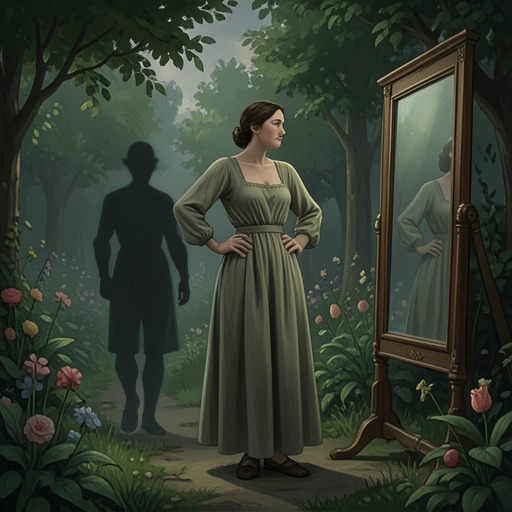
Connie’s walks give this absence a distinct form. She goes through the park and adjoining woods, kicks autumn leaves, and picks spring primroses, but even the natural world seems like an image reflected in a mirror. She feels herself as insubstantial as the figure she imagines others might read about. The contrast is not between an empty landscape and a living one: the leaves and flowers are there, yet she experiences no secure substance in them or in herself. What she lacks is touch and contact, while her life with Clifford consists of an endless circulation of ideas and stories. Sir Malcolm’s skepticism about those stories—that they contain little and will not last—echoes Connie’s growing sense that mental activity cannot guarantee reality.
The rhythm of time makes the same point without a decisive incident. Connie entertains guests, the household continues, and the clock moves from one half-hour to the next; nevertheless, the narration insists that whatever happens, nothing happens. Social life supplies a succession of occasions, not an accumulating sense of connection. Connie is a hostess to Clifford’s mostly male visitors, including critics and writers invited to praise his books, and to his aristocratic relations. She understands the praise and the social performance around it, but remains out of contact with the guests. She also withholds encouragement from male visitors because she knows Clifford would suffer at any sign of her flirting. His relatives are kind, but their kindness does not create mutual respect or closeness. The outwardly busy house thus becomes one of the clearest settings for Nothingness: presence, speech, and routine persist while intimacy does not.
That disconnection does not leave Connie untouched. A growing restlessness takes hold of her, affecting her limbs, spine, and heartbeat; she is also getting thinner. The narrative places this bodily disturbance alongside the life that has felt unreal. Nothingness is therefore not a calm or neutral condition. The absence of meaningful contact becomes an agitation that Connie cannot simply reason away.
Words, marriage, and the fear of blankness
The concept reaches its most intimate expression in Connie and Clifford’s marriage. Clifford describes their life as integrated and grounded in a habit of intimacy, but Connie experiences days when that shared life becomes blank. The two continue to occupy a common domestic world, and language continues to cover it, yet the words seem to conceal rather than establish a living bond. The conflict is between the name given to their life and what Connie feels it to be.
As the years pass, this emptiness becomes a fear. Connie’s mental life and Clifford’s seem increasingly to share the same void; even the marriage’s claim to intimacy can feel like a set of words laid over nothing. The narration’s return to this idea gives it structural force: Nothingness is not a single episode that can be left behind, but a perception that recurs beneath the routines and explanations of Wragby. The more confidently their life is described as integrated, the more sharply its felt blankness is exposed.
Success as a display of Nothingness
Clifford’s public success offers no clear escape from the void. He is nearly famous, earns a thousand pounds from his books, and becomes widely recognizable through photographs, a bust, and portraits. Within four or five years, his aptitude for publicity has made him one of the best-known young intellectuals. For Connie, the spectacle raises a question about what this fame represents. Clifford is clever at analyzing people and motives, but she feels that the analysis breaks things apart without giving them a new wholeness.
Michaelis’s play makes the performance more explicit. He selects Clifford as its central figure, writes the first act, and comes to Wragby with it. Clifford is thrilled by the prospect of being presented again, now through another person’s work. The visit and the play’s success turn literary and social recognition into a display watched by others. Connie sees the men’s desire to capture public attention as a kind of passion for display, while their public prominence does not amount to the personal connection she lacks. Success may make a person visible, but visibility itself cannot fill the absence.
The narration sharpens this contrast by showing Connie at once drawn into the excitement of Michaelis’s visit and aware of its emptiness. Her response does not cancel the critique: the display can produce a thrill, but the thrill is limited and temporary. Nothingness persists even inside the spectacle, as if publicity multiplies appearances without restoring substance.
The treadmill after disillusionment
After Connie’s sexual feeling for Michaelis collapses, she passes through the days drearily. What remains is the empty treadmill of the integrated life Clifford names: two people living together because they are accustomed to being in the same house. The sequence makes the idea concrete. A relationship can continue as arrangement after its emotional force has failed, just as household routine can continue without a felt connection between its members.
Connie then reflects on Nothingness as if accepting it might be the sole purpose of living, while the many busy, apparently important details of life accumulate into an empty total. That formulation gathers the novel’s recurring contrasts: activity without fulfillment, conversation without contact, fame without substance, and continuity without renewal. Nothingness is both Connie’s private fear and a critical measure of the world around her. It reveals the distance between life as it is described and life as it is experienced, while making the need for a more substantial form of human connection central to the novel’s larger crisis.