Shipley Hall
Lady Chatterley's LoverShipley Hall is a handsome Georgian house and park near Uthwaite, but its refined rooms and ornamental grounds stand within the reach of the collieries that helped make their owner wealthy. Connie’s visits reveal both the estate’s lingering beauty and its exposure to industrial change. After its owner’s death, the house is demolished, its grounds divided and built over; its disappearance becomes a concentrated instance of the novel’s larger image of one England blotting out another.
Setting and Approach
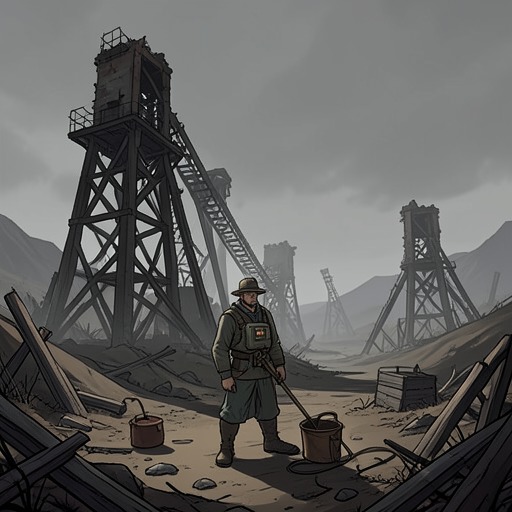
Shipley Hall stands above the surrounding landscape as a pleasant stucco house dating from the middle of the eighteenth century. Its park gates open near a colliery railway level crossing, and Shipley Colliery lies just beyond the trees. The estate is not sealed off from industrial life: the gates remain open because colliers have a right of way through the park, and miners gather there. The railway, mine, and public passage make the boundary between private property and the working world permeable even before the estate is sold and redeveloped.
The drive passes ornamental ponds where colliers have thrown their newspapers, then climbs to the house. A yew-tree avenue approaches it, while beautiful gardens lie behind. Connie prefers Shipley’s interior to Wragby Hall: it is lighter, more alive, and more elegant, with creamy-painted paneling, gilt-touched ceilings, carefully maintained appointments, and spacious, softly curved corridors. The house’s ordered grace is not merely a contrast of style. It gives physical form to an old landed world whose apparent self-containment depends on the nearby industrial economy.
Leslie Winter and the Collieries
Leslie Winter adores his house, yet three of his own collieries border the park. His generosity toward miners is entangled with the knowledge that their labor has made him rich. He has almost welcomed them into the grounds, and once explained to the Prince of Wales that miners were less ornamental than deer but more profitable. The remark carries the ease of an earlier social order, when miners could be regarded as useful dependents within a gentleman-owner’s domain.
That arrangement changes. New mining villages crowd around the park, and Winter feels that the population has become alien. Although he once felt himself lord of both his land and his colliers, he now senses that industry has acquired a will of its own, opposed to the gentleman-owner. The miners are not described as personally hostile; rather, their cold presence and refusal to defer make Winter feel that he no longer belongs. They resent the visible difference between their working lives and his well-groomed existence, and Winter privately recognizes that their resentment has grounds, even as he refuses to surrender his place.
Connie sees the cost of that altered relation in a walk with Winter. He once took her to the gate bare-headed, in patent-leather shoes and purple silk socks, speaking in his well-bred manner. Passing small groups of colliers who stare without saluting, he visibly winces. The comparison to an elegant stag in a cage turns his former authority into a spectacle: the estate still belongs to him, but the people around it no longer confirm his command. He is not pushed out by a single confrontation; the pressure is social and cumulative, until he retreats indoors and no longer cares to walk in the park after dinner.
Destruction and Redevelopment
Winter dies suddenly not long after Connie’s call and remembers Clifford handsomely in his will. His heirs promptly order Shipley Hall demolished because it costs too much to maintain and nobody will live there. The yew avenue is cut down, the park’s timber removed, and the land divided into lots. New streets of semi-detached houses rise near Uthwaite in what the narration presents as a bare, unsettled landscape.
Within a year of Connie’s last visit, the former estate has become Shipley Hall Estate: red-brick houses along new streets, marketed as desirable villas. The speed of the change is part of its force. The Georgian house that had seemed serenely established has disappeared so thoroughly that a passerby would not imagine it stood there only twelve months before. The estate’s name survives, but now labels a housing development where the house, avenue, and park have been erased.
Narrative Significance
Shipley condenses the novel’s account of industrial transformation into a change of ownership, use, and landscape. The mines first support the landed estate; later, the expanding industrial order presses against it and helps make it untenable. What disappears is not simply an old building. The former relation between squire, land, and workers has already weakened before the demolition, and the new development converts the estate into another part of the mining district’s spreading settlement.
The destruction belongs to a wider pattern visible in Connie’s journey through the Midlands: old halls are abandoned or pulled down, while brick housing and mining settlements spread across the countryside. The narrative describes this as one England blotting out another, and insists that the succession is mechanical rather than organic. Shipley’s short afterlife makes that idea concrete: the house and its carefully composed grounds give way within a year to a named estate whose newness does not preserve the old place’s character. Its fate sharpens the contrast between inherited beauty and industrial expansion without suggesting that the old order was innocent of the wealth that enabled it.