Stacks Gate
Lady Chatterley's LoverStacks Gate is both a mining settlement and an emblem of industrial transformation. Its postwar chemical works, engineered housing, and constant machinery remake the landscape beside Wragby Wood, bringing employment and new wealth while unsettling the older communities and the secluded world that Clifford Chatterley wants to preserve. The place is not merely a distant industrial backdrop: its lights and sounds enter the wood, mark the hours of intimate scenes, and expose the limits of retreat from the modern world.
The New Settlement
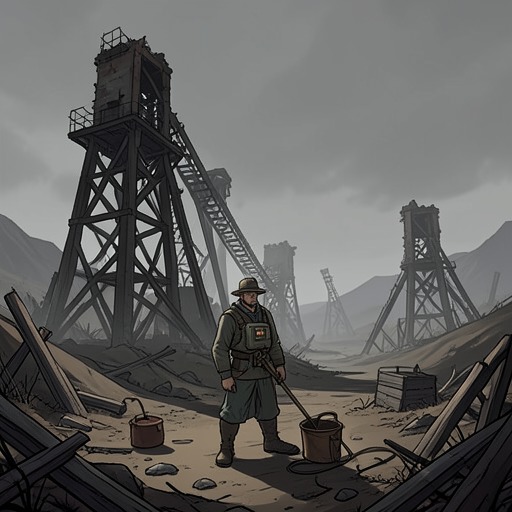
From the highroad, the postwar Stacks Gate first appears as a conspicuous complex centered on the red, white, and gilt Coningsby Arms, which resembles a grand hotel set apart from its surroundings. Beyond it stand rows of handsome modern dwellings, spaced with gardens and likened in the narration to dominoes laid down upon the earth. Behind the houses rise the vast overhead structures of the mine and chemical works, with galleries and installations so large and unfamiliar that the ordinary head-stock and pit-bank seem insignificant beside them. The settlement’s scale and arrangement make industrial development look less like the gradual growth of a town than a new design imposed on the landscape.
The visible development is only part of the story. Half a mile downhill from the new complex lies old Stacks Gate: a small colliery, dark brick dwellings, chapels, shops, and pubs. Yet the narration observes that this older settlement no longer counts as Stacks Gate in the dominant picture. The new works, workers’ dwellings, and hotel-like miners’ pub have displaced it as the place’s defining face. The industrial complex is called a modern Olympia, its vast works imagined as temples to all the gods; the metaphor gives its monumental scale an almost religious grandeur, even as the surrounding settlement’s older civic and communal landmarks recede.
The growth is recent even in the novel’s present. Since Connie Chatterley arrived at Wragby, the new settlement has risen, and its model dwellings have filled with people drifting in from elsewhere. Among the activities attributed to some newcomers is poaching Clifford Chatterley’s rabbits. The new housing therefore signifies more than architectural change: it brings a shifting population into the orbit of the estate and unsettles the boundary between the enclosed world Clifford claims to protect and the working world gathering beside it.
Work, Prosperity, and Tevershall’s Decline
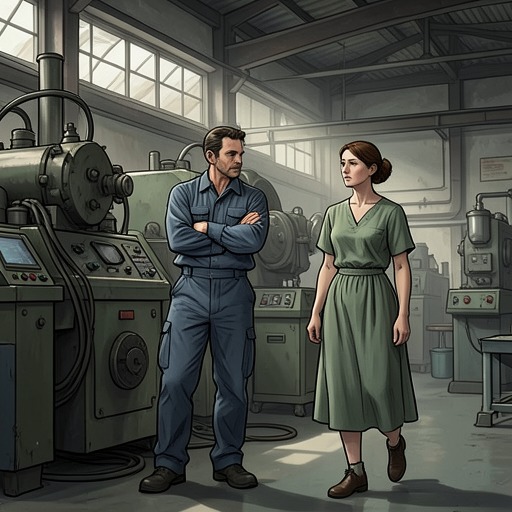
Stacks Gate’s expansion is tied to the diminishing prospects of nearby Tevershall. Mrs Bolton describes miners leaving Tevershall for Stacks Gate and Whiteover, where the new works and employment offer better prospects. The chemical operation is said to earn more from by-products than from coal itself, a striking change in a district where mining has long organized work and identity. The contrast is sharpened by the new houses, which Mrs Bolton describes as fine homes for the men, and by her report that workers who move there can do better than those who remain at Tevershall.
That prosperity belongs within a larger crisis. Tevershall’s once-famous pit has passed its best days, while New London, never especially rich, is vulnerable in the bad times. Mrs Bolton fears that New London will close first and that Tevershall may follow within a few years. The possibility of a permanent shutdown seems to her more alarming than a strike: a strike interrupts the familiar life of a working pit, but closure would end it. Her recollection that Tevershall was once the country’s best pit makes the predicted decline feel like the loss of a whole local order, not simply a change in employment.
The industrial transition also changes the work itself. Mrs Bolton reports miners’ unease about the deep, highly mechanized mines and the machines used to hew coal—machines some workers call iron men. Mechanization is presented as a source of both fear and economic calculation: what is lost through waste may, according to the account, be offset by savings in wages. The question of whether machines create more jobs or make people unnecessary remains unresolved in her recollection of earlier machinery and present-day change. Her account keeps Stacks Gate’s apparent modern prosperity in tension with the insecurity, displacement, and fear of redundancy that accompany it.
The difference between neighboring collieries is also presented as economically consequential rather than simply geographical. Tevershall and Stacks Gate are not three miles apart, yet local talk holds that Tevershall coal cannot yield the same chemicals as the coal processed at Stacks Gate. People hope for new investment to sustain Tevershall and provide work for women, many of whom travel to Sheffield for employment. The new works thus function as both a real alternative for some workers and a measure of what the older district lacks.
Encroachment on Wragby Wood
Stacks Gate’s industrial reach is registered inside the wood through sound, light, and changes to the land. Sir Geoffrey Chatterley cut trees there during the war for trench timber, leaving a denuded knoll with stumps, dead bracken, and burned patches. From its bare summit, Connie Chatterley can see the colliery railway and the new works at Stacks Gate. The opening in the trees breaks the wood’s seclusion and admits the industrial world into a place Clifford Chatterley would prefer to keep inviolate. He is having the hill replanted, but its damage angers him and turns his resentment toward Sir Geoffrey.
The conflict between the estate’s ideal and its surroundings is audible as well as visible. When Clifford declares his intention to keep the wood untouched and free from trespass, the eleven-o’clock hooters at Stacks Gate sound while Connie listens; he is so accustomed to them that he does not notice. This small contrast makes the industrial presence ordinary for him even as it punctures the stillness he claims to defend. The wood retains old trees, birds, and a remembered history of deer, archers, and monks, but the war cut and the nearby works make that inheritance vulnerable rather than intact.
At night, the encroachment becomes harder to ignore. After Connie leaves him, Clifford walks into the dark wood and climbs the stripped knoll. From there he sees the bright rows of lights at Stacks Gate, the smaller lights of Tevershall pit, and the distant rosy glow of furnaces. He hears traffic and the winding engines lowering miners for the seven-o’clock shift; the pit works three shifts. The scene turns the landscape into a map of continuous labor, its lights and machinery visible from the very height that reveals the wound in the wood.
Clifford understands that the apparent solitude is not secure: industrial noise breaks it, and unseen electric lights seem to mock it. His fear that the works will eventually destroy the wood and the bluebells gives the local geography a larger meaning. The novel presents the machinery as a force that threatens vulnerable forms of life, while Clifford’s desire for a private refuge is itself shadowed by the fact that the surrounding industrial world has already entered it.
A Measure of Modern Life
Connie’s journey past Stacks Gate offers a wider view of the region’s changing landscape. The new works rise above rows of housing, while the old castle at Warsop remains a ruin above miners’ dwellings and colliery smoke. Farther on, Chadwick Hall stands as a maintained but outdated showplace, a remnant of aristocratic power, and Uthwaite sends up its own smoke and steam amid railways, coal mines, and steelworks. The sequence places Stacks Gate within a county where industrial production is ascendant and older forms of authority persist chiefly as spectacle or memory.
The settlement’s daily rhythms also reach into private life. During a nearly five-mile round through the wood, Oliver Mellors encounters the faint, ceaseless shuffling noise of Stacks Gate colliery. At half-past two, the country seems to sleep, but trains, road traffic, furnace flashes, and the works’ lights make that sleep uneasy. Later, during an intimate encounter with Connie Chatterley, the distant seven-o’clock hooters mark Monday morning; Mellors hears them, while she does not. The same industrial signal that interrupts the wood’s stillness also provides a clock against which the lovers’ private moment unfolds.
Stacks Gate therefore joins social change to the novel’s treatment of separation and contact. Its chemical works and modern mine promise work and better conditions for some, yet their rise accompanies Tevershall’s feared collapse and the departure of its people. Their lights and sounds cross the estate boundary, challenging the fantasy that the wood can remain untouched by history. As a place, Stacks Gate is both a material center of postwar industry and a recurring reminder that the old landscape, the mining community, and private life are all exposed to forces they cannot simply shut out.