Ted and Mrs. Bolton's marriage
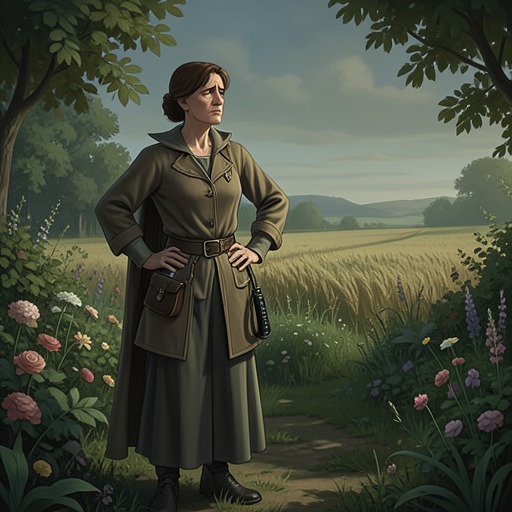
Lady Chatterley's LoverTed Bolton and Mrs. Bolton’s marriage is reconstructed through Mrs. Bolton’s recollections, shared with Connie Chatterley while the two women work together in a spring garden. The memories reveal a bond marked by his death in mining, the lasting force of his absence, and a marriage in which neither partner held unquestioned command. Mrs. Bolton’s account connects private intimacy to the dangers and constraints of working life, while presenting affection as something remembered through gestures, silences, and the desire for a lost partner’s presence.
The Marriage in Retrospect
Mrs. Bolton tells Connie Chatterley that her husband had been dead for twenty-three years. The number gives her loss a long duration, but not a finished one: as she recounts their life together, its emotional consequences remain immediate. The conversation takes place while the women are planting and tending flowers, and its quiet shared work opens a space for recollection. Mrs. Bolton speaks not as a detached chronicler but as someone who still carries the marriage in her memory.
Her portrait of Ted is made from apparently contradictory traits. She remembers him as a man who did not readily bend to others and would not lower his head, yet she also recalls that he seldom voiced hatred or complaint. His silence did not mean that nothing affected him. Mrs. Bolton describes him as someone who seemed not to care, while the details she supplies suggest a man deeply affected by work, childbirth, and the limits of their married life. The discrepancy between outward quiet and inward feeling is central to her account.
Work and Death
Ted’s connection to mining began early: his father sent him down the pit as a boy, and, Mrs. Bolton observes, leaving such work became difficult once he was grown. She believes that Ted hated the pit, although he never said so outright. In her recollection, his refusal to yield and his apparent indifference to danger were bound up with the occupation that had shaped his life. She interprets his death as the consequence of a life in the mine, rather than as an isolated event separate from his working circumstances.
Mrs. Bolton remembers his body after death as strikingly still, and recalls that seeing him that way broke her heart. The contrast between his quiet appearance in death and the stubbornness she attributes to him gives her memory its particular force: the mine had taken a man who had endured its demands without plainly naming what he felt. Her account does not establish every circumstance of his death, but it makes clear how she understood its cause and what that understanding meant to her.
Childbirth and Married Intimacy
The couple’s married life is also recalled through the birth of their first child. Mrs. Bolton remembers Ted sitting motionless when the baby was born and looking at her with an expression she understood as grave and almost fatal. Although she had been the one suffering through a difficult birth, she says she found herself comforting him. The episode unsettled the usual division between the person in pain and the person who gives comfort: Ted’s response to her suffering became a burden she felt compelled to soothe.
Afterward, he did not want them to have more children. Mrs. Bolton connected this decision to his difficulty accepting the pain of childbirth as natural or right, and believed that his distress diminished his ease in their married intimacy. She tried to persuade him to release that anxiety, but her recollection is that he could not, or would not, do so. This account does not portray a lack of affection; it shows affection entangled with apprehension, and a shared life in which his sensitivity could obstruct the mutual pleasure she hoped for.
Negotiation and Mutual Limits
When Connie Chatterley asks whether Mrs. Bolton had to manage her husband through coaxing, Mrs. Bolton acknowledges that she did sometimes persuade him. She adds, however, that he generally understood what she wanted and usually gave way. Their marriage was therefore not described as a simple contest in which one partner always ruled: he was not consistently the master, and neither, in her account, was she.
Mrs. Bolton also remembers that there were moments when a look from Ted showed her she had reached a limit and should yield. At those times, she says, she gave in even when it cost her. Her description presents authority as situational and legible between them, negotiated through their knowledge of one another rather than settled by a single permanent hierarchy. The detail qualifies her account of coaxing: she could influence him, but influence did not mean that her wishes always prevailed.
Bereavement and Narrative Significance
After Ted’s death, Mrs. Bolton repeatedly woke at night expecting him to be beside her. Her feelings, she explains, did not readily accept that he was gone; she wanted his presence and the reassurance of feeling him near. It took years, and what she describes as countless shocks, for the reality of his absence to settle. Her grief is thus remembered not as one moment of recognition but as a long interval in which habit and feeling continued to anticipate his return.
The recollection makes touch the most enduring sign of the marriage. Mrs. Bolton says that she never recovered from the loss of her husband’s physical presence and imagines that, in heaven, he will be warm beside her again. Connie responds by recognizing the force with which love can remain in the body. The scene gives Ted and Mrs. Bolton’s marriage significance beyond the account of its beginning and end: it shows how work, marital difficulty, and bereavement coexist in one remembered bond, and how a relationship can persist in the surviving partner as a need for the absent person’s nearness.