Tevershall
Lady Chatterley's LoverTevershall is the village adjoining Wragby Hall and the principal human landscape through which the novel registers the costs and instability of the coal economy. Its houses, working pits, public institutions, and residents form a community close to the Chatterley estate in distance but separated from it by class. The settlement is neither merely a backdrop of industrial damage nor a unified social world: its inhabitants have their own histories, loyalties, ambitions, and resentments, even as economic decline and mechanization narrow their prospects.
Setting and Physical Character
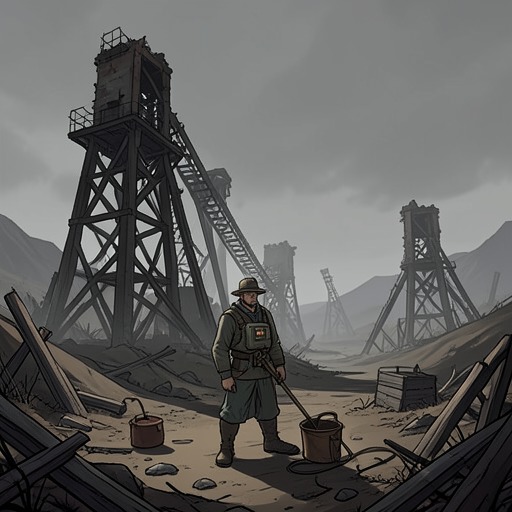
Tevershall begins almost at the gates of Wragby Hall and extends in a long straggle of small brick houses. The village is set beside a landscape dominated by the mine: from Wragby, the colliery chimney, its smoke and steam, and the burning Tevershall pit-bank are visible. The pit-bank has burned for years, and extinguishing it would cost thousands. Pollution reaches beyond the workings into the surrounding air and settles on the estate; the novel’s account emphasizes that industrial effects are not confined to the mine boundary.
The physical contrast between the old park and the settlement is stark. Wragby’s oak trees occupy elevated ground, while Tevershall’s tightly grouped houses extend through the adjoining countryside. The village’s brick rows, black slate roofs, coal-dusted streets, and wet pavements recur in Connie Chatterley’s views of the district. As she travels through its streets, she passes shops, a market-place, several public houses, chapels, a school, and miners’ facilities. The details establish a place where ordinary commercial and communal life continues, though the narrative depicts its built environment as heavily marked by industry.
The village also belongs to a landscape in transition. On the routes beyond it are older settlements, newer and somewhat larger workers’ houses, mining developments, and remnants of the former agricultural countryside. From a stripped section of Wragby Wood, Connie can see the colliery railway and the new works at Stacks Gate. Tevershall is thus connected to a wider industrial geography: mines, railways, processing works, and expanding housing increasingly press upon the older estate and rural landscape.
Class Relations and Community Life
Physical proximity does not produce social intimacy between Tevershall and Wragby. The narrative describes almost no communication between the village and the hall. Colliers stare at the Chatterleys, while tradespeople offer only awkward acknowledgments; neither side makes a sustained attempt at conciliation. Connie initially feels the village’s resentment, then becomes accustomed to it. Clifford Chatterley, who tends to be haughty toward people outside his class, likewise does little to bridge the divide. Their relationship to Tevershall is shaped less by personal acquaintance than by the established distance between an estate household and the mining population.
The villagers’ response to Connie is complicated rather than simply hostile. The miners’ wives can be polite and apparently welcoming, yet Connie senses that their manner also asserts their own worth and independence. Her position as Lady Chatterley does not erase their awareness of class difference; conversely, it does not persuade them to treat her as socially equal in an uncomplicated way. The novel presents mutual reserve as a condition of the relationship: the village may sympathize with the Chatterleys in the abstract, but everyday contact remains limited.
Mrs Bolton offers a different route into village life. A former parish nurse, she is respected for her work among the colliers and has acquired confidence and local standing. Her position is socially mixed: she feels superior to the miners she has cared for, is fascinated by the upper classes, and retains resentment toward the mine owners. Her husband, Ted Bolton, was killed in a pit explosion. The company’s inquiry treated his death in a way that shifted blame onto him, and her compensation was restricted to weekly payments despite her wish to use the money to establish a small shop. She trained in ambulance work and nursing, qualified, and worked at Uthwaite hospital before the company gave her parish nursing work. Her history makes the village’s class structure personal: employment and institutional support coexist with a grievance she has not forgotten.
Mrs Bolton’s conversation also changes the apparent scale of Tevershall. Through her accounts of residents, family histories, local disputes, and changing fortunes, the village emerges as socially active and varied rather than a single undifferentiated mass. Her talk supplies Connie and Clifford with knowledge that their more distant position would otherwise leave them without, while also making clear that village opinion has its own power and can circulate beyond the immediate setting.
The Mining Economy and Its Decline
Tevershall’s identity rests on a colliery whose best years have passed. It was once a celebrated and profitable mine, but by the period represented in the novel its future is uncertain. The district’s two collieries, Tevershall and New London, are both under pressure; New London is particularly vulnerable in bad times. Men have left Tevershall for work at Stacks Gate and Whiteover, where newer works and better housing suggest alternatives to the older pit. Local discussion treats the possibility of closure not as an abstract industrial statistic but as a threat to the continuity of community life.
The contrast with Stacks Gate points to changes in both technology and the use of coal. Its large chemical works do not look like a conventional colliery, and the value of the chemical by-products is said to exceed the value of the coal itself. Tevershall coal is understood to be less suitable for producing some of those chemicals, despite the short distance between the two places. At the same time, mechanized cutting reduces the need for workers, and miners worry about machines displacing the labor previously done by hand. The village’s economic crisis therefore involves more than a temporary shortage of work: its older industrial base appears poorly positioned against new methods and new forms of production.
Mrs Bolton’s account recalls the closure of other collieries, including New England and Colwick Wood. At Colwick Wood, rusted lines and an abandoned pit-head mark a former workplace left to decay. These examples give Tevershall’s possible closure a visible precedent. In another account, Mellors describes miners in a comparable district as working only two or two and a half days a week, with families expected to manage on sharply limited wages. His comments connect local industrial uncertainty to a broader problem: workers depend on an economy that demands both their labor and their spending, yet offers little security when the mines falter.
Streets, Institutions, and Changing Countryside
Connie’s journey through Tevershall records the range of its public spaces. Along the main route are grocers, clothing shops, a post office, an inn, and several public houses, as well as a Mechanics Hall and a Miners Welfare. The village has a Primitive Methodist chapel, a Wesleyan chapel, and a Congregational chapel; a newer school stands behind railings, and girls there are having a singing lesson when Connie passes. These features indicate institutions and routines embedded in the settlement, even where the narrative’s larger emphasis falls on social and environmental strain.
The route also shows the village extending into a layered industrial landscape. Older, darkened miners’ housing is followed by newer rows of larger homes, then by further mining settlements spread across the countryside. Lorries carrying iron can delay traffic through the older streets, while roads lead onward toward Stacks Gate. Beyond the built-up areas remain fragments of an older England associated with estates, cottages, and rural life. The novel presents these layers not as a harmonious succession but as signs of one form of settlement overtaking another: the industrial landscape expands while older buildings and ways of life become harder to sustain.
Narrative Significance
Tevershall makes the industrial economy tangible in domestic and communal terms. Smoke, mine noise, coal dust, damaged landscapes, declining employment, and the prospect of closure belong to the same system, but they register differently for the estate household, mine owners, and workers. Clifford’s renewed interest in the pits grows as he comes to see himself as their effective master. He visits the workings in a tub, studies mining and coal chemistry, and considers developing a concentrated fuel. His industrial project gives him a new sense of agency, while the village’s economic insecurity supplies its larger context: production offers a route to power for him even as mechanization and decline unsettle the people whose work sustains it.
The setting also puts limits on the idea of nature as a secluded refuge. Wragby Wood retains old trees and paths, but its cut-over ground exposes the railway and new works at Stacks Gate; at night, industrial lights and machinery remain audible from the surrounding country. Tevershall and the estate are therefore linked even when their residents avoid one another. The village’s proximity to Wragby reveals a shared environment without dissolving the class boundary between them.
Finally, Tevershall becomes a measure of historical change. The mines that once made money for the district now face closure, while industrial growth consumes older settlements and reshapes the countryside. The village’s importance lies in this double condition: it is a particular community, with memories and institutions that exceed an outside observer’s first impression, and a concentrated view of a wider order in which economic power, social division, and environmental damage develop together.