The decline of England’s landed estates
Lady Chatterley's LoverThe decline of England’s landed estates is a visible part of a larger historical reversal: industrial England has overtaken the agricultural country whose wealth once sustained its great houses. In the Midlands around Wragby, estates remain set among old parks and wooded land, but mines, smoke, and expanding settlements press against them. The novel traces this change from environmental intrusion to the demolition of a country house and the construction of a new estate in its place. What disappears is not only a style of architecture, but a landscape and a sense of historical continuity.
The Old Estate in an Industrial Landscape
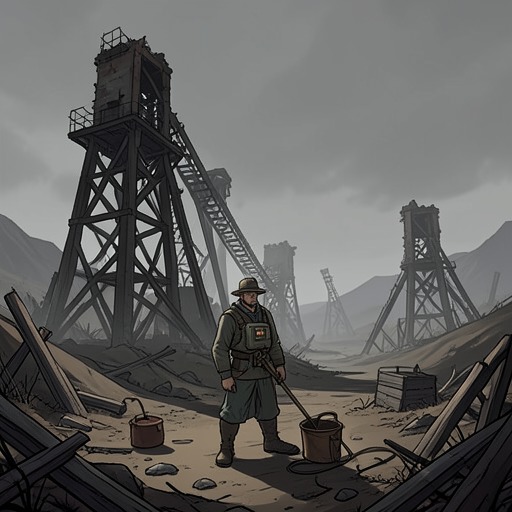
Wragby makes the contradiction plain. The house is a long, low building of brown stone, begun in the mid-eighteenth century and enlarged over time into an irregular, undistinguished whole. It stands on a rise in an old oak park, a setting that suggests inherited land and historical depth. Yet the view is already compromised by the nearby chimney of Tevershall pit and the smoke above the village. Tevershall stretches from close to the park gates in a long line of small, grimy brick houses. The estate has not been physically erased, but it no longer commands an uncontested landscape.
The industrial presence enters daily life as sound, smell, and residue. From Wragby, Connie Chatterley hears the screens rattling, the winding engine puffing, trucks clinking, and colliery locomotives whistling. The burning Tevershall pit-bank has been alight for years, and putting it out would cost thousands, so it continues to burn. Sulphurous fumes sometimes fill the house; even when the wind is still, the air carries the smells of materials brought up from below ground. Smuts settle on the Christmas roses. The damage is persistent rather than confined to a single catastrophe: the estate’s cultivated grounds and domestic interior are repeatedly exposed to the industrial world beyond them.
The wood offers a partial image of the older country, but it too bears the marks of ownership and extraction. It is a remnant of the great forest associated with Robin Hood, and its riding was once an old thoroughfare across the country; it is now a route through private woodland. During the war, Sir Geoffrey Chatterley cut trees there for trench timber. The resulting bare knoll exposes the colliery railway and the new works at Stacks Gate, opening a view into the industrial landscape. The breach matters because the wood can no longer sustain the impression of seclusion: modern industry is visible through the space cut into it.
Wealth, Displacement, and Demolition
The novel links the old houses to the industry that eventually displaces them. The mines had made the country houses wealthy, but that economic connection does not preserve them. Instead, industrial England increasingly blots out agricultural England, while the owners of large properties find the houses too costly or the changed surroundings too uncongenial. The decline is therefore not presented as a simple contest between an innocent countryside and an unrelated industrial force. The old order was entangled with mining wealth even as mining transformed the landscape on which that order depended.
Fritchley provides a concrete instance of the change. As Connie Chatterley passes, the Georgian mansion is being demolished despite having been in perfect repair. The Weatherleys had lived there in style until the war, but the house has become too large and expensive to maintain in a country its owners no longer find congenial. The gentry, the narrative observes, are leaving for places where they can spend their money without seeing how it is made. A building’s physical condition cannot secure its survival when the economic and social circumstances that once made it viable have altered.
Shipley makes the process still more visible. Squire Winter’s attachment to the old estate persists, and he believes the miners are right to resent the difference between their circumstances and his advantages. Yet he also represents a system he will not surrender. After his death, his heirs order the house demolished because it costs too much to keep and no one will live there. The avenue of yews is cut down, the park’s timber is removed, and the land is divided into lots. Within a year of Connie’s last visit, Shipley Hall Estate has appeared: red-brick semi-detached villas on new streets, where the stucco hall had stood only twelve months earlier. The speed and completeness of the substitution make decline legible as a change in land use, not merely an atmosphere of nostalgia.
A Landscape That Erases Its Past
The new development does not restore the estate under another name. It replaces a house, avenue, and park with streets of semi-detached homes, making the former landscape difficult even to imagine. The name Shipley Hall Estate preserves a trace of the lost house, but the development around it belongs to a different pattern of settlement. The old grounds are divided and built over; the landscape that gave the hall its setting has been dismantled along with the building itself.
This conversion belongs to a wider pattern in Connie Chatterley’s view of the Midlands. Old halls are abandoned and pulled down, while rows of brick dwellings spread across the countryside and new mining settlements appear in valleys and along hillsides. In the spaces between them survive fragments of an older England, but the fragments do not amount to an intact whole. The novel’s recurring image of one England blotting out another describes both physical encroachment and a struggle over meaning: the new landscape makes the old one harder to see, remember, and inhabit.
The change also breaks continuity between generations. Connie Chatterley, who belongs to the leisured classes and has clung to remnants of the old England, gradually recognizes that the new landscape is not a temporary disturbance. The younger generation grows up among new brick streets, new colliery buildings, and changed forms of leisure, largely unconscious of the country that preceded them. She cannot imagine what will follow this transition. Her inability to picture a next stage gives the historical change an unresolved quality: the old order is visibly disappearing, but the novel offers no assured successor capable of restoring its continuity.
Pastoral Seclusion Under Pressure
The landed estate and its woodland can suggest refuge from industrial life, but the novel repeatedly shows the limits of that pastoral promise. Wragby’s park stands beside a polluted village; the wood is private property, cut for timber, and opened to the sight of the railway and new industrial works. At night, lights and machinery remain perceptible from the denuded knoll. The surrounding woodland may still appear separate from the industrial world, but that separation is increasingly an illusion.
The decline of the estates thus carries an ecological as well as a social meaning. Smoke, sulphur, burning waste, and cleared trees are not incidental scenery: they register the accumulating costs of industrial change in places where people live and where older landscapes persist. At the same time, the estates’ dependence on wealth generated by the mines complicates any idealization of the past. The old country is neither untouched nor securely recoverable. Its houses and parks are caught within the same history that produces the mines, the new settlements, and the forces that finally make the great houses untenable.