Clifford’s Electric Chair Breaks Down in the Wood
Lady Chatterley's LoverClifford’s Electric Chair Breaks Down in the Wood is a breakdown on a wooded hill that becomes a revealing test of dependence, authority, and attachment. Clifford Chatterley’s motorized chair cannot manage the steep, uneven climb; his insistence that it proceed under its own power conflicts with Oliver Mellors’s practical help. As Connie Chatterley joins the effort, the machine’s failure makes visible a deeper division: Clifford and Mellors are not the friends she had once imagined, and Connie recognizes that her feelings toward her husband have changed decisively.
The Breakdown on the Hill
On the return journey, Clifford guides the chair down into a hollow, turns right, and then steers up the long slope, where bluebells and hyacinths grow. The climb is steep and jolting. The chair inches upward, falters among the flowers, struggles forward again, and stops. Clifford works the small motor, but the chair will not make the ascent. Connie warns that continued effort may break it altogether and waste his energy. When he sounds the horn, the keeper appears; the group waits among crushed flowers beneath a sky gathering clouds, while a wood-pigeon’s coo is drowned out by another blast of the horn.
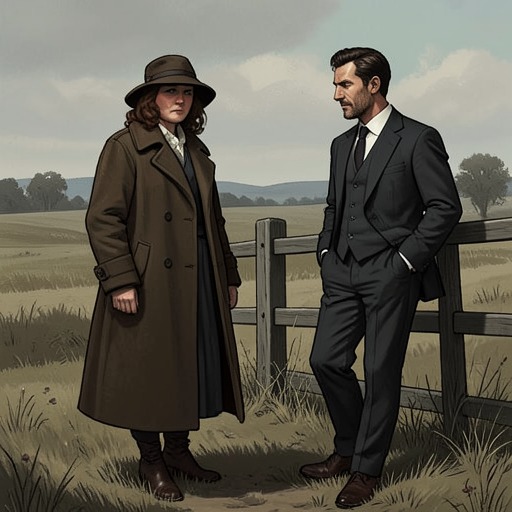
Oliver Mellors examines the situation and offers to push. Clifford refuses, insisting that the chair should manage by itself. It lurches sideways toward a ditch, and Mellors catches it by the rail. With Clifford pressing the controls and Mellors pushing steadily from behind, the chair fights its way onto the riding. Clifford takes its progress as proof that the machine is succeeding without assistance, then notices Mellors behind it and challenges the help. The exchange turns mechanical difficulty into a public dispute over who is controlling the chair—and whether Clifford will acknowledge his dependence on another man.
Dependence, Resistance, and Physical Labor
When Mellors steps back, the chair stops almost at once. Clifford is left seated and unable to make it move: his feet are useless to the task, and manipulating the small levers produces only strange noises. He becomes rigid with anger. His predicament is immediate and concrete: the chair is his means of movement, but in this terrain its motor cannot carry him, and his refusal of assistance leaves him stranded. The incident does not erase his agency—he continues to steer and to issue instructions—but it shows how sharply that agency is constrained by the chair, the slope, and his unwillingness to accept help.
The obstruction changes again when the brake is found to be on. Clifford directs Connie to take hold of a wheel and shows her how to pull it. She warns that lifting it may strain her, but follows his instruction; he heaves, she tugs, and the chair reels. The brake comes free. The keeper places a stone under the wheel and sits down on the bank, white-faced and trembling after the exertion. Connie watches him with anger and concern. Once the group reaches level ground, the keeper can push the chair alone. On the steeper final stretch, however, Connie and Mellors both work and wipe sweat from their faces at the top. Their shared labor has brought them closer than before, not through a declaration but through the effort itself.
The Marriage and the Keeper
While the chair is immobilized, Clifford’s dependence becomes a grievance he voices openly: he says he is at everybody’s mercy. No one answers. Mellors stands with his gun slung over his shoulder, his expression patient and abstracted; Flossie keeps watch near her master’s legs, uneasy before the chair and perplexed by the three people around it. The still group among the squashed bluebells gives the breakdown a social shape: Clifford is the employer and husband, Mellors the keeper whose physical help he resists, and Connie caught between them. When Clifford eventually accepts that the chair will have to be pushed, the concession follows a sequence of denials rather than a willing request.
At the top of the hill, Connie understands that her earlier hope for friendship between the two men was absurd. She had imagined a bond between her husband and the man who is the father of her child; now she sees them as mutually hostile, as unlike one another as fire and water. The episode gives this recognition its immediate cause: Mellors offers necessary assistance, while Clifford treats that assistance as an affront to his independence. Connie’s response is not merely disappointment in an imagined friendship. For the first time, she consciously and definitely hates Clifford, and she realizes that admitting this hatred makes her feel free and full of life. She thinks that she will never be able to continue living with him. The breakdown thus marks an inward turning point as well as a physical one: a failed ascent brings her to a clearer judgment of her marriage.
Aftermath and Significance
The physical effort also alters Connie’s relation to Mellors. After checking that he has not hurt himself, she notices his weather-browned hand, which she had never really looked at before. She associates it with his caress; he lays it softly on her wrist, and she bends to kiss his hand. The moment occurs while Clifford’s head remains motionless just in front of them. Its intimacy is set beside, not separated from, the strained labor and hostility that have preceded it. The chair has required Connie and Mellors to act together, and their bodily closeness becomes newly perceptible within the same scene that discloses the antagonism between the men.
Clifford tries to present himself as composed afterward, making conversation about Aunt Eva at Dieppe and Sir Malcolm’s invitation for Connie to travel to Venice by car or for Connie and Hilda to go by train. Connie says she would prefer the train, particularly because she dislikes long drives and dust, leaving the choice to Hilda. At the house, Clifford thanks Mellors and suggests that he eat in the kitchen; Mellors declines because he is going to his mother for Sunday dinner. Clifford’s practical conclusion is that he needs a different kind of motor. That proposed remedy addresses the machine, but not the scene’s more consequential changes: Connie has acknowledged that she hates him, and working together has drawn her closer to Mellors. The stalled chair exposes the gap between mechanical power and human dependence, while the trampled spring flowers hold the conflict in view.