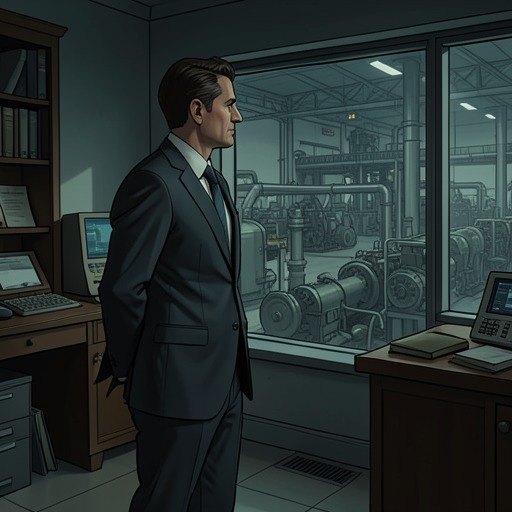
Clifford’s Return to the Mines
Lady Chatterley's LoverClifford Chatterley’s return to the mines is a decisive redirection of his energies: instead of seeking fulfillment through writing, he tries to revive Tevershall’s industrial fortunes and discovers a new form of power in technical management. The project appears to restore his sense of purpose, but it also brings him closer to the machinery of production while leaving the human cost of industrial life unresolved.
Causes and Industrial Setting
When Clifford and Connie Chatterley came home to Wragby in the autumn of 1920, the landscape made the mine’s presence impossible to ignore. Tevershall’s burning pit-bank had been alight for years; smoke, steam, and industrial smells reached the house, and smuts settled even on the Christmas roses. The mine was not simply a source of income or an estate concern. It shaped the air, the view, and the conditions in which the surrounding community lived.
The collieries were in decline. Tevershall had once been a famous and profitable mine, but its best days were over; New London, which had managed in ordinary times, was now vulnerable in a bad period. Men were leaving for work at Stacks Gate and Whiteover, where new chemical works and better housing suggested a different industrial future. Meanwhile, New England and Colwick Wood had already shut down. The rusting lines and overgrown pithead at Colwick Wood offered a visible warning of what closure could mean. Mrs Bolton’s account of these changes helped make the danger immediate to Clifford, even though his income from his father’s trust meant the pits were not essential to his personal security.
From Literary Success to Mine Management
Under Mrs Bolton’s influence, Clifford began to feel that he belonged to the mines and to assert himself as the person in command of Tevershall. His ambition was not simply to protect an income. He had been pursuing recognition through stories and popular success, but he now distinguished that audience from the workers whose labor sustained industrial wealth. In his view, the literary world dealt in publicity and admiration, while the industrial world produced the material wealth on which society rested. He was drawn to enter that harder contest for success and power.
This shift changed how he experienced his own capacities. Connie’s presence had made him conscious of his inward states and, in the narrative’s account, kept him apart from the outer world. Mrs Bolton instead directed his attention outward. Clifford grew more practically effective, even as he became less attentive to emotional and human life. His renewed activity therefore did not amount to a balanced recovery: it offered a channel for force and self-assertion at the cost of further narrowing his concern.
The Return Underground and Technical Study
Clifford acted on this new interest by going back to the mine. Crippled and seated in a tub, he was hauled into the workings, where the underground manager showed him the coal seam with a powerful torch. The visit reawakened knowledge he had acquired before the war. Rather than remaining a symbolic landowner at a distance, he entered the industrial space physically, though dependent on the equipment and workers who carried him through it.
He then studied the industry systematically. He returned to technical works on coal mining, consulted government reports, and read recent German research on mining and the chemistry of coal and shale. Because valuable discoveries were guarded, the field appeared to him as a contest of ingenuity as well as a practical study of methods, by-products, and chemical possibilities. He found this technical work more compelling than art or literature. The contrast is central to his change of direction: what had once seemed secondary to artistic achievement now promised a way to act upon the world and escape absorption in himself.
Clifford’s return became a sustained managerial campaign. He went down to the pit day after day and pressed the general manager, overhead manager, underground manager, and engineers with questions and demands they had not expected. He felt power gathering through his command over the operation and over the hundreds of colliers who worked there. The narrative presents this authority as exhilarating to him, but it also identifies its reach: his renewed agency is exercised through control of an industrial workforce.
The Fuel Experiment and Its Limits
Clifford first considered converting coal into electric power, then turned toward a more concentrated fuel. A new German locomotive engine, described as self-feeding and requiring no fireman, suggested an application for a fuel that could burn in small quantities at great heat. The possibility that such fuel might need some external stimulus beyond an air supply led Clifford to begin experiments. He enlisted a clever young chemist who had already shown exceptional ability to help him.
The experiment gave Clifford a feeling of triumph. He believed he had finally moved beyond the self-enclosed life that art had failed to transform. Yet the evidence establishes the attraction and beginning of the project, not its eventual technical success or its effect on employment. The fuel idea remains a promise under investigation, not a completed solution to Tevershall’s decline.
Power, Labor, and Narrative Significance
The project’s promise is complicated by the economic pressures surrounding it. Mrs Bolton describes machinery that can hew coal where men once did the work, with labor saved in wages even as the change is called wasteful. Workers fear the machines, and the possibility of a future with little use for human labor shadows Clifford’s pursuit of efficiency. Her account also makes clear that employment is unevenly distributed: Tevershall men have moved elsewhere, while girls travel to Sheffield for work. The industrial project is therefore entangled with livelihoods, not only with technical ingenuity or Clifford’s personal renewal.
That tension surfaces directly when Connie challenges Clifford over Tevershall’s hopeless conditions. He maintains that its inhabitants built their own lives and that no man is forced to work for him; Connie counters that he makes them work for him and that their lives, like those of the owners, have been industrialized. His return to the mines thus carries a conflict the project cannot settle by technical means alone. Clifford seeks renewed life through coal, management, and invention, while the surrounding evidence insists that industrial power is inseparable from polluted surroundings, precarious work, and class relations. The narrative shows him gaining purpose and command, but does not show the mines restored or the human consequences overcome.