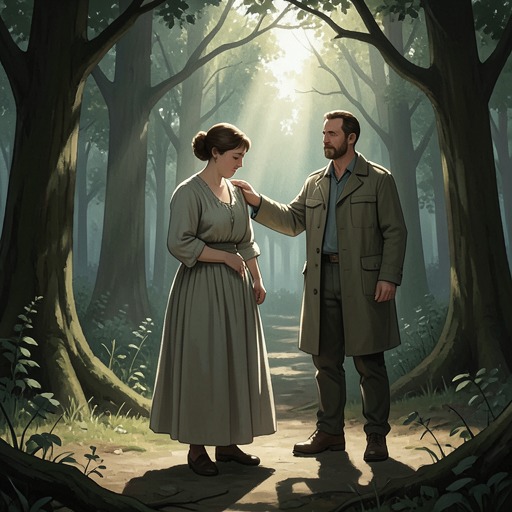
Connie and Mellors’ First Sexual Encounter
Lady Chatterley's LoverConnie and Oliver Mellors’s first sexual encounter begins not with a declaration of love but with a visit to the chicken coops and Connie’s sudden tears. In the hut, Mellors offers a quiet closeness that briefly lifts a cloud from her, yet the encounter leaves her questioning whether its meaning is real. Its decisive turn is reciprocal but not identical: Mellors recognizes a return to life, while Connie remains uncertain about what she has experienced.
Background and Contrasting Ideas of Intimacy
Connie’s upbringing had encouraged a strong ideal of personal freedom. As a young woman in Dresden, she and her sister Hilda had moved among students, discussed politics and art with men, and walked in the forests singing. In that remembered world, conversation and intellectual companionship mattered more than sexual connection. Connie’s early experience had also left her with the sense that sex could feel like an old form of subjection, and that a woman might preserve her inner independence even when yielding outwardly.
The novel has already tested that theory against experience. During her affair with Michaelis, Connie could become active in seeking her own satisfaction, but his response to that activity left her stunned. That earlier encounter gives the scene with Mellors a relevant contrast: the question is not simply whether Connie desires sexual intimacy, but whether an encounter can offer something other than a contest over who directs it. The scene does not settle that question by argument. Instead, it makes a small gesture of care, and Connie’s unspoken distress, the immediate conditions of their approach.
The Clearing and the Chickens
One evening, despite her duties as hostess at Wragby, Connie escapes after tea and crosses the park into Wragby Wood. She hurries toward the clearing, where Mellors is closing the coops for the night. A few chicks remain outside the shelter, resisting the hen’s efforts to gather them in. Connie says she has come to see the chickens and asks whether there are more. Her attention initially rests on the birds rather than on the keeper.
When Connie reaches gingerly through the coop, the mother hen pecks at her hand. Mellors crouches beside her, reaches in more confidently, and draws out a chick. Connie holds the small bird in her hands; its alertness and unsteady life capture her attention. As she helps return it to the hen, a tear falls on her wrist. Mellors moves away at first, aware of his own returning desire, but then sees Connie kneeling and crying. His response changes from withdrawal to compassion. He touches her knee and tells her not to cry. The emotional hinge of the scene is this shift: the encounter grows out of her visible anguish and his response to it, not out of a conversation about their relationship.
The Encounter in the Hut
Mellors asks Connie whether she will come to the hut. He leads her inside, clears away the chair and table, and spreads a brown soldier’s blanket taken from the tool-chest. His face appears pale and without expression, as though he were submitting to something he could not avoid. Connie remains motionless before lying down. The narration presents her as quiet and withdrawn, with the encounter unfolding while she experiences it in a state resembling sleep or a dream.
The account emphasizes soothing touch and stillness rather than dialogue or mutual explanation. Mellors’s approach is gentle, and Connie does not interrupt the silence. The difference between their immediate experiences matters: the event is an intimate beginning between them, but the scene does not portray Connie as arriving at a settled understanding of it. Her passivity and uncertainty remain part of its meaning, rather than evidence that she has reached a clear decision about love, freedom, or the future.
Aftermath and Significance
Afterward, Connie wonders why the encounter was necessary and why it seemed to lift a great cloud from her. She asks herself whether it was real, and the narration connects that doubt to her sense that giving herself to another person makes the experience real, whereas keeping herself entirely to herself leaves it empty. Even as she recognizes relief, she cannot transform it immediately into certainty. Mellors, by contrast, lies beside her in silence, which she experiences as peaceful despite his remaining a stranger to her.
In their later exchange, Mellors describes what has begun as life and says he had thought he was finished with it. Connie echoes the word with a thrill. The encounter therefore marks a change for him as well as the start of their sexual relationship: a guarded man who believed he had closed himself off feels himself opened again. When they walk through the darkening wood, he holds her against his breast and says that the experience was good for him, then asks whether it was so for her. Connie answers yes, though the narration qualifies her response as not wholly truthful; she had not been conscious of much. That qualification preserves the scene’s unresolved quality. Mellors finds renewed life in the encounter, while Connie receives comfort and a sense of relief without yet possessing the same clarity. Their first intimacy begins a relationship, but it does not erase the difference between what each of them feels or knows.