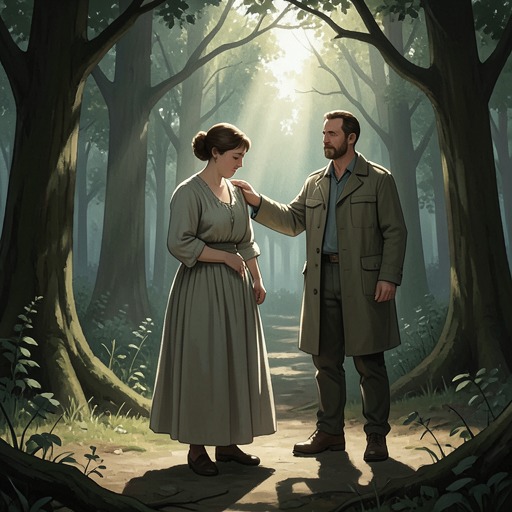
Connie and Mellors’ Sexual Awakening in the Wood
Lady Chatterley's LoverThe encounter in the young fir thicket of Wragby Wood marks a change in Connie Chatterley’s understanding of intimacy with Oliver Mellors: what follows is not merely renewed passion, but an experience she associates with shared fulfillment and a newly vulnerable attachment. The scene’s meaning is deliberately unsettled, however, by its account of Connie’s initial refusal, Mellors’s persistence, and her inability to act. Its aftermath turns inward, as Connie distinguishes the adoration she has begun to feel from the self-directed passion she already knows.
Circumstances and Setting
The episode begins after Connie has visited Mrs. Flint, whose baby has stirred in her thoughts the warmth of motherhood and the painful sense that she herself lacks something she may not be able to have. Leaving the Flints’ pasture, she climbs a fence and enters a narrow path among dense young firs. She dislikes this new part of Wragby Wood, finding it choking and grotesque. Her reflections on the baby and on her own childlessness are interrupted when she sees a man barring the path: the keeper, Oliver Mellors.
The setting shapes the scene rather than simply decorating it. The half-grown firs are dense enough to obstruct Connie’s way, and Mellors leads her through their prickly growth to a small space among dead branches. He puts down dry boughs and places his coat and waistcoat over them. This enclosed, makeshift clearing separates the encounter from the open pasture and the path, while the surrounding trees also make the scene feel constricted. The natural setting is therefore both a refuge from ordinary social space and a physical barrier through which Connie is led.
The Encounter and Its Tension
Mellors asks whether Connie has been giving him the slip. She denies it, but does not complete her explanation. When he steps close and puts an arm around her, she feels the nearness of his body and tries to push him away, saying that it is not the time. He answers that there is still half an hour and says he wants her. The narration then describes Connie as having lost her will and as giving way. That sequence matters: her resistance and his insistence are part of the scene’s evidence, not details to be erased by its later language of awakening.
In the clearing, the encounter proceeds while Connie remains largely passive. The account says she does not help him and lies inert; Mellors arranges the boughs and covers her with his clothing. The scene thus presents an imbalance of action alongside the physical closeness between them. Its later account of shared pleasure does not make the earlier refusal disappear. Read together, these details complicate any uncomplicated description of the episode as mutual surrender: Connie’s experience changes during the encounter, but the narration also records that she initially says no and does not actively direct what follows.
The passage’s emphasis then shifts from action to sensation and altered awareness. Connie experiences an unfamiliar sequence of feeling that she cannot control or bring to a conclusion through her own effort. The prose describes this as a change from the kind of passion in which she had previously exercised her will. Afterward, both lie still and unaware of their surroundings for a time. The shift is significant not because it resolves the scene’s imbalance, but because it gives Connie a new experience against which she can recognize the limits of her former, more self-controlled pattern.
Aftermath and Relationship
When they begin to recover their awareness, Mellors covers Connie and then sits beside her, taking her hand in silence. He tells her that they came off together that time and reflects that many people pass through life without knowing such an experience. Connie does not answer. His words give the moment a shared interpretation, but the narration does not make her response verbal or immediate: she remains quiet, and the meaning of the encounter continues to unfold after they part.
As the sun’s last rays touch the wood, Mellors says he will not accompany her and that it is better not to. His dog is waiting anxiously for him to leave. Connie walks home alone, carrying a changed sense of her own inner life. She feels, in her thoughts, as though another self has become alive within her; the image of a child returns, now joined to her feeling for Mellors. The earlier sight of Mrs. Flint’s baby has made motherhood a point of comparison, but Connie’s reflection is not simply a wish for a child in the abstract. She imagines a child bound to a man toward whom she feels profound desire and attachment.
Awakening, Adoration, and Selfhood
Connie distinguishes the passion itself from what is new: yearning adoration. That distinction gives the episode its lasting consequence. She fears that loving Mellors too deeply could make her helpless, efface her identity, and turn her into a slave. At the same time, she recognizes that she could resist this feeling through force of will and return to a form of passion in which she retains control. The conflict is therefore internal as well as relational: Connie is weighing the vulnerability of attachment against the self-command she has relied on.
For a moment, she imagines the older passion as a kind of female power that makes the man merely an instrument. But she finds that possibility familiar and barren, whereas adoration feels unknown and profound. Her decision is not a settled promise to surrender her independence; she knows she could fight the feeling, and she fears what it might cost. Yet she does not immediately crush it. The encounter’s decisive change lies in this choice to let an unfamiliar attachment remain present. The scene closes not with a public declaration or a resolved future, but with Connie recognizing that her desire has acquired an emotional depth she both fears and values.