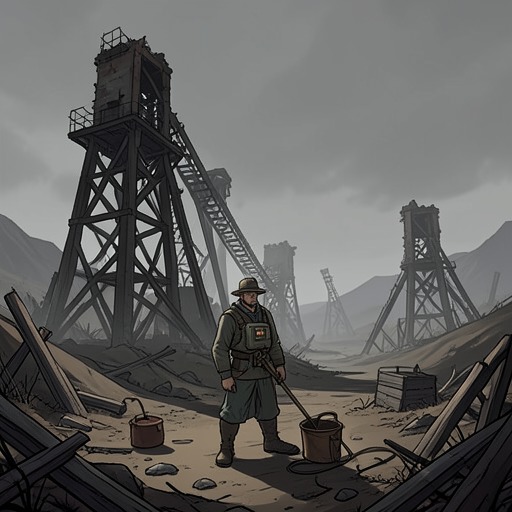
One England blots out another
Lady Chatterley's Lover“One England blots out another” is the novel’s compressed account of a landscape and social order being displaced by industrial expansion. The phrase does not describe a smooth transition: mines that once sustained the country houses now help erase them, and industrial settlements replace both estates and older working-class cottages. As Connie Chatterley sees this change on the road through the district, the vanishing buildings make a wider break in history visible: the future is arriving, but she cannot imagine what it will be.
The phrase and its historical reversal
The expression appears as the narrator interprets the country Connie is passing through. Its central irony is economic as well as historical. The mines had made the great halls wealthy; now the mines and the industrial world they represent blot those halls out. The agricultural England is being supplanted by an industrial England, and the old meanings attached to the landscape are displaced along with its buildings. The passage repeats the image of blotting out until it becomes a principle of change: “One meaning blots out another. The new England blots out the old England.”
The result is not presented as an organic continuity, but as a mechanical one. That distinction gives the phrase its force: a new landscape may occupy the same ground, yet it does not inherit the older place’s social and cultural life in any living, gradual way. The sequence is therefore more than a contrast between picturesque old buildings and modern works. It describes one social order materially undoing the setting of another, while leaving the future that follows uncertain.
A landscape caught between orders
The drive makes that reversal visible in successive views. Above the new works at Stacks Gate rise vast plumes of smoke and vapor; the place has no chapel, pubs, or shops in the older sense, only the works, model dwellings, and a hotel that is in practice a miners’ pub. The new settlement has arisen since Connie came to Wragby, and its dwellings have filled with newcomers. Industry is not a distant stain on the countryside: it builds settlements, remakes local life, and alters what can be seen from the road.
The older country persists in a different register. Chadwick Hall stands above its park as a famous Elizabethan house, still maintained but reduced to a show place, its former authority out of date. The narrator sets this surviving monument against the present below: Uthwaite, where railway lines, coal mines, steelworks, smoke, and glare gather in the valley. As the car descends from the rolling country, the view closes in on blackened miners’ cottages, foundries, walls, clanking iron, lorries, and screaming whistles. The changing scale of the view makes the transition palpable: from estates that once dominated open land to industrial structures that overwhelm the observer.
The social geography is layered rather than simply divided between old and new. Blackened cottages line the older streets; newer, somewhat larger workers’ houses spread farther through the valley; and raw-brick mining settlements appear in the hollows and on the slopes. Between them survive fragments of an older cottage England, but they are remnants, not a stable alternative. The countryside’s apparent continuity conceals a landscape being reorganized by industry.
The demolition of the old estates
Fritchley gives the transformation a specific human and architectural cost. The Georgian mansion is in perfect repair, yet it is being demolished as Connie passes. The Weatherleys had lived there in style until the war, but the house is now considered too large and expensive, and the country too uncongenial. The departing gentry can spend their money elsewhere without having to see how it is made. In this account, abandonment is not simply decay: economic pressure and class separation help determine which people leave and which structures disappear.
Shipley makes the process still more stark. Its gates stand open beside the level crossing of the colliery railway, and a right of way through the park brings colliers into the grounds. The colliery itself stands beyond the trees. After Squire Winter’s death, the heirs order Shipley demolished because it costs too much to maintain and nobody will live there. The yew avenue is cut down, the park stripped of timber and divided into lots, and new semi-detached houses rise on the estate. Within a year of Connie’s last call, Shipley Hall Estate occupies the site; the stucco hall that stood there twelve months earlier has become almost impossible to imagine.
The new estate’s name preserves the old place only as a label. Its red-brick “villas” and streets do not continue the life of Shipley Hall; they occupy its cleared ground. The description of an ornamental coal mine on a lawn sharpens the reversal: what once threatened the estate from beyond its trees has become part of the new landscape’s defining character. The change is neither complete nor finished, but the passage insists that the direction is clear: the England of the Squire Winters and Wragby Halls is gone, even while its blotting out remains incomplete.
Connie’s perception and the uncertain future
Connie belongs to the leisured class and has clung to what remains of the old England. It has taken her years to understand that the new industrial landscape is not an incidental intrusion but a force continuing to displace that world. Her perspective gives the phrase an intimate as well as a historical meaning: the loss is registered by someone attached to the older order, yet able to see that attachment cannot preserve it.
What follows the old England remains beyond her imagination. She sees new brick streets spreading into fields, new structures rising at collieries, and younger people whose lives are shaped by the Pally or the Welfare rather than by an inherited awareness of the old country. The narrator describes a gap in continuity of consciousness: the younger generation is almost American in its break with the past, but industrial in the world it inhabits. Connie feels there is no next, and longs to hide herself, or at least take refuge in the bosom of a living man. Her personal unease does not solve the historical question; it shows how exposed she feels within a change too large for her to picture.
That uncertainty also prevents the phrase from becoming a simple elegy for country houses. As Connie watches miners returning from the pits, the passage presents them as patient and kind, yet physically distorted and diminished by underground labor. They remain men, but the narrator sees something human bred and killed out of them. The old England is vanishing, while the industrial present is shown as grievously incomplete; neither condition supplies an easy vision of what should replace the other. “One England blots out another” therefore names both a material demolition and a rupture in human inheritance, with the promised next England still unanswered.