The hut
Lady Chatterley's LoverThe hut is the gamekeeper’s shelter in Wragby Wood and the principal secluded setting for Connie Chatterley and Oliver Mellors’s meetings. Its darkness, small lantern, and narrow approach offer a contrast to Wragby Hall and the surrounding industrial landscape, but not an escape untouched by the outside world. The hut becomes a place where intimacy can take shape, while the story keeps its vulnerability and the lovers’ coming separation in view.
Setting and Access
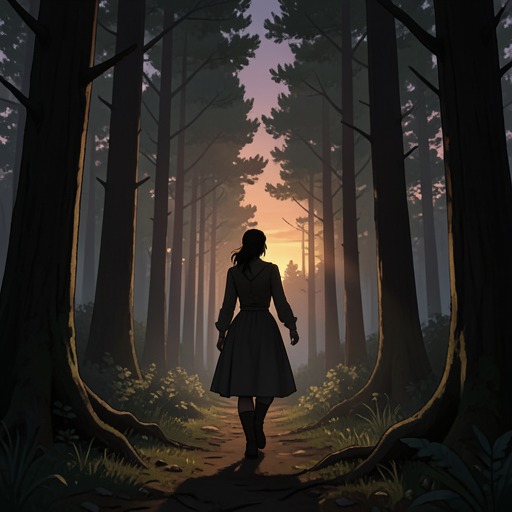
The hut stands within the wood, reached by a narrow track branching from the riding. When Clifford Chatterley’s chair passes along the broader path, the track to the hut is too narrow for it—hardly wide enough for one person. That practical limit separates Clifford’s route from the keeper’s secluded ground. As Connie watches Clifford continue toward the well, Mellors approaches her on foot with his dog behind him. The hut’s privacy is therefore not simply a matter of distance: it depends on a path that some visitors cannot take.
The shelter belongs to a woodland whose seclusion is already compromised. Wragby Wood is a remnant of an older forest, and the surrounding riding passes through private land. Sir Geoffrey Chatterley’s wartime cutting has left a denuded knoll visible from the wood; from its crown, the colliery railway and new works at Stacks Gate intrude on the view. The hut’s intimacy is set inside this altered landscape, not in an untouched wilderness. The industrial world can be glimpsed and heard beyond the trees, even when the lovers withdraw into the shelter.
That contrast sharpens in the broader setting. Wragby stands near Tevershall, where the pit’s smoke and steam, the burning pit-bank, and the smell of sulphur, iron, coal, or acid make industrial disturbance part of everyday life. From the wood, Mellors sees the lights at Stacks Gate and Tevershall and hears the winding engines lowering miners to work. He recognizes that the apparent seclusion is illusory: industrial noise and light cross the boundaries of the wood. The hut offers a refuge within that pressure, not a protected world beyond it.
Meetings and Use
The hut is a place for private encounters between Connie and Mellors. On one visit, after they have gone inside, it is quite dark; Mellors makes a small light in the lantern. He asks whether Connie has left off her underthings, and she confirms that she has. The brief exchange makes the hut’s privacy tangible: the lovers can speak and act there away from the household and its routines, while the lantern supplies only enough light to orient the encounter.
Their meetings also give the hut a conversational role. During a thunderstorm, Connie asks Mellors about his earlier life as an officer. His answer opens onto his bleak view of industrial society: he describes men reduced to labor-insects, stripped of manhood and real life, and says he would wipe out the machines and end the industrial epoch if he could. The hut shelters not only their physical closeness but also a disclosure of his anger and despair. The storm outside accompanies a conversation that reveals how little he believes the wider world can be escaped.
As the rain intensifies, Connie opens the door, sees it falling like a heavy curtain, and feels an urge to run into it. She removes her stockings, dress, and underclothing, puts her rubber shoes back on, and dances in the rain with movements she had learned in Dresden. Mellors watches, then strips and follows her outside; Flossie runs ahead. Their movement carries them away from the shelter into the rain and along the path. The hut thus serves as a threshold as well as a refuge: the lovers can leave its protection and meet the weather together.
Intimacy and Vulnerability
After the storm encounter, the thought of separation remains present between them. Connie sits on Mellors’s thighs with her head against his breast while the firelight falls unevenly across them. He takes up flowers that are still wet enough to drip onto the floor and reflects on how they remain outdoors in all weather. The flowers bring the storm’s exposure back into the hut, where warmth and shelter coexist with the knowledge that the lovers’ relationship has no secure future in view.
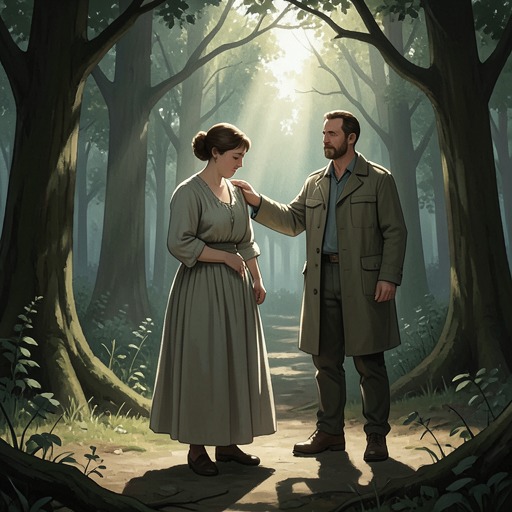
That awareness gives the shelter’s privacy a poignant limit. The hut can hold a moment of closeness, but it cannot resolve the larger conflict surrounding Connie’s marriage or guarantee that the couple can remain together. When Connie dresses to return to Wragby, she feels that the journey home is faintly ignominious. As she and Mellors emerge onto the riding, Mrs Bolton falters toward them, worried that something has happened. Connie answers that nothing has happened. The encounter makes the boundary around the hut’s secrecy visible: the lovers leave the secluded space and re-enter a world in which other people may notice their movements.
Narrative Significance
The hut’s meaning depends on the tension between withdrawal and exposure. Its narrow track keeps Clifford’s chair from reaching it, and its dark interior allows Connie and Mellors a private meeting; yet the wood is crossed by industrial sounds, its damaged clearing opens a view toward mining works, and the lovers repeatedly return to the riding and the household beyond it. Rather than presenting nature as an uncomplicated refuge, the novel places the shelter within a landscape already reshaped by industry and ownership.
The storm scene makes that tension bodily. Connie moves from the hut into the rain, and Mellors follows; their intimacy is expressed not by remaining safely enclosed but by stepping out into the weather together. At the same time, the prospect of separation persists even in the shelter’s warm aftermath. The hut is consequently both a practical hiding place and a temporary space in which the lovers’ closeness becomes possible—precious precisely because it remains vulnerable to the world around it.