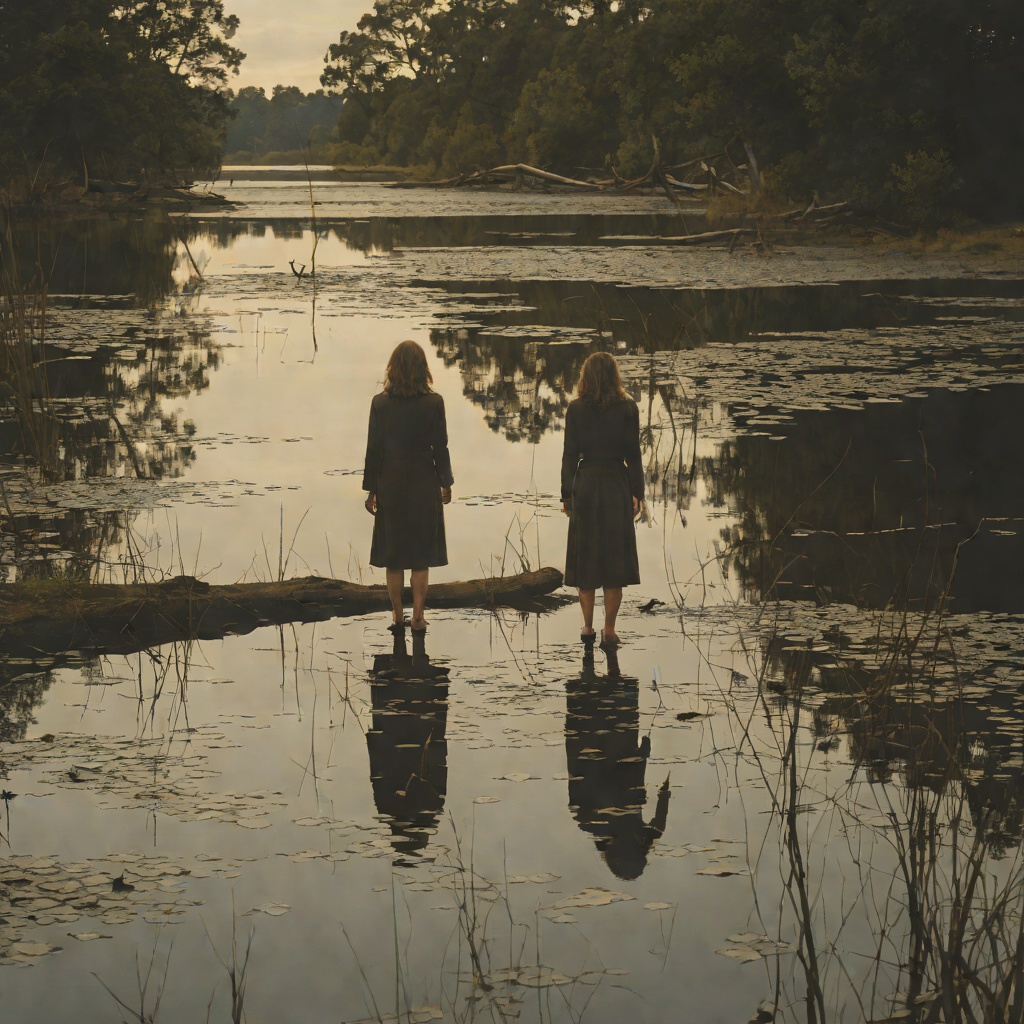
Cylburn Arboretum
Lady in the LakeCylburn Arboretum is a wooded expanse in Baltimore that the novel invests with a double life: it is at once a place of private romantic memory and the public site of a murdered girl's discovery. For Maddie Schwartz, the arboretum is first a landscape of thwarted desire, the spot where she once parked with the boys she dated and where, a week before her wedding, she nearly made love to Milton Schwartz. He refused, wanting to wait because he believed she was a virgin. Years later, the same ground becomes the scene of a very different revelation, when Maddie and Judith Weinstein find the body of Tessie Fine in a gully near the fence line. The arboretum thus binds together the two poles of Maddie's life—the respectable marriage she built on a lie and the violent truth that will pull her toward a new identity as a newspaperwoman.
A Landscape of Memory and Desire
Long before it becomes a crime scene, Cylburn Arboretum is a repository of Maddie's erotic past. She remembers parking there with all the boys she dated, and she recalls the near-miss with Milton, the two of them a week out from their wedding, parked in a popular spot near the arboretum, so close to doing the deed. Milton said no, and Maddie, who had already lost her virginity, mimicked the pain of a first time on her wedding night, an early lesson in the marriage principle of letting some lies lie. The arboretum is thus tied to the foundational deception of her marriage, the secret she carried into her life with Milton. When she later returns to the grounds to search for Tessie Fine, she cannot explain why she thought to look there, because to do so would be to confess that she remembered parking there with boys, and that she had tried to get her future husband to make love to her in that very place. She says only, "Just a hunch."
The arboretum's character as a place of wildness within the city is part of what draws Maddie's attention. She reflects that it is not far from where Tessie Fine was last seen, no more than a mile, a bit of wildness in the heart of the city. If one were to dump a body somewhere, she thinks, this would be the place. The grounds are larger and more heavily wooded than she recalled, with trails that go deep, all the way down to Cylburn Avenue. The day of the search, which had started with promises of spring, has aged into something raw and punishing, and the two women walk the trails systematically, aware that they need to leave by five, the closing time during winter.
The Discovery of Tessie Fine
Maddie and Judith arrive at the arboretum after taking buses to a synagogue parking lot, joining volunteers about to set out on a search for the missing girl. When a man tells them, "This is no job for women," Maddie refuses to be dismissed, replying, "Then we'll do our own search. It's not as if we need your permission to walk around Baltimore." With their deadline approaching, Maddie suggests they walk the last trail all the way to the fence. The land dips there, creating a gully, and the fence is broken, torn open. From the street, the bottom of the gully is invisible; one has to be on the hill, above it, to see what Maddie sees.
What she catches is a glimpse of something shiny, too shiny, in the gray-green wintry underbrush: a bright silver crescent on the heel of a shoe. The shoe is attached to a leg, the leg to the body, the body to a head, a face—a face too composed, too still. No child's face was ever this still. With her loden-green coat and brown tights, Tessie Fine has almost disappeared into the landscape, but her red tresses flame like out-of-season wildflowers, and her shoes shine on, catching the last rays of light. The discovery is the novel's central turning point, the moment that propels Maddie out of her private world of secrets and into the public realm of news, where she will eventually find work at The Baltimore Star newsroom.
A Place of Contrast and Transformation
The arboretum stands in sharp contrast to the other spaces that define Maddie's life at this time. Her apartment on Gist Avenue, where she has moved after separating from Milton, is a place of reduced circumstances, a charming but shabby dwelling in a neighborhood that is mixed on its way to being not so mixed. There, she stages a false burglary, shoving her engagement ring into the dirt of a potted African violet and running into the street screaming for help. The arboretum, by contrast, is a place of genuine wildness and genuine danger, where the truth of Tessie Fine's death lies hidden in a gully. Where the apartment is a stage for Maddie's deceptions, the arboretum is a site of unvarnished reality, the place where a dead girl's body is finally seen.
The arboretum also carries a different kind of contrast in the novel's later scenes. When Maddie is stabbed by Angela Corwin, she experiences a supercharged energy and a clarity of thought, aware that she should be in pain but feeling none. The hospital walls where she later recovers are a pale institutional green, while the Formica chair is yellow—colors that echo the gray-green underbrush of the arboretum where Tessie Fine lay. The echo suggests that the arboretum's palette of muted greens and yellows has become part of Maddie's perceptual world, a reminder of the death she witnessed and the new life that grew from it. The place where she found Tessie Fine is thus not merely a location but a transformation, the ground where the old Maddie—the wife, the liar, the woman of reduced circumstances—began to give way to the woman who would become a journalist, chasing stories and truths across Baltimore.