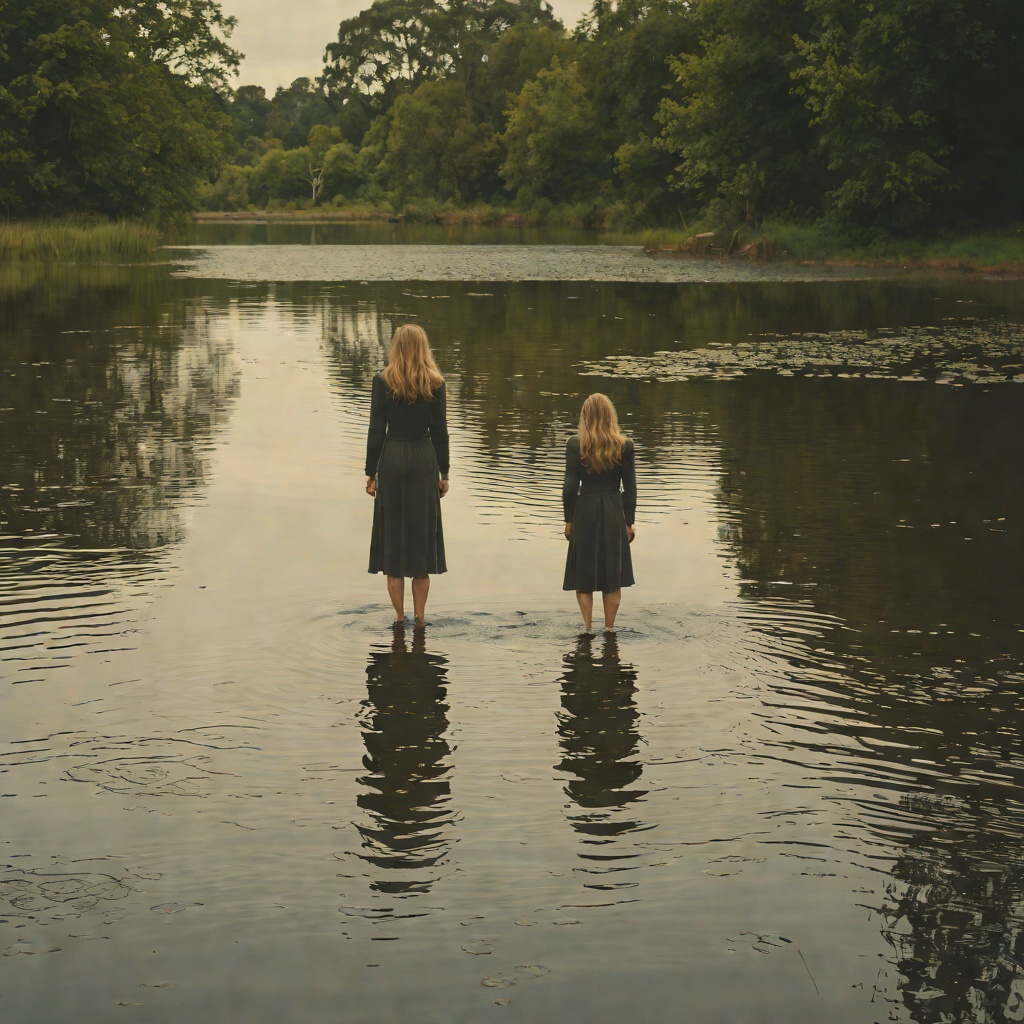
Druid Hill Park Fountain
Lady in the LakeThe Druid Hill Park Fountain stands at the geographic and symbolic heart of the novel, a public landmark that becomes the resting place of Cleo Sherwood's body and the pivot around which Maddie Schwartz's transformation turns. Located a block from the temple where Maddie first observed Cleo, the fountain and its surrounding park form a nexus of the city's social worlds—the place where a poor Black woman seeking solitude and a middle-class white woman seeking purpose unknowingly cross paths. It is here that the novel's central mystery is born and here that its resolution begins, making the fountain far more than a setting: it is the site where death becomes spectacle, where a forgotten woman gains a nickname, and where Maddie's journalistic ambitions find their first true story.
The Fountain as a Site of Death and Discovery
The fountain's most decisive role comes with the discovery of Cleo Sherwood's body. After steeping in the water for months—through the cold winter, the fitful spring, and into early summer—Cleo is dragged from the fountain as a 'nasty broken thing,' her face and much of her flesh gone. The condition of her body makes identification difficult and renders her almost anonymous, a fate that seems to confirm her social invisibility. No one outside her family was supposed to care about her disappearance; she was dismissed as 'a careless girl who went out on a date with the wrong person and was never seen again.' The fountain thus becomes the stage for a kind of public erasure, where a woman who had been beautiful and vital is reduced to an object of morbid curiosity.
The discovery itself comes about through a chain of small, seemingly unrelated events. A passerby notices that the lights at the fountain have stopped working and writes a letter, which reaches Maddie at the newspaper. She calls the Department of Public Works to report the outage, a routine act of initiative that she performs without expecting any consequence. When a worker later finds a body in the fountain, the police come to the newsroom asking why Maddie called and what she knows about the person who inquired about the lights. The letter, handwritten in a masculine hand with a name that struck Maddie as false—'not John Smith, but similarly generic'—has been discarded, and Maddie cannot produce it. This moment marks the beginning of her entanglement with the case, transforming her from a minor columnist handling small problems into someone connected to a death that the authorities would rather ignore.
A Place of Solitude and Escape
Before it became a site of death, the fountain and the surrounding park served as a refuge for Cleo Sherwood. Living in a crowded apartment with eight people—her father and mother, her sister and two brothers, her two boys, and herself—she found no peace at home. She would slip a book into her purse, often a Jean Plaidy or Victoria Holt novel, and tell her mother she was going to the library, a lie her mother never had the heart to challenge. Instead, she would walk the paths of the park, drink up the silence, drop onto a bench, and lose herself in the imagined world of old England. The park offered her the solitude that her domestic life denied, a space where she could momentarily escape the pressures of being a mother, a daughter, and a woman whose choices had brought her back to her parents' home 'like a bad penny.'
The fountain's location, a block from the temple, also places it within a landscape of social observation. It was on the temple steps that Maddie stood beside her husband Milton, and it was there that Cleo first saw her, taking in Maddie's appearance and calculating her own ambitions. The park thus becomes a meeting point of two women who never speak but whose lives are intertwined through the fountain's waters. Cleo's decision to take a roundabout way to the park that afternoon, with a book in her purse, is a small choice with enormous consequences, one that binds her fate to the fountain and to Maddie's later investigation.
The Fountain as a Symbol of Transformation
The fountain's significance extends beyond the plot into the novel's thematic structure. For Maddie, the discovery of Cleo's body marks a turning point in her own life. She has recently left her husband Milton, moved to a smaller apartment on Gist Avenue, and begun working at the newspaper in a limited capacity. The fountain gives her a story that matters, one that she can pursue with the 4.5 hours of comp time she has earned. It is through this investigation that she begins to define herself not as Milton's wife or her mother's daughter, but as a journalist with a purpose. The fountain, in this sense, is the catalyst for her reinvention, the place where her professional ambitions and her personal desires converge.
For Cleo, the fountain represents a different kind of transformation. Alive, she was Cleo Sherwood, a woman with green eyes and a straight nose, a face that earned her the nickname that later inspired a man to call her Helen, saying she was beautiful enough to start a war. Dead, she becomes the Lady in the Lake, a name Maddie gives her that turns her into a public figure, a story to be told. The fountain is thus the site of her double identity, the place where her humanity is stripped away and replaced by a narrative that serves others' purposes. She reflects bitterly on this transformation, asking why Maddie could not have stayed in her beautiful house and her good-enough marriage and let her remain at the bottom of the fountain, where she was safe. The fountain, for Cleo, is both her grave and the instrument of her posthumous fame, a paradox that underscores the novel's meditation on who gets to be remembered and why.
The Fountain in Maddie's Later Life
The fountain's resonance extends into Maddie's later years, when she has become a successful columnist. She revisits the Tessie Fine story, her role in it, at suitable intervals, and the memory of the fountain and what it contained remains a touchstone for her sense of self. She writes about herself, telling herself it is because she has done her time writing about others, but she knows in her heart that she is always writing about herself, that the only story she can ever know is her own. The fountain, with its buried body and its hidden truths, is the origin of that self-knowledge, the place where she first confronted the gap between the stories people tell and the realities they conceal.
In her public speeches, Maddie invokes the idea of connection, quoting E. M. Forster's Howards End: 'Only connect the prose and the passion, and both will be exalted, and human love will be seen at its height. Live in fragments no longer.' She describes herself as a planchette, guiding her readers toward the answers they desire. But the fountain stands as a reminder of the limits of that connection, the fragments that cannot be joined, the stories that resist telling. It is the place where Cleo's story ended and Maddie's began, and its waters hold the unresolved tension between the two women's fates. The fountain, in the end, is not just a location but a symbol of the novel's deepest concerns: the power of naming, the violence of erasure, and the impossible desire to connect across the divides of race, class, and death.