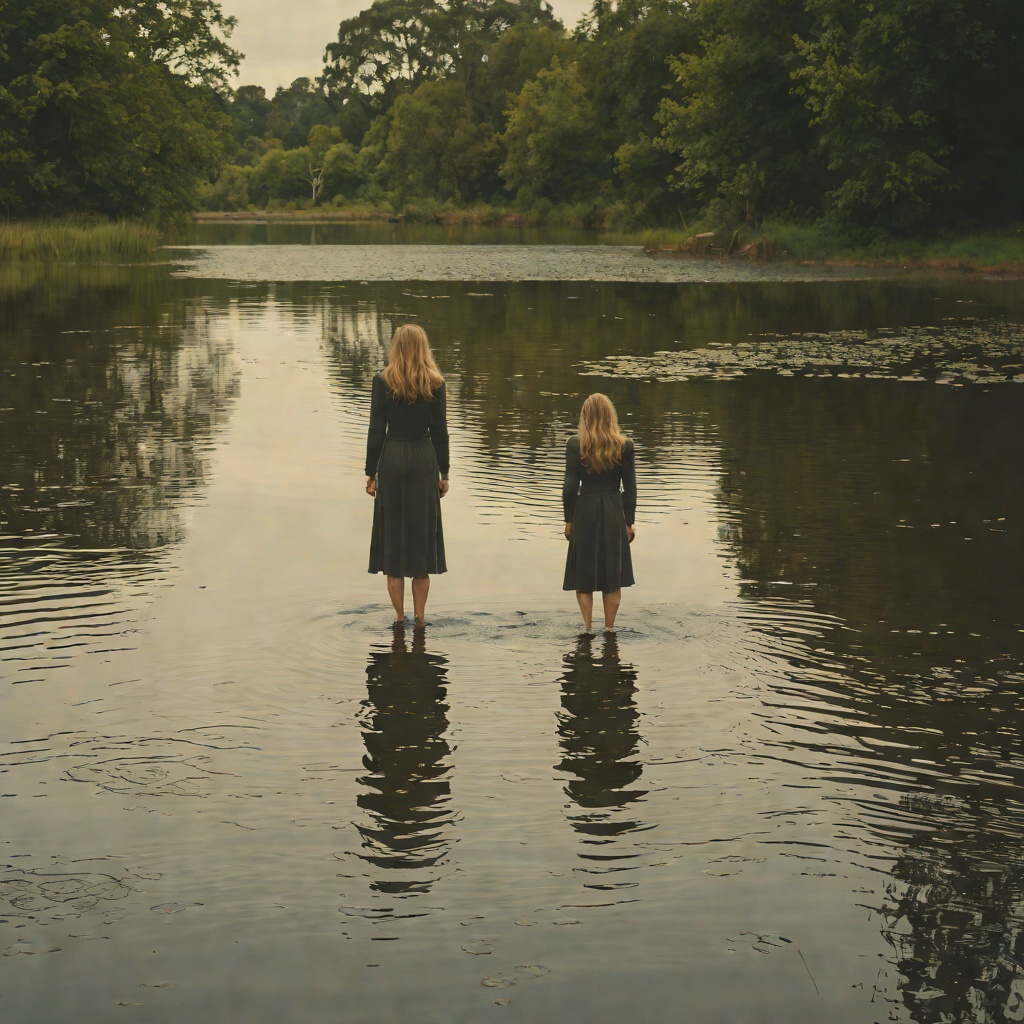
Green and yellow
Lady in the LakeGreen and yellow is the recurring color motif that threads through the novel's central mystery, appearing first as a psychic's vision of Cleo Sherwood's final moments, then as a symbol of the lies, jealousy, and cowardice surrounding her death, and finally as a quiet confirmation of the truth that Maddie Schwartz can never reveal. The phrase binds together the novel's deepest concerns: the unreliability of perception, the gap between what is seen and what is true, and the way that even the most intimate knowledge can be withheld from the world. It is a motif that moves from the supernatural to the bitterly ironic, from a fraud's guesswork to a dead woman's own testimony, and ultimately to the very walls of a hospital room where a supposed corpse sits up and speaks.
The Psychic's Vision
The motif enters the story through Madame Claire, the psychic whom Cleo Sherwood's mother consults after her daughter's disappearance. When Maddie Schwartz presses her for details, Madame Claire describes seeing "green and yellow, all around" in Cleo's final living moments. She elaborates that she thought it might be the sun, that Cleo was someplace where she could not turn her head and was forced to look into the sun, perhaps a room or a ceiling. When Maddie questions the colors because they do not match where Cleo's body was found, Madame Claire insists that the yellow came from earlier in the evening, that Cleo "must have been in a yellow room," and repeats the haunting phrase: "Yellow was the last thing she saw." The psychic's certainty is striking, and Maddie, already troubled by the case, walks home feeling like Orpheus going into hell to retrieve Eurydice, haunted by the thought of "yellow, disappearing. The eclipse. That damn eclipse."
The Dead Woman's Correction
The novel then delivers its most devastating twist on the motif: the dead woman herself speaks. Cleo Sherwood, in a passage that reveals she is not dead at all, mocks the psychic's vision with bitter irony. "Green and yellow, huh?" she asks. "You get what you pay for, Maddie Schwartz." She reveals that the green and yellow were the upholstery on the balcony seats in the theater where she sat two weeks before she supposedly died, watching Man of La Mancha in New York with her lover. The real green, she insists, was jealousy, and there was no yellow at all—"unless you count the cowardice of the man who decreed I had to die but would not deign to do the job himself." The colors that Madame Claire claimed to see in Cleo's final hours were nothing more than the psychic's guesswork, a fraud's improvisation that happened to touch on truth without ever grasping it. The ermine stole that Cleo's mother brought to the psychic was actually rabbit, not ermine, and the psychic's pronouncement of the colors "tells you everything you need to know about the woman who claimed she saw my final hours."
The Colors of Desire and Memory
Green and yellow also carry a private, erotic resonance for Maddie herself. Reflecting on her first lover, she remembers "a green silk sofa" and "the yellow sliver of a moon during an eclipse," and realizes that Madame Claire's trick is precisely this: whatever colors the psychic sees, the client fills in the story. The colors become a Rorschach test, a screen onto which each person projects their own memories and desires. For Maddie, the green and yellow are the colors of her own lost passion, the awakening of a "terrible lust" that she had to bottle and tame by marrying quickly. The motif thus connects Cleo's fate to Maddie's own history of desire, secrecy, and self-reinvention.
The Colors of the Truth
The motif closes where it began, in a hospital room. After Cleo Sherwood reveals herself to be alive and leaves, Maddie falls back asleep and realizes that "the hospital walls were a pale institutional green, while the Formica chair was yellow." The colors that Madame Claire claimed to see in Cleo's final hours are, in fact, the colors of the room where Cleo's faked death was exposed. The green and yellow that were supposed to mark Cleo's death instead mark her survival, the moment when the truth finally surfaces—and the moment when Maddie realizes she can never tell anyone. The motif thus completes its arc: from a psychic's vision of death, to a dead woman's mockery of that vision, to the quiet, unshareable confirmation that the vision was wrong. Green and yellow, the colors of Cleo's supposed last sight, become the colors of her actual second chance, hidden in plain sight in a hospital room where a woman who was supposed to be dead simply stands up and walks away.