Pikesville
Lady in the LakePikesville is the affluent, predominantly Jewish suburb northwest of Baltimore that serves as the novel's fixed point of domestic convention—the place where Maddie Schwartz lived with her husband Milton and son Seth, and the place she must leave behind to remake herself. It is less a setting than a gravitational field: the source of the social codes, class expectations, and racial attitudes that Maddie spends the entire novel measuring herself against. From the moment she sells her engagement ring to fund a new life, Pikesville operates as the symbolic opposite of everything she is trying to become, and its pull on her son, her old friends, and her own sense of self never fully releases her.
The Domestic World Maddie Leaves Behind
Maddie's separation from Milton begins with a practical calculation rooted in Pikesville's geography. She rents a two-bedroom apartment downtown, sparse on furnishings, assuming Seth will live with her. But Seth refuses, saying he would rather stay with his father in the Pikesville house, near his friends and his school—even after she offers to drive him to school each day. Maddie suspects Milton's meddling, and comforts herself with the knowledge that Seth has only two years left at home. The choice is telling: Pikesville represents continuity, friendship, and the familiar, while Maddie's downtown apartment represents an uncertain experiment that her own son does not believe in.
The suburb's social world is defined by its judgments. Maddie's mother, Tattie Morgenstern, unfailingly refers to her daughter's situation as her "reduced circumstances," a phrase that becomes a refrain of maternal disapproval. The nagging is specific and relentless: now that Maddie is living in reduced circumstances, she might want to clip coupons, shop sales at Hochschild's, and consider giving up her car entirely. The implication is that Maddie has fallen from the secure height of Pikesville respectability into a lesser state, and that her mother's advice is the only path back to propriety. Maddie's lack of a phone in her new apartment is framed as a small mercy—it means her mother cannot call every day to discuss her future and her reduced circumstances.
The Geography of Class and Race
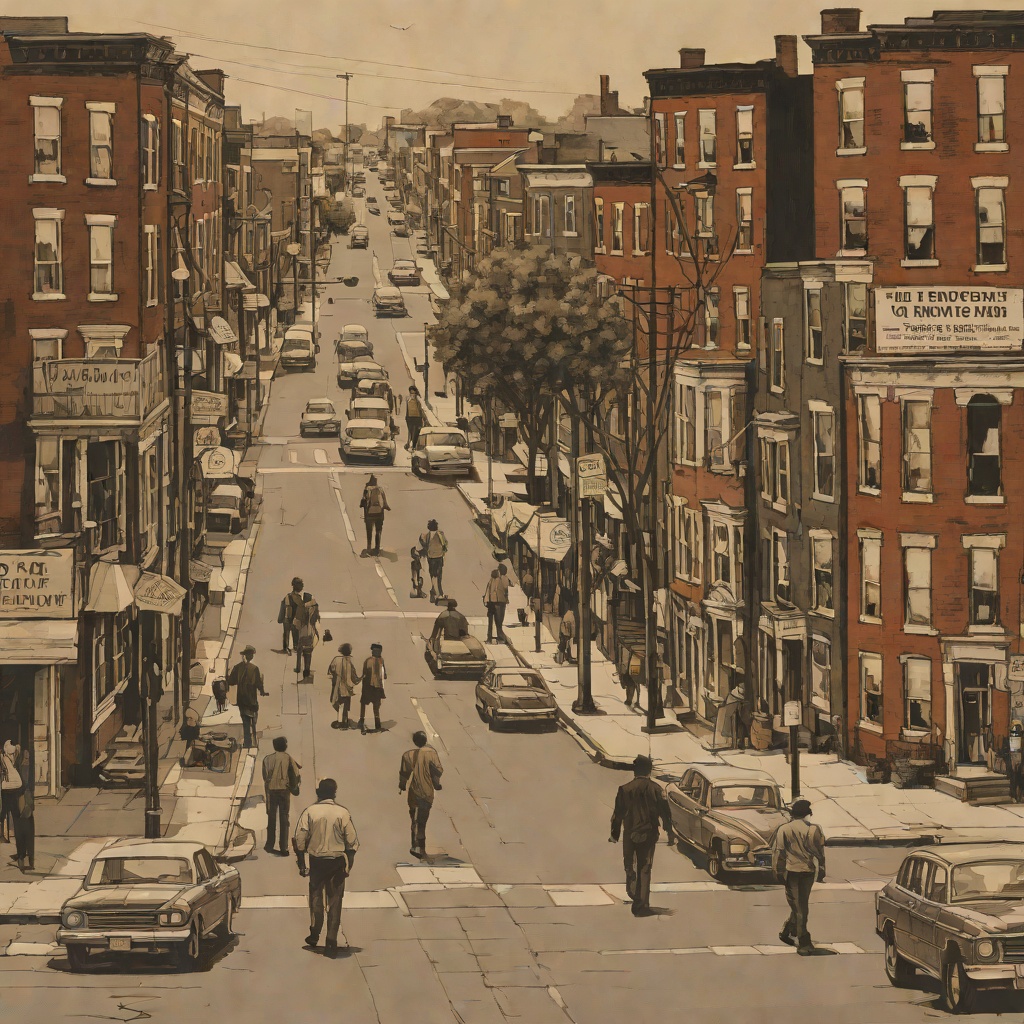
Pikesville's identity is bound up with the city's racial and ethnic geography. When Maddie is driven home by police after the search for Tessie Fine, the officers note that they drive up to Pikesville, "which I expected, it's where all the Jews live." The suburb is so thoroughly identified as the Jewish enclave that it requires no explanation. But the same drive reveals the divide within Maddie's own life: the other woman, the one with the lawyer husband, lives in Pikesville, while Maddie must apologize that she lives downtown, "pretty far out of your way." The contrast marks her as having crossed a boundary that the other woman has not.
The suburb's whiteness is also the lens through which Maddie first confronts the racial reality of her new investigations. When Ferdie Platt laughs at her outrage over how little attention Cleo Sherwood's disappearance received, he explains it bluntly: "Because she's a Negro, Maddie. That's why it wasn't a big deal when she went missing." Maddie insists she is not naive, but she is hurt—she had believed her anger was a tribute to her lover, and that the reason they could never go out in public had nothing to do with race, only her marital status and perhaps his. The conversation exposes how Pikesville's insulated whiteness has shaped her assumptions. Similarly, when she asks a man why no one attended a funeral, his answer is simply "She's colored," as if that settles the matter. Maddie's education in the city's racial hierarchy is measured in such moments, each one tracing back to the segregated world she left behind.
The suburb's racial attitudes are also visible in its changing neighborhoods. Maddie knows the signs that a neighborhood is about to tip from white to black: the "Under Contract" and "SOLD" signs swinging beneath the original "For Sale" signs are covert code for "Get out now." She cannot understand why whites in the city do not want to live next to black people, but she knows they do not, and that the mass hysteria means property values plummet rapidly. She reflects that the Christian neighborhoods had not wanted the Jews either, and still did not really. The white women walking into Pietro's for haircuts would be happy for the convenience of a dry cleaners in the neighborhood, but they would not want Mr. Taylor as their neighbor. Pikesville, in this light, is not merely a place but a pattern of exclusion repeated across the city.
The Social Lines Drawn in Pikesville
Maddie's abandonment of Pikesville costs her its social world. When she seeks a confidante for her stories from work—going to the morgue, venturing into a Negro neighborhood—she realizes she has no friends. She tries calling Eleanor Rosengren, whom she has not seen since the fateful dinner with Wallace Wright that changed her life, but Eleanor seems distant and odd. Maddie understands that lines have been drawn up in Pikesville, and that her old friends will be on Milton's side as surely as they live on the county side of the city-county line. She has abandoned not only Milton but the whole neighborhood, and her new way of life is a rebuke to all of them. The suburb's social cohesion is revealed as a mechanism of enforcement: to leave it is to lose everyone in it.
Yet Pikesville also provides Maddie with one of her few allies. Judith Weinstein, the young woman who works at the jewelry store where Maddie tries to sell her engagement ring, sees Maddie as her best chance to get out of the house without marrying first. Judith is the youngest of five children and the only girl, and her mother has decreed that she must stay home until she marries—something she does not want to do. She does not want to teach school or go into nursing, the stable jobs that would free her from her parents' home, and she does not want to date men like her brothers or her father. Maddie, who has left her husband and is living alone downtown, represents a possible future. The irony is that Pikesville's constraints produce both Maddie's escape and Judith's desire for one.
The Suburb as a Point of Return
Pikesville remains a point of reference even after Maddie has left it. She goes there to get her ears pierced, finding a jeweler up in Pikesville who will do it for the price of the fourteen-karat earrings she must wear until her ears heal. The errand is a small act of self-creation—she has left most of her jewelry at the house in what she believed was a show of good faith, and she will not bother to see what she could get for those old things—but it requires a return to the suburb she has left. The visit is brief and practical, but it underscores how Pikesville remains woven into the logistics of her new life.
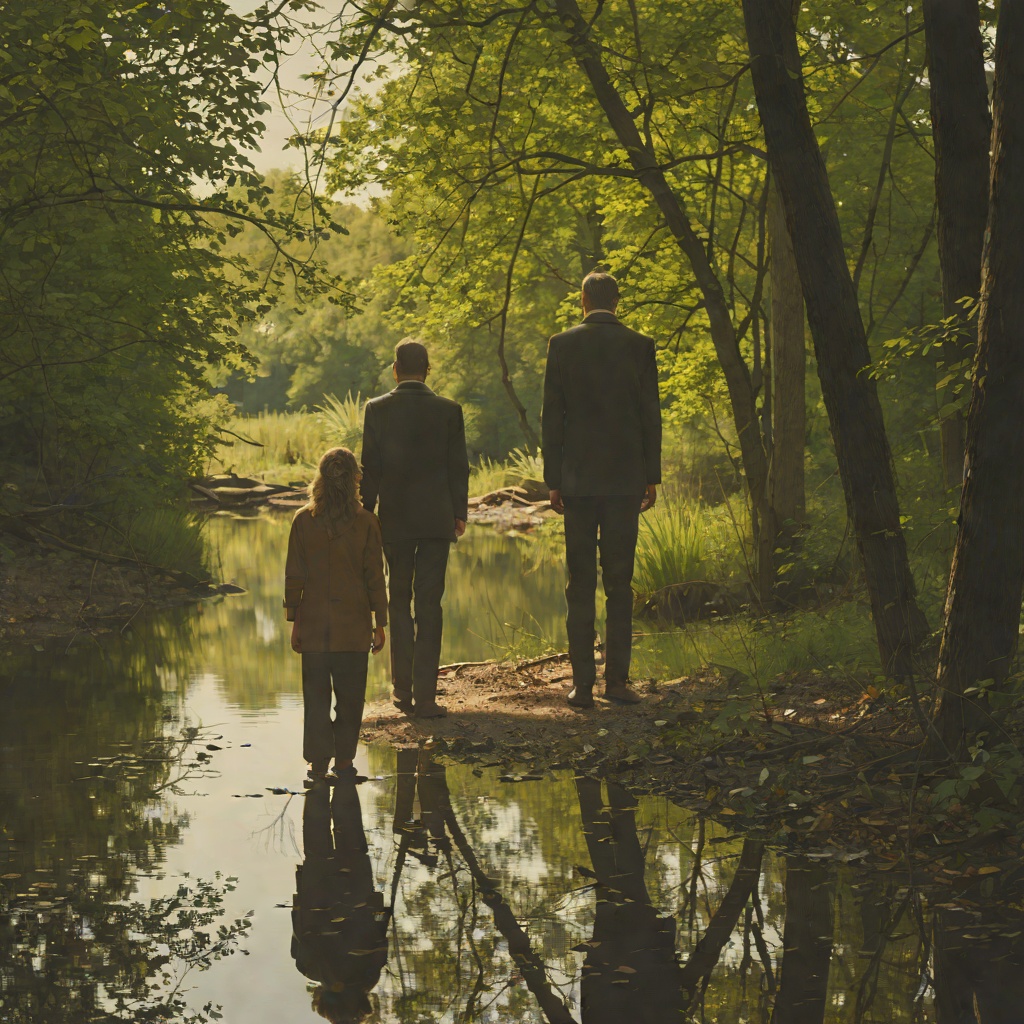
The suburb also appears in the novel's deeper narrative layers as the place where Maddie's old life and new life intersect. The opening lines of the book—"I saw you once"—are spoken by Cleo Sherwood, who recalls seeing Maddie on the temple steps in Pikesville, next to Milton, at what must have been his father's funeral. Cleo remembers that Milton now looked exactly like his father, a man she remembered with some affection, and that people gathered around him, patted his back, clasped his hands, waiting to comfort him—a sign that Milton was a big shot. The encounter is a moment of mutual assessment between two women who could not be more different: Cleo, a poor Negro woman, and Maddie, a Jewish housewife from the affluent suburb. Cleo's narration makes explicit the racial and class hierarchy of the moment: Maddie, she guesses, gave herself the crown because she saw a Negro woman, a poor one at that. The scene in Pikesville is thus the seed of the novel's central relationship—the dead woman and the woman who will find her—and it is located precisely in the suburb's temple steps, where Maddie's world and Cleo's briefly, fatefully crossed.
In the end, Pikesville is the measure of how far Maddie has come and what she has given up. It is the place where her son chose to stay, where her mother's voice of disapproval still reaches her, where her old friends have taken Milton's side, and where she once stood on temple steps as a married woman next to her husband, unaware that a woman watching her would one day become the Lady in the Lake. The suburb is not merely a location but a set of meanings—class, race, propriety, belonging—that Maddie must continually negotiate, and that the novel uses to define the cost and the value of her transformation.