The Baltimore Star newsroom
Lady in the LakeThe Baltimore Star newsroom is the professional heart of Maddie Schwartz's transformation from a housewife living in reduced circumstances to a working journalist, and the place where she first tastes the byline she craves. It is a filthy, loud, male-dominated space that nonetheless offers her a path to a new identity, and it is where she learns the calculus of what makes a story worth printing.
First Impressions and the Physical Space
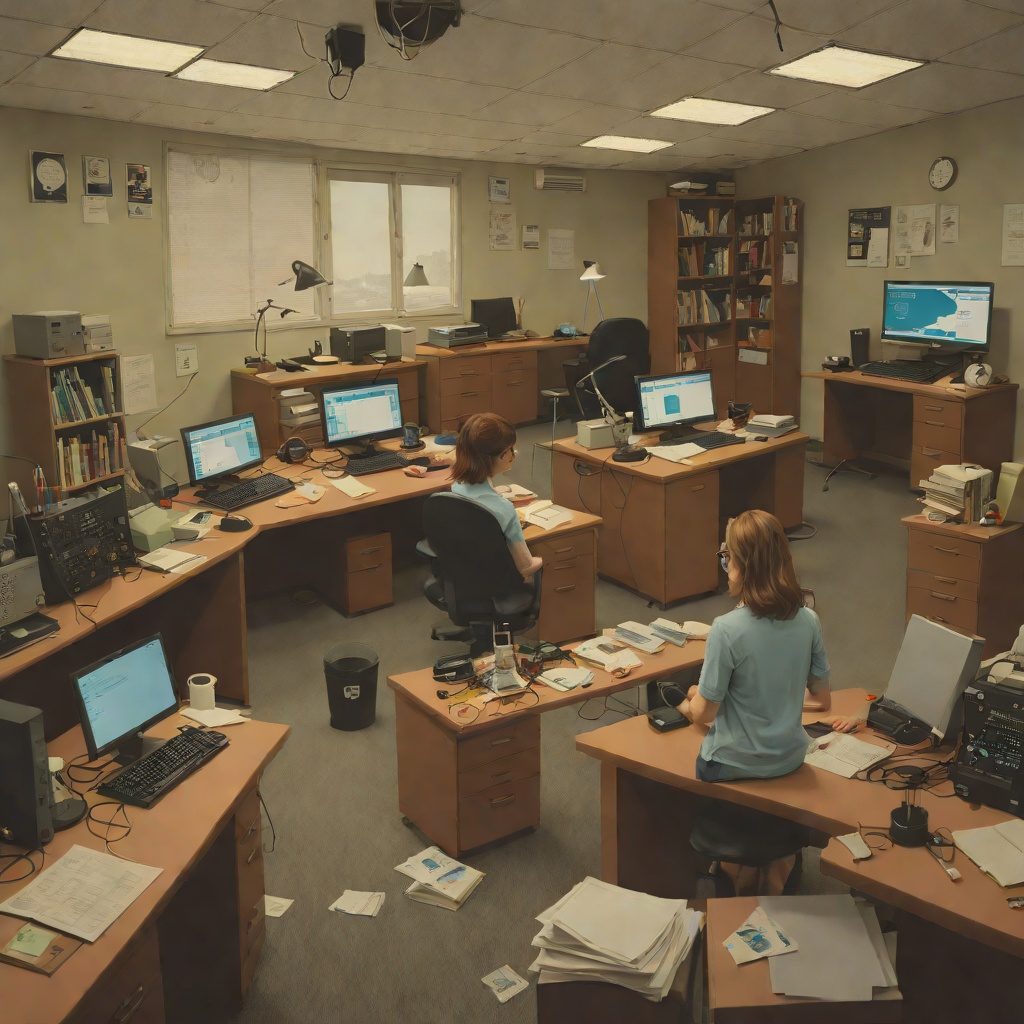
Maddie's first impression of the newsroom, upon visiting to see Bob Bauer, was that it was, well, filthy. Filthy and loud. Newspapers were piled everywhere, people shouted, typewriters clacked, and a bell rang somewhere. The room was full of men, though she reminded herself that women worked there too, having read their bylines and seen their stories. Mr. Bauer's desk was in the corner of the room where the Sunday staff worked, its windows facing south toward the water. The view would have been bright and expansive if the windows had not been caked with dust and dirt, and someone had written in the grime: The Star, One of the World's Newspapers. It took Maddie a moment to get the joke, which was a jab at The Beacon, the more sober morning newspaper that called itself "One of the World's Best Newspapers." The building itself was an easy walk from her new apartment, not even a mile down the hill, and she imagined how satisfying it would be to make that walk Monday through Friday and return home, up the hill, tired after a long day.
A Place of Professional Transformation
The newsroom became the stage for Maddie's professional rebirth. After she brought Bob Bauer the story of Stephen Corwin's correspondence, she spent two days sitting by his side, sometimes typing, sometimes talking, letting him rewrite her, but also insisting, at certain moments, on having her way with the words forming on the copy paper in his cantankerous typewriter. The result was a front-page piece, A KILLER UNBURDENS HIMSELF, with Mr. Bauer's byline and her name in italicized print: Based on a correspondence with Madeline Schwartz, part of the search party that discovered Tessie Fine's body. This experience crystallized her ambition. When her lover Ferdie Platt later told her she wanted her name in the newspaper "not in a story, on top of a story," she recognized it as exactly what she wanted. She knew that the italicized credit did not count as a byline, that it was not, in some ways, even her name. The newsroom was where she learned the difference between being a source and being a reporter.
The Newsroom's Role in Major Stories
The newsroom was also the site where the paper's editorial judgments were made, judgments that shaped how the city understood its crimes. When Thomas Ludlow confessed to the murder of Cleo Sherwood, Maddie called the city desk and said, as if she had said it a thousand times before: "Cal, this is Maddie Schwartz. Please put me through to rewrite. I've gotten a big break on the Cleo Sherwood story." By ten o'clock the next morning, most of the city knew that a white man had killed Cleo Sherwood for the very everyday crime of not loving him. It was not a page one story, and Maddie understood the calculus that determined that: the dead woman was a Negro, she was killed for love, or for lack of love more accurately. But it was a story good enough for the metro page, the ending to the tantalizing tale of the Lady in the Lake. The newsroom, then, was not just a place of work but a place where the value of a life was weighed against the demands of the front page.
A Place of Personal Significance and Departure
The newsroom also held a deep personal significance for Maddie, becoming a place already familiar and dear to her. When she stepped off the elevator one day in June 1966, carrying a cardboard box from the luncheonette, she immediately registered an absence in the newsroom. A layer of sound had been stripped away; the wire machines still clacked and caroled and the phones rang, but the conversations were muted. There were no shouts, no laughter, only essential murmurs as the newspaper steamrolled toward its final edition, the 8-star. The features editor, a deep-bosomed, red-faced woman named Honor Livingston, was waiting in the "Helpline" cubbyhole with the paper's top editor, Mr. Marshall, and Maddie put down the cardboard box with trembling hands, fearing something terrible had happened to Seth or Milton. This moment of dread underscored how much the newsroom had become central to her life. Ultimately, though, she wrote the Star out of her official history. She took her first-person near-death story about Angela Corwin, parlayed it into a job at the Beacon, and never looked back. The Beacon was a little stuffy and dull after the Star, but it was willing to give her a chance as a reporter. The Star newsroom, for all its filth and noise, was the place where she became a journalist, but it was a stepping stone to a career she would build elsewhere.