segregated police department
Lady in the LakeThe segregated police department is the institutional bedrock of racial hierarchy in the novel's 1960s Baltimore, a system that determines not only who can wear a uniform but what that uniform permits its wearer to do. Its rules are simple and absolute: Black officers walk patrols or work undercover in narcotics, and they are barred from the tools that define modern policing—no cars, no radios. This segregation is not a distant policy but a lived constraint that shapes the movements, ambitions, and daily humiliations of the department's few Black members, and it becomes a crucial point of contrast for the white protagonist, Maddie Schwartz, as she navigates her own quest for purpose and justice.
The Rules of the System
The department's segregation is articulated most directly by Ferdie Platt, a Black police officer who becomes Maddie Schwartz's confidant and lover. When Maddie expresses a wish to become a detective, Ferdie corrects her romantic notion with a blunt account of institutional reality: "The department's segregated, Maddie. Negro cops walk patrols, maybe do undercover in narcotics. We can't use cars. I don't even have a radio, just a call-box key." This inventory of prohibitions—no car, no radio, only a call-box key—is the material texture of the system, a set of absences that define the Black officer's place. The restriction is so complete that Maddie, who has witnessed Ferdie's late-night visits to her apartment in a patrol car, chooses not to ask how he managed to obtain one, a silence that acknowledges both the rule and its covert violation.
Ferdie Platt and the Limits of Mobility
Ferdie's experience illustrates how the segregation of the department constrains even the most capable officers. He tells Maddie that Negroes "could be patrols or vice cops and that was pretty much it," a ceiling that leaves no room for advancement into detective work or the investigative authority that comes with it. The patrol car he uses to visit Maddie at night is therefore a transgression of the system's rules, a small act of defiance that the system itself makes necessary. His mobility is not a right but a privilege stolen from a system designed to deny it, and the novel underscores this by having him describe his official equipment—a call-box key—as the sum of his technological reach. The contrast between what he can do and what he could do is the daily experience of the segregated department.
Violet Wilson Whyte and the Meaning of the Uniform
The system's restrictions are further illuminated through Violet Wilson Whyte, a Black policewoman who has risen to a position of some prominence within the department. When Maddie asks her what it is like to be a "first," Mrs. Whyte responds with a philosophical shrug: "Not that different from being the second or the third or the thousandth." This answer carries the weight of a career spent inside a segregated institution, where being a pioneer does not exempt one from the rules. Mrs. Whyte explains that the department "still doesn't have that many Negroes. And they're not allowed to do as much as their white counterparts," confirming that Ferdie's account is not an isolated grievance but a systemic condition. Yet Mrs. Whyte also embodies a different relationship to the uniform. She recalls walking a beat on Pennsylvania Avenue when she was younger, and she describes that work not as a limitation but as a form of service: "I felt like I did more for the children of that neighborhood in that job than I did as a teacher." For her, the uniform is a tool of visibility and inspiration, a way of showing Black children "that there were other things to be." Her pride in the job exists alongside, and in tension with, the segregation that defines it, and her phrase "We cannot imagine what we cannot see" becomes a quiet manifesto for the power of representation within a system that otherwise denies it.
Maddie Schwartz and the Education of a White Observer
For Maddie Schwartz, the segregated police department is an education in the mechanics of racial injustice. She learns its rules not from a textbook but from Ferdie's testimony and Mrs. Whyte's example, and the knowledge changes how she sees the world. When she observes a Black officer emerging from her apartment building in the middle of the night and getting into a patrol car, she understands immediately that this is a violation of the system—"there's no way, just no way, that guy can be legit"—because she has internalized the rule that "the coloreds don't get to use cars." Her decision not to ask Ferdie how he obtained the car is a mark of her growing complicity in, and sympathy for, the small rebellions the system forces. The novel uses her perspective to make the segregation of the department visible as a lived reality, one that shapes not only the careers of Black officers but also the moral landscape of the city itself.
The System as a Mirror of the City
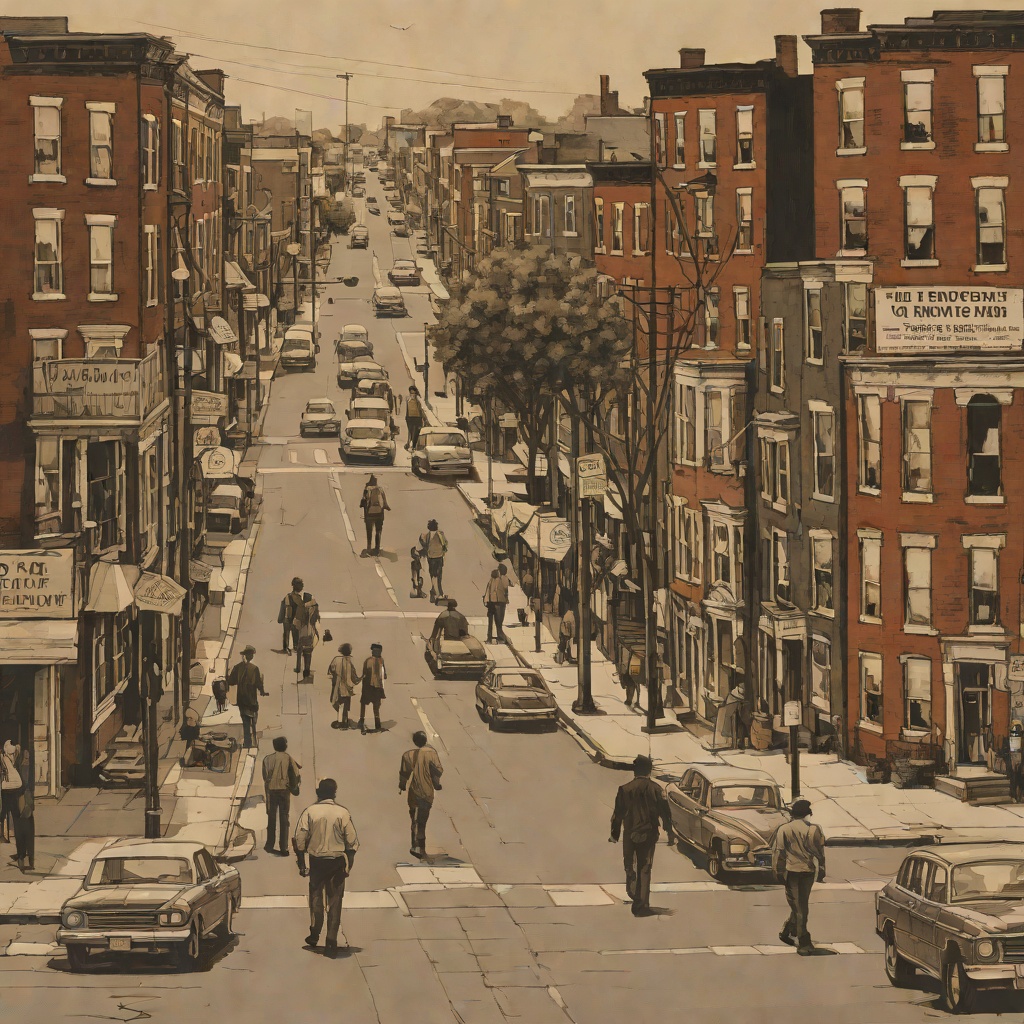
The segregated police department is not an isolated institution but a mirror of the broader society it polices. Its rules—who may drive, who may carry a radio, who may investigate—are a microcosm of the racial order of 1960s Baltimore, where mobility, authority, and trust are distributed along color lines. The novel does not present the department as a villainous monolith but as a bureaucracy whose everyday procedures encode and enforce inequality. Ferdie's call-box key, Mrs. Whyte's beat on Pennsylvania Avenue, and the patrol car that should not exist are all details that accumulate into a portrait of a system that limits Black officers even as it employs them. The segregation of the department is thus both a concrete fact of the plot and a symbol of the larger structures that the novel's characters must navigate, resist, or quietly subvert.