Embarazo
Las madres noEmbarazo is not a single, uniform experience in the book but a turning point whose meaning changes with circumstance: it can arrive unexpectedly, be pursued through medical treatment, or unfold amid divided loyalties. Across the Narrator’s reflections and the stories of Alice Espanet, Léa, and Sylvia Plath, pregnancy brings desire and fear into contact with social expectations, intimate relationships, creative ambition, and the uncertain boundary between illness and responsibility.
An unplanned pregnancy and a changed future
The Narrator’s pregnancy begins not with a long campaign to conceive but with a delayed period and disbelief. She and Niclas had tried several cumbersome contraceptive methods before relying on another method that had worked for a year. On the fourth day of the delay, she bought a test at a pharmacy expecting to rule out the remote possibility of pregnancy; its positive result surprised her more than it frightened her. Her account insists that an unintended pregnancy can happen even to an adult, stable, highly educated couple, complicating the assumption that such a pregnancy must conceal a tacit decision.
At the time, she wanted children only in the abstract and imagined she had another four or five years before she needed to decide. She had just finished and published a book and was beginning to enjoy its success. After years of turning away from writing, she had found in it a sustaining sense of purpose and a place where she belonged. In this newly established life, a baby did not seem necessary. The pregnancy therefore interrupted not an absence of desire for children, but a future the Narrator had assumed she could postpone while she built a life around writing.
Her first response also unsettles the couple’s balance. She briefly resented Niclas, whom she knew wanted to become a father and was already interested in the practical details of that future, including the maxi-cosi and transitional objects. Yet after several days of hesitation and shock, she accepted the responsibility and began to desire the baby. Learning the unfamiliar vocabulary of pregnancy and birth became part of that adjustment: she found its medical terms alienating and proposed, in their place, the more expansive language of nautical journeys. The change in feeling did not erase her earlier uncertainty; it marked the beginning of a new attachment formed alongside it.
Planned pregnancy and medical uncertainty
Alice’s pregnancy follows a sharply different route. With Ritxi, she underwent fertility treatment in a clinic, where a blood test confirmed the pregnancy after two embryos had been transferred and three others frozen. The transferred embryos were graded category B, a quality associated with a medium probability of a twin pregnancy. The clinicians explained the risks of carrying multiples, including pre-eclampsia, restricted growth, premature birth, and caesarean delivery. Despite those risks, both partners wanted two embryos transferred. A few days later, an ultrasound showed that both had developed.
The contrast with the Narrator is deliberate: she did not learn that she was pregnant until the twelve-week scan, when she felt relieved to see that she was carrying one baby. Niclas responded with disappointment that there was only one. Meanwhile, Alice and Ritxi had actively sought treatment and faced uncertainty at each stage, from embryo quality to the possibility of twins. The book does not treat medical planning as control over the outcome; even a carefully chosen procedure leaves the couple waiting on probabilities and clinical findings.
The Narrator imagines the clinic’s pastel surroundings as a place where Alice was left among white coats with little ability to defend herself. That image anticipates the book’s later attention to Alice’s mental state and criminal responsibility, but it remains the Narrator’s interpretation rather than a clinical finding. At trial, a prosecutor challenges a psychiatrist to acknowledge that his diagnosis of postpartum psychosis rests on Alice’s conduct and her own account, not on an official diagnosis. Pregnancy and its aftermath thus enter not only as intimate experience but as contested evidence, interpreted through medical and legal institutions.
Pregnancy within relationships
For Léa, pregnancy unfolds alongside an affair. When she was three months pregnant, she met Fabrice, a married father of two who was twelve years older and whose child was not hers. They began meeting clandestinely at the Hôtel d’Angleterre as her pregnancy progressed. Fabrice was willing to act as the baby’s father, while the relationship became an addictive entanglement of fear, guilt, and desire, punctuated by repeated breakups and returns. A month before giving birth, Léa decided to end the affair and resisted renewed contact through the final weeks of pregnancy. The night after the birth, however, she sent Fabrice a message from the hospital to tell him that everything had gone well.
This episode places pregnancy inside a relationship rather than outside it as a purely medical condition. Léa’s changing body did not end the affair; the pregnancy and the clandestine meetings continued together, until a decision to stop was tested again after childbirth. Her message from the hospital gives that return a precise moment: even after she had chosen restraint, the event of birth drew her back into contact with Fabrice.
Motherhood, work, and the erosion of self
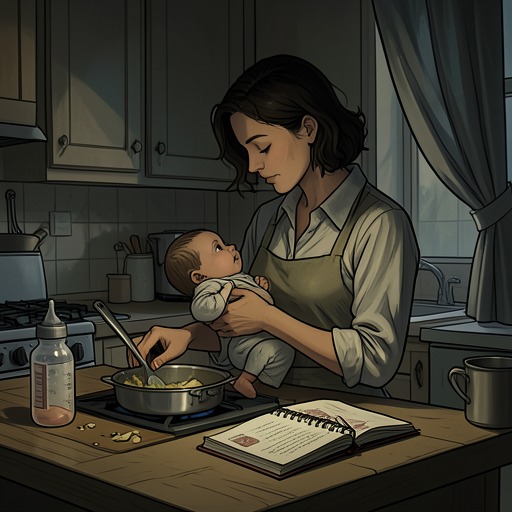
The Narrator describes the change after birth as more than a change in daily routine. When she walked alone, an unusual occurrence, she felt exposed and incomplete, as though strangers could not understand her without knowing she was a mother. Even a solitary walk failed to release her from the baby; she carried the child in her consciousness. After three months without sleeping more than three hours at a stretch, repeated visits to the nurse to monitor the newborn’s weight, and close attention to the baby’s bodily functions, motherhood seemed to have consumed her other identities. Writer, worker, wife, daughter, and the person she had been before were pushed into a remote past.
She also emphasizes the less visible burden of care: not only exhaustion but hours of boredom and repetitive work. Breastfeeding, changing nappies, settling a crying baby, and checking whether the baby was breathing could fill the day while time continued normally for everyone else. She describes this labor as isolating and undervalued, while a culture that praises self-giving offers little recognition for its daily demands. The account places the longing to escape beside the ordinary acts of care, without treating ambivalence itself as proof of a lack of love.
At the nursery, Erik would notice the Narrator as soon as she arrived, crawl toward her, and reach up to be held. The intensity of their reunion made her dwell on his physical presence and on the possibility that this contact with life might eventually become visible in her writing. Yet she was not sure it would. The scene holds affection and artistic uncertainty together: the child’s joy is vivid, but it does not automatically resolve the Narrator’s question about whether motherhood can nourish, or displace, her work.
Divergent postpartum accounts and wider stakes
Sylvia Plath offers a striking counterpoint to the Narrator’s experience. Plath’s two births were described in detailed letters to her mother in the United States; both were quick and easy home births, and the children brought happiness to a life otherwise marked by distress. The account presented in the book finds no indication of postpartum depression. Plath’s creative force returned in the puerperium: after arranging childcare turns with her husband, Ted Hughes, she wrote in her study, and she composed Ariel soon after the birth of her second child, Nicholas. In letters written six weeks after Nicholas’s birth and in the months that followed, she described increasing time for writing and deep happiness in her children.
Set beside these accounts, Plath’s experience does not supply a standard against which other mothers can be measured. Instead, the contrast reveals how differently childbirth and the period after it can intersect with creative work and emotional life. The book extends that question into legal history: it notes that Spain treated infanticide as a distinct offense from 1822 until the 1995 Criminal Code abolished the separate category, while Canada retains a provision concerning a mother whose mental state has been altered by pregnancy, childbirth, or lactation. In Alice’s case, the defense invokes mental disorder to argue that she could not understand or act according to the unlawfulness of her conduct; the court ultimately substitutes outpatient psychiatric treatment for imprisonment. Pregnancy therefore remains consequential beyond birth: its bodily and psychological aftermath becomes part of the argument over how a mother’s actions are judged, what responsibility means, and what care the legal system can provide.