Erik
Las madres noErik is the Narrator and Niclas’s son, whose small, vulnerable body first enters the narrative amid the confusion of an urgent birth and later becomes a vivid measure of the Narrator’s love, fear, and divided attention. His infancy is traced through physical details and ordinary changes: the newborn left on his mother’s chest, the child crawling toward her at daycare, his first steps, longer nights of sleep, and an illness that sends both parents to the hospital. These moments matter not because Erik is given an independent account of his inner life, but because the Narrator’s changing experience of motherhood is repeatedly concentrated in her attention to him.
Birth and Early Separation
Erik is born seven hours after the Narrator receives an epidural. The pregnancy has reached its thirty-eighth week, but a diagnosis that the fetus is small has been changed to one indicating that he is too small, prompting the decision to induce labor. He weighs two kilos and one hundred grams. The Narrator remembers him as warm and dirty when he is placed on her chest, where his body leaves a mark shaped like Lanzarote on her sternum. The image gives their first contact a particular physical form: a newborn’s weight and warmth briefly imprinted on his mother before he is taken away.
The delivery room quickly fills with people, and the explanations offered to the Narrator—Apgar tests and stained amniotic fluid—do not initially make sense to her. In practice, the news means that Erik will not immediately be returned to her. He spends eight hours in the neonatal unit, although he does not need an incubator. Niclas visits him twice and takes photographs; unable to move while the anesthetic still affects half her body, the Narrator hears Niclas repeat that Erik is the largest baby in the unit. She is exhausted but cannot sleep, and her thoughts return to Alice Espanet, the case that has already begun to occupy her. During the separation, she repeatedly checks that the mark on her chest remains and tries to hold on to the newborn’s sweet smell.
When Erik is brought back that evening, he has been washed but still carries a strong scent that has become familiar to his mother. The Narrator describes him as resembling a small bun fresh from the oven and registers an almost literal desire to eat him. A pediatrician explains the tests and needle marks on his thighs, as well as the sucrose given to ease the pain. The medical account offers a possible explanation for his size: at some point he stopped gaining weight, perhaps even losing a little, and may therefore have been better off outside the womb. The Narrator mainly wants reassurance that he is all right; the pediatrician says he can now feed and grow.
Care, Feeding, and the Daily Routine
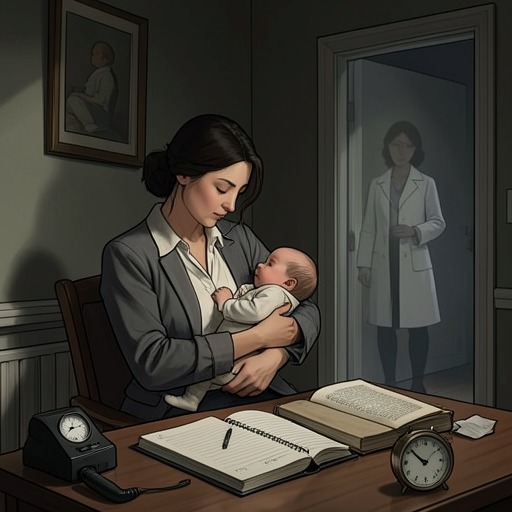
A midwife’s instructions lead the Narrator to bring Erik to her breast. For the following months, breastfeeding becomes much of her practical life. She describes the outward picture as her own amorphous body attached to two large breasts, with a tiny, beautiful child attached to them. The image conveys closeness, but it does not make the early months painless: the Narrator is recovering from a tear and the physical exertion of childbirth, her nipples are raw, and she has little sleep. Erik’s smallness and beauty are therefore present alongside the bodily cost of caring for him, rather than resolving it.
The return to work is complicated by the decision to take leave and leave Erik at daycare. His adaptation is gradual. On the first day, the Narrator stays in the classroom; on the second, she waits in the corridor while he is alone for twenty minutes; on the third, she manages forty-five minutes in a café across the street. From the fourth day, she brings her laptop. Erik rides in the front carrier while the computer is carried behind her, an arrangement that makes visible how closely childcare and the Narrator’s writing project occupy the same space.
At midday, Erik notices her as soon as she enters the daycare grounds. Whatever he has been doing, he leaves it and crawls quickly toward her, happy and reaching out his arms. The reunion becomes one of the Narrator’s most intense experiences of his infancy. She attends to the particularity of his body—his spine, cheeks, soft bottom, and skin—and tells herself to take in the moment because this form of love will not recur in quite the same way. The scene does not erase her difficulty in enjoying motherhood; instead, the force of Erik’s welcome makes that difficulty sharper. She wonders whether such close contact with life will eventually find its way into her writing.
Growth and Changing Rhythms
During the family’s August holiday, Erik overcomes a fear of water, and his parents hold a small party for him beside the swimming pool. After the family returns home, he begins to take his first steps. He comes toward the Narrator with his arms extended, delighted and astonished by his own achievement. She experiences his arrival with love and pride, while also recognizing how quickly a child changes during the demands of daily care.
Another change comes when Erik first sleeps for ten consecutive hours. The event happens again two days later and then recurs soon afterward, suggesting a new pattern. By this point, he nurses only once a day, at night, to help him fall asleep. The Narrator compares waking after an uninterrupted night to encountering the first snow of winter: a quiet, elegant change that makes the familiar home seem like a better version of itself. His new sleep does not solve the larger uncertainties in her life, but it marks a concrete shift in the household’s routine and in the demands of his care.
Illness and the Narrator’s Vulnerability
At almost fourteen months, Erik is hospitalized with a high fever and unusual sleepiness. Niclas calls the Narrator to say that he is at the hospital and cannot wake the child properly. She is away from home, sixty-five kilometers from the city, after meeting Jakes Ruiz de Infante. She leaves at once and drives back with what she describes as fearful, guilty thoughts. The crisis makes distance itself feel consequential: while Erik is ill, she is not beside him, and the circumstances of her absence become part of her distress.
In the hospital cot, Erik appears especially delicate to her. He has always been very thin, with thighs she has never been able to pinch; nearing fourteen months, he has almost no hair. Strangers seldom call him a cute child, instead remarking on his adult-looking face or lively eyes. Yet with rosy cheeks, one lock of hair stuck to his forehead, and the fever reduced by medication, he seems perfect to his mother. The Narrator recognizes that this attachment exposes her to fear rather than making her feel invulnerable. She watches a needle enter his spinal cord during the lumbar puncture and has to look away; Niclas holds her.
The test confirms viral meningitis, which is not considered serious in the first assessment, though Erik remains under observation overnight because his fever is still very high. The parents sit on either side of his cot in uncomfortable chairs and do not sleep. Erik sleeps, waking once to nurse; his mouth feels hot against the Narrator’s breast. His illness ends without the feared diagnosis, but the night leaves the family inside the immediate facts of care: monitoring his fever, listening for his cough, and speaking softly when he turns over and continues sleeping. Niclas tells the Narrator that they are doing well. Erik’s recovery offers relief, while the episode makes plain how easily his health can become the point around which the Narrator’s attention, fear, and sense of responsibility gather.
Narrative Role
Erik’s story is presented through the Narrator’s close, bodily attention rather than through speech or independent action beyond the observed milestones of infancy. The birth mark shaped like Lanzarote, his reach toward his mother at daycare, and his hot mouth at the hospital are small, specific details through which the book registers attachment. They also keep motherhood from becoming a simple ideal: feeding and reunion bring tenderness, while exhaustion, physical pain, work, and the possibility of illness remain present in the same account.
His care runs alongside the Narrator’s attempt to write about Alice Espanet. Immediately after giving birth, she cannot sleep and finds herself thinking about the case; while raising Erik, she tries to make time for research and writing, and later his illness interrupts her time away. The contrast does not make Erik an obstacle or a symbol with a single meaning. Rather, his changing needs and the Narrator’s love for him show what her writing life must coexist with—and why that coexistence can carry both joy and fear.