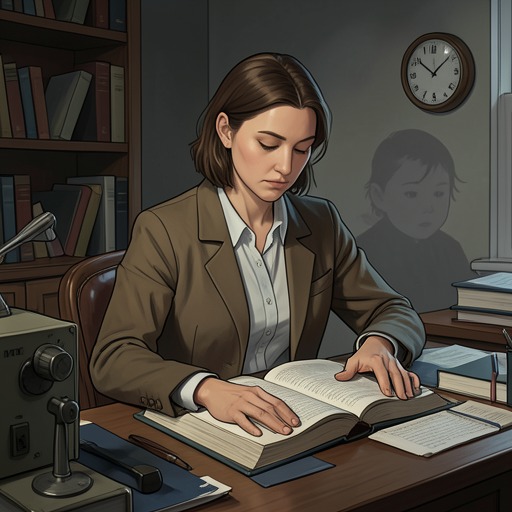
Mélanie
Las madres noMélanie, a twenty-two-year-old au pair from Orléans, is the first person outside the family to discover the twins after Alice Espanet has drowned them. Her startled call for emergency help brings the authorities to the House of Armentia, and her later testimony makes her both a witness to the immediate aftermath and a source of evidence about the months that preceded it. Through her, the novel connects a young caregiver’s ordinary routines and missed warning signs to the public drama of Alice’s trial.
Background and Work in the Household
Mélanie had been in Vitoria-Gasteiz for nine months, learning Spanish and trying to decide what to do next in her life. Until the crisis, she is described as cheerful and somewhat sentimental. Her work caring for Alice Espanet and Ritxi’s twins had begun when the babies were one month old and continued until the household was shattered by their deaths. She did not particularly enjoy the job, chiefly because she could not predict Alice’s behavior.
The work shifted between two difficult arrangements. At times Alice stayed close, watching Mélanie’s every movement and advising her how to hold the babies, change their diapers, and apply cream. At other times Alice announced that she was going to paint, shut herself in her studio, and left Mélanie alone to manage the children. Mélanie preferred the latter, even though it meant carrying the workload without help. When Alice hovered, her mood could turn critical or depressed: she worried that the twins were gaining too little weight or were too fat, and fretted over whether they slept too little or napped too long, as if either change might mean they were ill.
Discovery at the House of Armentia
The afternoon of the discovery was a Thursday in high summer, and Mélanie had just used up her four hours off. She returned from a bicycle outing with a young man she had recently met, muddy from lying on damp grass. At the House of Armentia she entered quietly, hoping the twins might be asleep and that she could take a shower. The rooms she checked were silent.
On the stairs she felt a vibration and experienced what she later described as an impulse to flee: she imagined riding away downhill without looking back. Similar impulses had shaken her before while she worked in the house, but she continued down the corridor. In the partly open bedroom she saw the twins on their parents’ bed, almost covered by a duvet, and Alice Espanet sitting beside them in a striped armchair, wearing a nightgown with her left breast uncovered.
Mélanie approached in a tremble. During the five steps toward the bed, her mind emptied; she could not look at Alice Espanet and felt, for the first time in her short life, erased and gone. She touched the bundles only briefly. The twins were naked and motionless, their lips purple and skin cold; the sheet beneath them was still wet. Alice Espanet spoke calmly, saying that the children were all right. The composure of her voice and the indifference of her posture struck Mélanie as terrible.
She took the telephone from the bedside table and called for help, although she did not remember picking it up. The recorded call lasted two minutes and contained communication difficulties, sighs, crying, and disbelief as she urgently asked for an ambulance, police, or firefighters. During the call, Alice Espanet apparently remained in the armchair, unmoving and still uncovered. Once the emergency response began, the house filled with people. Mélanie waited outside on the steps, hugging her knees and staring at the mud on her ankles; inside, she struggled to answer questions and could barely breathe. Someone gave her water, and she swallowed a white pill without asking what it was.
Aftermath and Departure
Mélanie told Ritxi that she would sleep at a friend’s home. He answered with a dismissive swipe of his hand, and she again prepared to flee on her bicycle. She could not leave yet: she still had to go to the police station and answer questions. She remained there until she had run out of tears and the police were satisfied. Not long afterward she left the country and moved to Paris, where for a time she tried to find work as an actress. Fourteen months after the discovery, learning that she would have to testify at the trial brought on an anxiety attack.
Her departure does not free her from the event. At trial she is the only witness to testify behind a screen. She refuses an interpreter but cannot bring herself to look at Alice Espanet. The screen both protects her and shapes the courtroom’s image of the accused: it gives the prosecution a visual staging of danger, as if Alice Espanet’s alleged menace required a barrier. Mélanie’s testimony therefore carries emotional force beyond the facts she reports, while the arrangement around it influences how those facts are seen.
Testimony and Narrative Significance
On the stand, Mélanie describes not only the discovery but the everyday unpredictability that had made the household difficult. Several times Alice Espanet rushed into the room where Mélanie was working, distressed that she had lost the children. Mélanie would leave what she was doing and hurry to the twins’ room, only to find them asleep where she had left them ten minutes earlier. After this happened three or four times, she stopped reacting with alarm and instead tried to reassure Alice Espanet, telling her that the children were in their room and asking her not to wake them.
The account prompts the painful counterfactuals that shadow Mélanie’s role: whether she should have taken these episodes more seriously, spoken to Ritxi, or stayed home that Thursday. But the afternoon off was her only free time, and the young man was the first to invite her out since she arrived in the city. The narrative gives those ordinary circumstances their full weight without making them proof that she could have prevented the deaths.
Asked by Carmela Basaguren whether Alice Espanet loved the children, Mélanie answers that she worried about them, and that whether such concern amounted to love was uncertain. She finishes her testimony in tears, moving two jurors to discreetly wipe their eyes. Her answer refuses an easy distinction between care and love, just as her testimony leaves unresolved how far Alice Espanet’s mental disturbance could explain or excuse her actions. Mélanie’s position is consequential but limited: she can recount what she saw and the patterns she lived alongside, while the trial must decide what those facts mean.