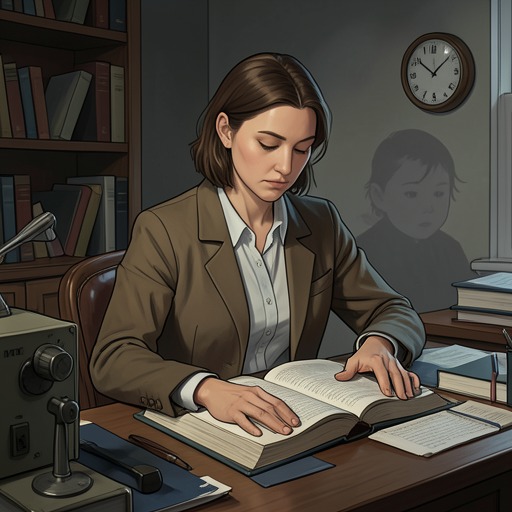
Ritxi
Las madres noRitxi, known to clients as Ricardo and to friends as Ritxi, is Alice Espanet’s husband and the father of their twins. After Alice kills the children, he becomes at once a bereaved father, a witness to her arrest, and the person who works to get her out of prison. His choices—first to withdraw, then to defend and care for her—shape the couple’s aftermath, but the book never resolves what those choices mean to him. His actions are visible; his private grief and expectations remain largely beyond reach.
Identity and the first hours
Ritxi arrives at the House of Armentia only ten minutes before the judge. He has spent the day in Madrid and reaches home in a chauffeur-driven car, his skin still marked by the day’s sweat. There he sees the twins’ small bodies placed in large gray bags and Alice taken away in a police car. She is wearing pilates leggings and a loose shirt, hastily put on; her hands are not cuffed, a detail that offers him a measure of relief. He calls her name once. She does not turn her head, holding it rigidly upright as the car carries her away.
The account gives no scene of his breaking down. No one sees him cry. When someone offers him a white pill, he knocks it away; it may remain beneath the living-room sofa. He is told that Alice has been taken to a hospital’s seventh floor for psychiatric assessment. The small, concrete details of that night—the discarded pill, the unanswered call, the gray bags—register a catastrophe that the people around him cannot yet make comprehensible.
Withdrawal, questioning, and the missing days
Ritxi has no parents, and his only brother lives in the United States. He refuses offers of help from on-call psychologists and concerned friends, insisting on staying alone at home. His refusal is so firm that, after midnight, the authorities leave him there and postpone taking his statement until morning. During the night he disconnects the telephones.
At around eight the next morning, two police officers arrive at the House of Armentia. One later describes him as excessively calm. He opens the American-oak door, asks for two minutes to change his shirt—the one he has worn since the previous day still carries the sweat of Madrid—and invites the officers inside. He is soon ready to go with them. The calm manner and orderly preparations sit uneasily beside the loss he has just witnessed, but the narrative does not claim to know what lies behind them.
After the first interrogation, Ritxi does not return to the house. One newspaper reports that a friend collects him at the police station and takes him to a home in Elciego. The account of those five days is otherwise absent: the book cannot establish how he passed them or what occupied his thoughts. At the twins’ private cremation, attended by Ritxi, his brother, newly arrived from Austin, and close friends, the silence persists. There are no photographs from inside the crematorium, and the narrator acknowledges that the ceremony’s details are unknown.
Choosing Alice’s defense
The most consequential turn in Ritxi’s actions comes after the cremation. Rather than join the prosecution or seek the harshest sentence for Alice, he contacts his trusted lawyer and asks for the best criminal defense lawyer in the city. The lawyer found for the case is Carmela Basaguren, an experienced advocate known for her feminist commitments. She accepts the case that day and quickly prepares an appeal aimed at securing Alice’s release from pretrial detention.
The defense argues that Alice has roots in the area, poses no flight risk, and is unlikely to reoffend. It also signals that the eventual defense will seek acquittal on grounds of mental incapacity, invoking the provision for a person who, because of a mental disorder or alteration at the time of an offense, cannot understand its illegality or act according to that understanding. Ritxi’s support therefore has immediate practical consequences: he helps place Alice’s case in the hands of a lawyer and backs a strategy that treats her mental state as central to criminal responsibility.
The decision is striking because the book presents Ritxi as a victim of the crime as well as Alice’s husband. The narrator considers possible explanations—love, compassion, denial, even moral complicity—but does not settle on one. Nor is there reliable access to the private conversation when Ritxi later collects Alice from prison. The suggestion that his first words might have been an act of forgiveness belongs to the narrator’s speculation, not to a documented exchange. The gap between what Ritxi does and what anyone can know about his motives becomes part of his characterization.
Marriage, care, and unresolved warning signs
Ritxi and Alice remain together after her release and leave the city to live in a small house in Elciego, near his work. Every two weeks they report to a court in Vitoria, with Ritxi accompanying his wife. At first photographers wait for them; over time they stop appearing. The couple also travels to Barcelona every two weeks to see a prominent psychiatrist. Alice begins treatment for psychosis, keeps her daily medication in a compartmentalized plastic box, and returns to painting as occupational therapy. Their life is thus organized around supervision and treatment, even as public attention fades.
Earlier, when Alice and Ritxi leave the clinic by car with their baby daughter Angela, their son Alex has to remain hospitalized. The journey is short. Ritxi is nervous but elated, making plans for the hours ahead, while Alice appears withdrawn and answers his stream of talk with silence. He turns on the radio; Fauré’s Requiem is playing. At a traffic light, Alice unfastens the baby’s straps, releases her own seat belt, and gets out carrying the child. Ritxi freezes, then leaves the car when the light changes and horns urge him forward. He finds Alice sheltering in a doorway and singing a lullaby. The episode is not documented in the municipal police files, a qualification that keeps the story within the limits of Ritxi’s account at trial.
Ritxi later says that he did recognize warning signs. The couple had hired Mélanie to reduce the workload at home; a reiki practitioner came to the house to ease Alice’s chronic sadness, and Alice attended pilates twice a week. To him, the overall impression had been that she was improving and the situation was under control. In retrospect the measures had not been enough, but the book does not turn that hindsight into proof that he knew what would follow.
The trial and the life afterward
At trial, Ritxi also explains why he did not seek help after Alice destroyed her paintings during an exhibition. Photographs taken by a communications employee and shown to the jury depict extensive damage. Ritxi argues that the episode was not inexplicable: artists can be pathologically dissatisfied with their work; Alice may have felt exposed by showing something intimate; jealousy may have played a part; and, he says, the mess was quickly cleaned up. He presents this account with confidence and resists the prosecutor’s attempt to connect the aborted exhibition to the later crime. His explanation shows how he frames the episode, but does not establish that the danger was objectively small.
The book’s account of Alice’s later life depends chiefly on statements from Ritxi and her psychiatrist, sources it identifies as interested rather than independently verified. Alice is said to live in isolation, take strong medication, and never be left alone: a nurse watches her while Ritxi works. He accompanies her on frequent trips to Barcelona for psychiatric care, giving his time, money, and love in the hope of recovering the woman he regards as the love of his life. The psychiatrist reports improvement but says treatment will take time, relapse remains a substantial possibility, and another pregnancy cannot be recommended.
Ritxi’s commitment does not restore the life that preceded the deaths. The twins have been cremated, and the couple’s private future remains difficult to see from outside. The narrator stresses how little can be confirmed about what Alice does at home and how little attention is paid to the children once the case recedes from public view. Against that uncertainty, Ritxi’s sustained care is unmistakable, while its meaning—and the limits of what either spouse can recover—remains unresolved.