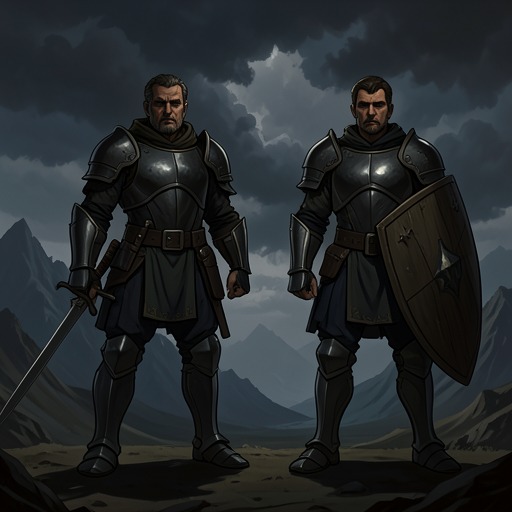
Caleb (Malphas) and Xevikan
Last ChristmasCaleb (Malphas) and Xevikan are brothers bound by a history of conflict and an uneasy, incomplete movement toward reconciliation. Their relationship changes when Xevikan appears at Caleb’s wedding with Myone, brings a gift, and later asks his brother to help; yet gratitude never becomes uncomplicated trust. The brothers’ encounters make kinship both an old source of hostility and a possible route back into a family and a war Caleb has tried to leave behind.
Kinship and the Burden of the Future
The brothers’ relationship is shadowed by family history before either makes a gesture toward reconciliation. When Caleb touches Myone, he sees a future image of the child she carries: the boy will fight beneath Jaden’s banner. The vision unsettles him because Xevikan hates their father, and Caleb cannot imagine Xevikan’s son fighting for the grandfather who caused them so much harm. Their bond is therefore tied not only to what the brothers have done to one another, but to the legacy their family may pass on.
Caleb asks whether Xevikan knows about the baby. Myone urgently tells him to say nothing, insisting that she carries Caleb’s brother rather than his brother’s son. Her denial makes the child’s parentage a secret at the center of the family relationship. The scene also gives Caleb knowledge of a future that Xevikan apparently does not share with him: the child may one day take a side in the conflict between the brothers’ generation and their father. The vision does not settle that future, but it places their private kinship within the larger consequences of inherited enmity.
A Wedding Witnessed by His Brother
At Caleb’s wedding to Lilliana, Xevikan’s presence is an unexpected reversal. The priest has placed wreaths of dried greenery and holly berries on the couple and calls their witnesses forward. Caleb sees Myone and Ophelos, then notices Xevikan and is left momentarily speechless. Myone meets Xevikan’s gaze and bashfully moves to stand with him. For Caleb, the brothers’ appearance together as witnesses is not a simple return to closeness: it confronts him with the fact that they have come to show him kindness despite all that has passed.
That kindness awakens guilt as well as gratitude. Caleb recognizes that he was not there for Xevikan and Myone, and admits to himself that he does not understand why they would treat him generously now. Until Lilliana, he had never known or experienced kindness in this way. The wedding’s emotional center remains his bride, but Xevikan’s presence helps him see the occasion as something made possible in part by Myone’s earlier attempt to kill him. The reversal complicates the brothers’ history: an act of violence has, through its consequences, helped bring Caleb to a life and a marriage he values.
Gifts, Gratitude, and the Limits of Reconciliation
Caleb’s response to Xevikan’s kindness becomes more tangible when Myone explains that Xevikan came to bring a small clay pot as a gift for the newlyweds. Caleb hesitates to take it; Myone nudges it into his hands and reassures him that it is a gift. He has never expected such a gesture, particularly from his brother and from the woman who once tried to kill him. The modest object matters because it makes generosity concrete: Caleb must accept something from people he has understood through conflict.
Later, Caleb thanks them for their kindness and passes his skin to Xevikan. His gratitude does not erase his defensive manner; he frames the thanks with a smirk and pretends not to care what either of them thinks, even as he acknowledges that he owes them. Xevikan says he is glad to see Caleb happy and wishes him a better ending than the stolen moments they have been forced to share. Myone is glad, too, that Caleb is no longer destined to join their future battles. Their exchange offers affection and relief, but also marks a separation: Caleb’s better ending may depend on remaining outside the life of fighting that still binds Xevikan and Myone.
Renewed Conflict and Guarded Alliance
A year later, Xevikan’s appearance at Caleb’s new life does not make the old mistrust disappear. Caleb is enjoying Lilliana’s reactions to food when he senses the ripple of power from his brother; the physical recognition immediately strips away his patience. He turns to confront Xevikan, and interprets the visit through their long history of ill will. A year of kindness, he insists, cannot undo a lifetime of hostility, and he does not trust his brother to have come without a reason.
Lilliana hugs Xevikan, a gesture Caleb knows carries no hidden meaning, but he resents even sharing her affection with his brother. The moment exposes how far reconciliation remains from ease: Caleb can acknowledge Xevikan’s prior generosity and still experience his presence as a threat to his place in the family. When Xevikan says they could use Caleb’s help, Caleb refuses the idea of returning as if nothing happened. He points to the danger of appearing before their mother, uncle, or aunt, whom he believes would not trust gods and might kill him. Myone could take him to their father, but even that possibility does not remove the risks or repair the brothers’ past.
Xevikan later insists that Caleb must set his hatred aside because their mother knows he has a weakness. The revelation is painful to Caleb, who asks what Xevikan means; Xevikan explains that his mother and the King of All Darkness had little difficulty working out why Caleb vanished and then appeared on the wrong side. Their exchange shows that Xevikan’s appeal is not merely an invitation to resume brotherly closeness: it carries urgent knowledge about Caleb’s vulnerability and his political position. The relationship ends in tension rather than settled reconciliation. Caleb has learned to receive his brother’s kindness, but he still distrusts his motives; Xevikan, in turn, presses him to face a danger that may make their divided paths impossible to maintain.