Christmas
Last ChristmasChristmas is part of a charged seasonal threshold in the story: it brings together the winter solstice’s promises of renewal, Caleb’s dread of the season, and a gathering that culminates in his reunion with Lilliana. Across these moments, the holiday is both communal ritual and a reminder that the boundary between ordinary life and extraordinary events can become perilously thin.
Seasonal Meaning and the Solstice
For Lilliana, the solstice offers an ideal beginning. When she proposes it for her wedding to Caleb, she presents the date as the mark of a new year, associated with new beginnings and rebirth. Her choice gives their marriage a public, seasonal meaning: it is not only a union between two people but also an entry into a hoped-for life together. Caleb’s reaction supplies the counterpoint. He sees the solstice as the longest night of the year, when portals open and dangerous things may enter the world. The same date that represents renewal to Lilliana therefore carries a threat for him.
The wedding makes these competing meanings visible in its customs. The priest places wreaths of dried greenery and holly berries on Caleb and Lilliana’s heads, then lights candles and calls their witnesses forward. The wreaths are uncomfortable, but Caleb accepts them, absorbed instead by how lovely Lilliana looks. The ceremony turns the season’s natural materials into signs of a sacred union, while the presence of witnesses makes the marriage a shared occasion rather than a private vow.
Lilliana also explains the solstice’s social purpose through the celebrations planned around it. A bonfire will follow, and people will let go of past grievances to begin anew. The holiday thus promises more than a fresh calendar: it offers a ritual means of changing relationships and entering a different communal order. Caleb does not share her easy confidence, but he recognizes the generosity behind her view. The contrast between his suspicion and her hope gives the date its emotional complexity.
The Thin Veil and Seasonal Risk
Caleb’s unease is not merely an objection to ceremonial timing. On another solstice night, he searches the darkness after seeing something and finding nothing there. He reasons that on any other night he might dismiss the sight, but the veil is thin on the solstice, allowing things to cross over; whatever crosses may be more powerful than usual. The holiday’s danger is therefore tied to a stated supernatural condition, not just to Caleb’s pessimism.
That condition complicates the season’s promise of renewal. The solstice opens a space in which old grievances may be put aside, but it also opens a passage through which other forces can enter. Celebration and vulnerability share the same threshold. The wedding rites offer candles, greenery, witnesses, and a bonfire as ways of making meaning together; Caleb’s watchfulness registers what those rituals cannot guarantee. The text holds both responses in view without making either the whole truth of the season.
Christmas at Sanctuary in 3250
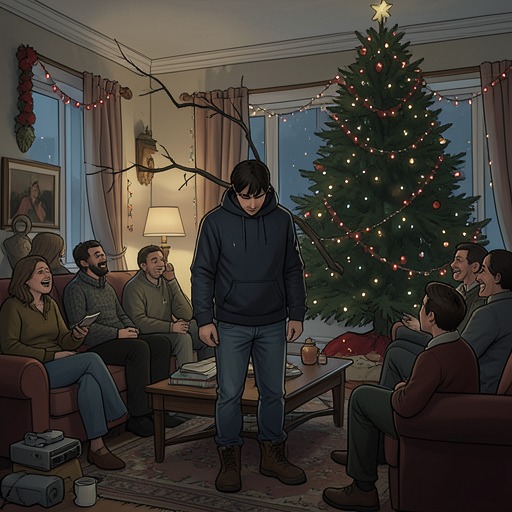
By Christmas 3250, the season has become something Caleb actively resents. Ambrose and his companions have persuaded him to attend a holiday gathering at Sanctuary, a bar and grill owned by a family of shape shifters. Xevikan has helped bring about his attendance, despite knowing why Caleb might object. Caleb approaches the building at a distance, half a block away, while holiday music and the Howlers’ carols reach him. The music unexpectedly calms him, even as he remains convinced that agreeing to come was foolish.
Inside, the celebration overwhelms his expectations. The decorations make the place look, in his view, as though the North Pole has exploded. Aimee Peltier welcomes him with a kiss on the cheek and gives him a yellow, hot, frothy drink whose contents he cannot identify. The warmth of her greeting and the bewildering abundance around him make the party a social experience he has never had before. When Julian of Macedon enters dressed as Santa, complete with a red suit, beard, and sack of presents, Caleb responds with a groan. The scene’s comedy comes from the distance between the familiar festive performance and Caleb’s baffled, reluctant presence within it.
Reunion and the Holiday’s Reversal
The gathering changes meaning when Caleb comes face-to-face with Lilliana, the person he least expected to see again. Tears fill his eyes as she approaches hesitantly, looking up at him with love and reaching toward his whiskered cheek. The story places this recognition inside the Christmas party rather than making the holiday merely a decorative backdrop: the noisy, extravagant public celebration becomes the setting for an intensely personal return.
Caleb is still unable to believe that Lilliana is there. He carries resentment toward his father for keeping her from him, but that grievance cannot outweigh the fact that she is finally standing before him. He thinks of her as the one Christmas wish he had not dared to make, because he could not bear another disappointment. The wish’s fulfillment reverses his earlier hostility toward the season without erasing the grief and fear beneath it. Shaking and afraid the moment may be a dream, he lifts Lilliana into his arms and kisses her.
Across the wedding and the later Christmas gathering, the season’s meanings remain in tension: the solstice calls forth renewal, but also the possibility of dangerous crossings; Christmas can provoke Caleb’s resistance, yet it provides the occasion for a reunion he had stopped himself from hoping for. The celebrations do not make uncertainty disappear. Instead, they gather people around rites and customs at a moment when the future feels unusually open, allowing a new beginning to arrive where Caleb expected only another disappointment.